Boca Raton, FL, United States
Landing Point · US United States
Connected Cables
| Cable | Status |
|---|---|
| Bahamas Internet Cable System (BICS) | Active |
| CELIA | Planned |
| Colombia-Florida Express (CFX-1) | Active |
| Confluence-1 | Active |
| GlobeNet | Active |
| Monet | Active |
| South America-1 (SAm-1) | Active |
| TIKAL-AMX3 | Active |
Live Performance
RTT measurements to this landing point from 2026-04-15 through 2026-10-13 - live ICMP round-trip time via our monitoring probes. Recomputed daily. ✓ No anomalies detected in the monitored period.
Measurement sources
| Probe | Location | Samples | Avg |
|---|---|---|---|
| #61587 | control probe | 130 | 153.9 ms |
| #6410 own probe | Sao Paulo BR | 76 | 132.5 ms |
| #6487 | control probe | 67 | 265.9 ms |
| #64139 | control probe | 47 | 71.7 ms |
| own probe | Minsk BY | 47 | 156.4 ms |
| own probe | Saint Petersburg RU | 39 | 155.8 ms |
| #4113 | control probe | 37 | 31.6 ms |
| #7283 | control probe | 15 | 41.7 ms |
| #7460 | control probe | 13 | 142.3 ms |
| #28151 | control probe | 11 | 107.0 ms |
| #6427 own probe | Sydney AU | 7 | 196.7 ms |
| #6568 own probe | Singapore SG | 3 | 253.2 ms |
| #65152 | control probe | 2 | 128.9 ms |
| #10515 | control probe | 1 | 54.8 ms |
| #1009897 | control probe | 1 | 54.7 ms |
| #1012996 | control probe | 1 | 64.3 ms |
| own probe | Almaty KZ | 1 | 198.4 ms |
| own probe | Tbilisi GE | 1 | 163.5 ms |
| own probe | Jerusalem IL | 1 | 164.8 ms |
| own probe | Sevastopol UA | 1 | 200.5 ms |
About Boca Raton, FL, United States
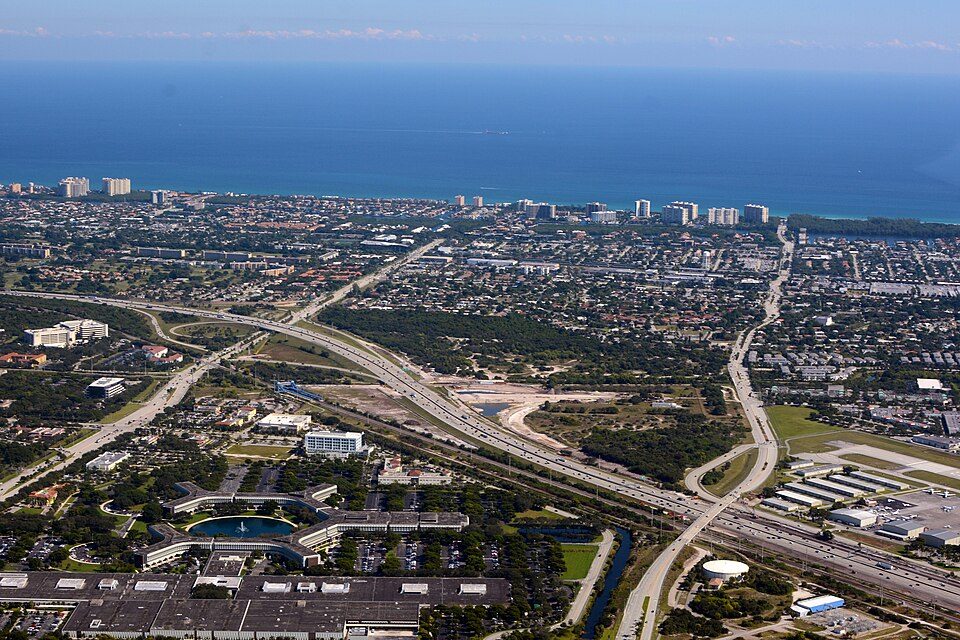
Boca Raton, FL: Submarine Cable Landing Point
Boca Raton is a city in Palm Beach County, Florida, situated on the Atlantic coast of the United States approximately 45 miles north of Miami. As a submarine cable landing point, it hosts eight international and regional submarine cable systems, making it one of the more active cable landing locations on the eastern seaboard of the United States. The cables landing here span a wide range of distances and destinations, connecting the southeastern United States to South America, the Caribbean, and Central America.
Among the most significant systems terminating at Boca Raton are South America-1 (SAm-1), a 25,000 km cable reaching Argentina, Brazil, Chile, Colombia, the Dominican Republic, and Ecuador, and GlobeNet, a 23,500 km system linking the United States to Bermuda, Brazil, Colombia, and Venezuela. Together, these two long-haul cables establish Boca Raton as a primary U.S. gateway for connectivity into the South American continent via the Atlantic corridor. Alongside these intercontinental systems, shorter regional cables extend Boca Raton's reach into the Caribbean basin and Central America.
Cables Landing at Boca Raton, FL
South America-1 (SAm-1) is a 25,000 km cable that reached ready-for-service status in 2001. In addition to Boca Raton, it connects Argentina, Brazil, Chile, Colombia, the Dominican Republic, and Ecuador, forming a broad ring-like structure along the Atlantic and Pacific coasts of South America.
GlobeNet spans 23,500 km and entered service in 2000. It links Boca Raton with landing points in Bermuda, Brazil, Colombia, Venezuela, and other U.S. locations, providing an early-generation transoceanic route across the Atlantic corridor to South America.
Monet is a 10,556 km cable with a ready-for-service date of 2017, connecting Boca Raton directly to Brazil. It represents a more recent generation of high-capacity transoceanic infrastructure on this U.S.-Brazil corridor.
CELIA is a 3,700 km regional cable with an expected ready-for-service date of 2027. It will connect Boca Raton to Antigua and Barbuda, Aruba, Curaçao, Martinique, Saint Barthélemy, and Sint Eustatius and Saba, serving the Eastern Caribbean island chain.
Confluence-1 is a 2,571 km domestic cable with a projected ready-for-service date of 2026, connecting two U.S. landing points, with Boca Raton as one terminus.
Colombia-Florida Express (CFX-1) is a 2,438 km cable that entered service in 2008, linking Boca Raton to Colombia and Jamaica. It provides a focused Caribbean and northern South American connection from the Florida coast.
TIKAL-AMX3 is a 1,935 km cable projected to reach ready-for-service status in 2026, connecting Boca Raton to Guatemala and Mexico and extending the landing point's reach into Central America.
Bahamas Internet Cable System (BICS) is a 1,100 km cable that entered service in 2001, providing direct connectivity between Boca Raton and the Bahamas. It represents the shortest system landing here and serves an inter-island and near-shore corridor.
Regional Context
Within the United States, Boca Raton ties with San Juan, Puerto Rico as the landing point hosting the greatest number of submarine cables among those listed as regional peers, each serving eight cable systems. Other active U.S. landing points such as Hermosa Beach, CA, Kapolei, HI, and Myrtle Beach, SC host five cables each, while Grover Beach, CA and Hillsboro, OR each host four. Boca Raton's position on Florida's southeastern Atlantic coast gives it a distinct geographic orientation toward the Caribbean, South America, and Central America that differentiates it from Pacific-facing peers.
Network Role
Boca Raton functions as a multi-cable hub on the U.S. Atlantic coast, aggregating connectivity across intercontinental routes to South America and a cluster of shorter regional links into the Caribbean and Central America. Its eight cables span from long-haul systems of over 20,000 km to near-shore connections under 1,200 km, reflecting a layered connectivity profile that addresses both distant continental endpoints and proximate island territories. Two additional cables - CELIA and TIKAL-AMX3 - are expected to reach service in 2026 and 2027 respectively, expanding the landing point's Caribbean and Central American reach further.
In the broader submarine cable graph of the United States, which encompasses 113 cables across 160 landing points, Boca Raton stands out as a concentrated node on the southeastern Atlantic coast specifically oriented toward Latin America and the Caribbean, a corridor that few other U.S. landing points serve with comparable density.
What next: Boca Raton, FL, United States in the global directory of cable landing points; see surrounding routes on the interactive submarine cable map or follow live network monitoring.
Our measurements to Boca Raton
Traceroutes from our own measurement points over the last 30 days: usual delay and number of network hops on the way to Boca Raton.
- From RIPE Atlas probes: 111 ms, 21 hops, 40 traces
Last trace: 2026-10-15. Live network map
Other Landing Points in United States
FAQ
Landing Point
- CountryUS United States
- Coordinates26.3503°N 80.0889°W
- Connected Cables8
See Real Cable Routes
View actual submarine cable routing from Boca Raton, FL, United States - with backbone nodes, distance calculations, and latency estimates
Open Calculator →