Anchorage, AK, United States
Landing Point · US United States
Connected Cables
| Cable | Status |
|---|---|
| ACS Alaska-Oregon Network (AKORN) | Active |
| Kodiak Kenai Fiber Link (KKFL) | Active |
Live Performance
RTT measurements to this landing point from 2026-04-11 through 2026-08-27 - live ICMP round-trip time via our monitoring probes. Recomputed daily. ✓ No anomalies detected in the monitored period.
Measurement sources
| Probe | Location | Samples | Avg |
|---|---|---|---|
| own probe | Moscow RU | 70 | 174.7 ms |
| #7062 own probe | Cape Town ZA | 68 | 275.5 ms |
| own probe | Saint Petersburg RU | 49 | 191.1 ms |
| own probe | Minsk BY | 25 | 169.1 ms |
| #6410 own probe | Sao Paulo BR | 4 | 147.4 ms |
| #51310 | control probe | 2 | 110.7 ms |
| #60259 | control probe | 2 | 107.0 ms |
| #64833 | control probe | 2 | 110.3 ms |
| own probe | Almaty KZ | 2 | 200.2 ms |
| own probe | Tbilisi GE | 2 | 162.2 ms |
| own probe | Jerusalem IL | 2 | 161.8 ms |
| own probe | Sevastopol UA | 1 | 194.4 ms |
| own probe | Kyiv UA | 1 | 137.8 ms |
About Anchorage, AK, United States
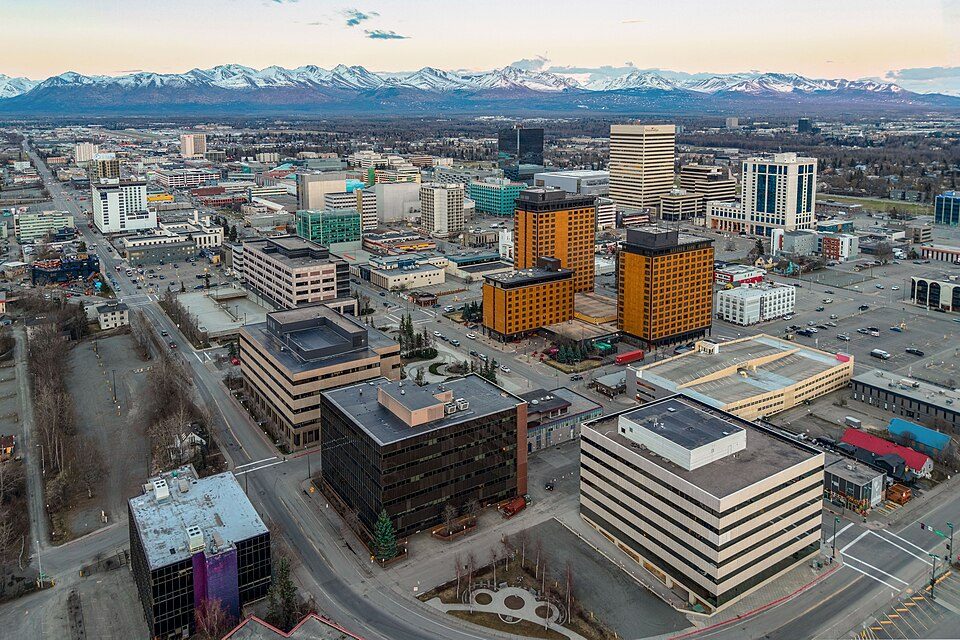
Anchorage, AK: Submarine Cable Landing Point
Anchorage, the most populous city in Alaska and home to nearly 40 percent of the state's population, serves as a submarine cable landing point on Alaska's southern coast. Two submarine cables make landfall here, connecting Anchorage to other points within the broader United States telecommunications network. Both cables are domestic in scope, linking Alaskan communities and the state's largest urban center to the wider national fiber infrastructure.
The two cables landing at Anchorage - the ACS Alaska-Oregon Network (AKORN) and the Kodiak Kenai Fiber Link (KKFL) - together form a domestic corridor that supports intra-Alaskan and Alaska-to-contiguous-US connectivity. Rather than serving as an intercontinental gateway, Anchorage functions as a regional hub within a US-only cable topology, providing fiber-based connectivity along Alaska's coastline and southward toward Oregon.
Cables Landing at Anchorage, AK
The ACS Alaska-Oregon Network (AKORN) is a submarine cable spanning approximately 3,000 kilometers, with a ready-for-service date of April 2009. The cable connects landing points within the United States, linking Alaska to Oregon and providing Anchorage with a long-haul domestic fiber route running southward to the contiguous 48 states.
The Kodiak Kenai Fiber Link (KKFL) is a shorter submarine cable at 966 kilometers, which entered service in 2007. Like AKORN, it connects landing points entirely within the United States, serving the coastal communities of Alaska - including, as its name suggests, the Kodiak and Kenai regions - and terminating at Anchorage as part of a regional Alaskan fiber network.
Regional Context
Within the United States submarine cable landscape, which spans 113 cables across 160 landing points, Anchorage sits among the lower-volume landing points by cable count, ranking in the top 84 percent of US locations by number of cables hosted. Compared to high-density US landing points such as Boca Raton, FL and San Juan, PR - each hosting eight cables - or Hermosa Beach, CA and Kapolei, HI with five cables each, Anchorage's two cables reflect its role as a regional domestic node rather than an international gateway.
Network Role
Anchorage functions as a two-cable domestic terminus, enabling fiber connectivity between Alaska's population centers and the contiguous United States via AKORN, while KKFL extends that network along the Alaskan coastline to smaller communities in the Kodiak and Kenai areas. The combination of a long-haul route (AKORN at 3,000 km) and a shorter regional link (KKFL at 966 km) gives Anchorage a dual role: serving as both an endpoint on the primary Alaska-Oregon corridor and a node within the intra-Alaskan coastal network.
In the broader US submarine cable graph, Anchorage represents the northernmost tier of domestic submarine connectivity, ensuring that Alaska's largest city - and through it, a significant share of the state's population - remains tied into the national fiber network through dedicated undersea routes rather than relying solely on terrestrial or satellite links.
What next: Anchorage, AK, United States in the global directory of cable landing points; see surrounding routes on the interactive submarine cable map or follow live network monitoring.
Other Landing Points in United States
Landing Point
- CountryUS United States
- Coordinates61.2175°N 149.8584°W
- Connected Cables2
See Real Cable Routes
View actual submarine cable routing from Anchorage, AK, United States - with backbone nodes, distance calculations, and latency estimates
Open Calculator →