Chennai, India
Point d'atterrissage · IN India
Câbles connectés
| Câble | Statut |
|---|---|
| Bay of Bengal Gateway (BBG) | Actif |
| Chennai-Andaman & Nicobar Islands Cable (CANI) | Actif |
| I-2SEA | Planifié |
| i2i Cable Network (i2icn) | Actif |
| India Asia Xpress (IAX) | Actif |
| MIST | Actif |
| Project Waterworth | Planifié |
| SeaMeWe-4 | Actif |
| SeaMeWe-6 | Actif |
| Tata TGN-Tata Indicom | Actif |
Performance en direct
Mesures RTT vers ce point du 2026-03-07 au 2026-09-11 - RTT ICMP en direct via nos sondes de mesure. Recalculé quotidiennement.
Sources de mesure
| Sonde | Emplacement | Mesures | Moy. |
|---|---|---|---|
| #4429 | control probe | 185 | 95.1 ms |
| #1014589 sonde propre | Almaty KZ | 61 | 235.8 ms |
| #6410 sonde propre | Sao Paulo BR | 56 | 334.9 ms |
| #6487 sonde propre | Singapore SG | 49 | 69.4 ms |
| #1033 | control probe | 46 | 83.8 ms |
| #1014597 sonde propre | Tbilisi GE | 17 | 204.7 ms |
| #1014473 sonde propre | Minsk BY | 6 | 198.0 ms |
| #1014969 sonde propre | Jerusalem IL | 4 | 244.8 ms |
| #6427 sonde propre | Sydney AU | 2 | 164.8 ms |
| #6477 | control probe | 1 | 40.0 ms |
À propos Chennai, India
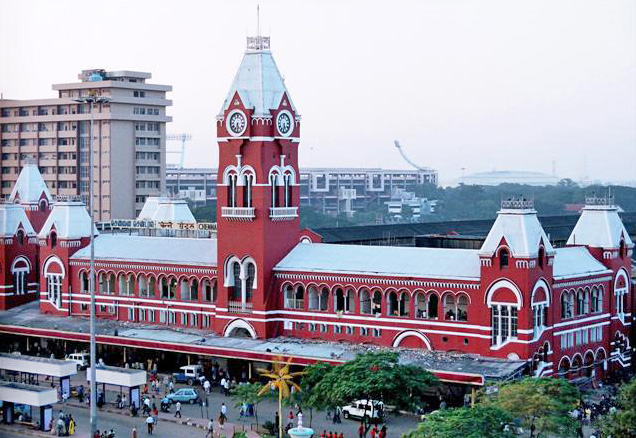
Position dans l'infrastructure régionale
Chennai est la capitale du Tamil Nadu et le principal point d'atterrissage sous-marin des câbles en Inde de la côte est. Il se trouve à 13,063485°N, 80,243084°E sur la baie de Bengale. La ville fait partie des trois principaux hubs sous-marins indiens — à côté de Mumbai (côté océan Arabe) et Cochin/Tuticorin au sud — et sert d'entrée indienne vers l'Asie du Sud-Est et l'Asie orientale. De nombreux câbles importants se terminent à Chennai, reliant l'Inde à Singapour, la Malaisie, la Thaïlande, l'Indonésie, le Sri Lanka, les Maldives et d'autres points de terre ferme régionaux.
Le rôle de Chennai est structuralement distinct de celui de Mumbai : les câbles de Mumbai se dirige principalement vers le Moyen-Orient et l'Europe via le corridor du canal de Suez/mer Rouge, tandis que ceux de Chennai se dirigent vers l'est en direction de l'Asie du Sud-Est. Cette spécialisation est/est-ouest donne à l'Inde une redondance géographique au niveau national — un incident affectant les câbles de Mumbai sur la mer Arabe occidentale n'affecte pas directement les câbles de Chennai dans le golfe du Bengale oriental.
Câbles sous-marins se terminant à Chennai
Project Waterworth, un système de 50 000 km construit par Meta, est prévu pour être prêt pour la mise en service. Il atteint l'Australie (Darwin), le Brésil (Fortaleza), l'Inde (Mumbai), la Malaisie (Penang), l'Afrique du Sud (Amanzimtoti, Cap-Town) et les États-Unis (Los Angeles, Myrtle Beach). Waterworth est l'un des plus longs câbles en développement au monde.
SeaMeWe-6, un câble sous-marin de 21 700 km prévu pour la mise en service en 2026 et appartenant à une consortium de 16 membres dont Microsoft. Il atteint Bahreïn, Bangladesh, Djibouti, Égypte, France (Marseille), l'Inde (Mumbai), Maldives, Malaisie, Oman, Pakistan, Qatar, Arabie Saoudite, Singapour, Sri Lanka, Émirats arabes unis.
India-Asia Xpress (IAX), un câble sous-marin de 5 791 km en service depuis 2024 et appartenant à China Mobile et Reliance Jio. Il atteint l'Inde (Digha, Machilipatnam, Mumbai), la Malaisie (Morib), les Maldives, Singapour (Tuas), Sri Lanka, Thaïlande.
MIST, un câble sous-marin de 8 100 km en service depuis 2024 et appartenant à Orient Link. Il atteint Mumbai, la Malaisie, Singapour, Thaïlande.
Bay of Bengal Gateway (BBG), un câble sous-marin de 8 100 km en service depuis 2016. Il atteint Mumbai, la Malaisie, Oman, Sri Lanka, Émirats arabes unis.
SeaMeWe-4, un câble sous-marin de 20 000 km en service depuis 2005. Il atteint une route de 16 pays incluant la France, l'Égypte, l'Arabie Saoudite, les Émirats arabes unis, le Pakistan, le Bangladesh, Singapour, la Malaisie, la Thaïlande.
Câble Chennai-Andaman & Nicobar Islands (CANI), un câble sous-marin de 2 300 km en service depuis 2020 et appartenant à BSNL. Il est un câble national indien reliant Chennai à sept points de terre ferme dans les îles Andaman & Nicobar (Sri Vijaya Puram, Havelock, Long Island, Rangat, Kamorta, Little Andaman, Car Nicobar, Great Nicobar).
i2i Cable Network (i2icn), un câble sous-marin de 3 200 km en service depuis 2002 et appartenant à Bharti Airtel. Il atteint Tuas (Singapour) — l'un des premiers liens directs fibre Inde-Singapour.
Tata TGN-Tata Indicom, un câble sous-marin de 3 175 km en service depuis 2004 et appartenant à Tata Communications. Il atteint Changi North (Singapour).
Topologie des connexions et redondance
Le portefeuille de Chennai donne à l'Inde une forte redondance pour la connectivité vers l'Asie du Sud-Est : plusieurs câbles (BBG, IAX, MIST, SeaMeWe-4) atteignent Singapour par des itinéraires différents ; plusieurs câbles atteignent également la Malaisie, le Sri Lanka et les Émirats arabes unis. La combinaison de câbles appartenant à des consortiums (SeaMeWe-4/6, BBG) et à des opérateurs individuels (IAX de Reliance Jio + China Mobile, MIST d'Orient Link, i2icn de Bharti Airtel) offre une diversité au niveau des opérateurs au-delà du simple nombre de câbles.
Le câble national indien CANI reliant Chennai aux îles Andaman & Nicobar est un actif spécifique d'infrastructure nationale — sans lui, l'Union territoriale indienne des îles Andaman & Nicobar dépendrait entièrement de la connectivité par satellite. La mise en service en 2024 des câbles IAX et MIST (deux nouveaux câbles modernes vers Singapour) reflète une investissement continu dans la capacité fibre orientale de Chennai, soutenant l'augmentation croissante des centres de données indiens dans le Tamil Nadu et le Karnataka.
Géographie et coordonnées
Le point d'atterrissage sous-marin de Chennai se trouve à 13.063485°N, 80.243084°E (13°03'48"N, 80°14'35"E), sur la côte Coromandel du Tamil Nadu dans le sud-est de l'Inde. La position de Chennai face au golfe de Bengale offre des corridors directs d'accès par câble vers l'est en direction de l'Asie du Sud-Est sans ombre de la péninsule indienne.
Questions fréquemment posées
Quels sont les câbles sous-marins se terminant à Chennai, Inde ?
De nombreux câbles se terminent à Chennai y compris le Bay of Bengal Gateway (BBG, 2016), l'India-Asia Xpress (IAX, 2024), MIST (2024), SeaMeWe-4 (2005), CANI (2020), i2icn (2002), Tata TGN-Tata Indicom (2004). Planifiés : SeaMeWe-6 (2026), Project Waterworth (Meta).
Quelles sont les coordonnées du point d'atterrissage sous-marin de Chennai ?
Le point d'atterrissage sous-marin de Chennai se trouve à 13.063485°N, 80.243084°E (13°03'48"N, 80°14'35"E), sur la côte Coromandel du Tamil Nadu dans le sud-est de l'Inde.
Quels pays se connectent à l'Inde via Chennai ?
Par les câbles passant par Chennai, l'Inde atteint Singapour, la Malaisie, la Thaïlande, l'Indonésie (planifiée), le Sri Lanka, les Maldives, le Bangladesh, les Émirats arabes unis, Oman, l'Arabie Saoudite, le Qatar, Bahreïn, le Pakistan, l'Égypte, Djibouti, la France et (via Project Waterworth) Australie, Brésil, Afrique du Sud et États-Unis.
Quand a été posé pour la première fois un câble sous-marin à Chennai ?
Le premier câble sous-marin documenté à Chennai dans les données GeoCables est i2i Cable Network (i2icn), en service depuis 2002, suivi par Tata TGN-Tata Indicom en 2004 et SeaMeWe-4 en 2005.
Qui opère les câbles se terminant à Chennai ?
Les opérateurs de Chennai incluent des entreprises indiennes (Bharti Airtel, Tata Communications, Reliance Jio, BSNL), l'opérateur singapourien Singtel en tant que membre d'un consortium, China Mobile (IAX), Orient Link (MIST), le consortium multi-opérateurs SeaMeWe (16-18 opérateurs) et le consortium Bay of Bengal Gateway.
=== FIN ===Et ensuite : Chennai, India dans l'annuaire mondial des points d'atterrissage; visualisez les routes environnantes sur la carte interactive des câbles ou suivez la surveillance réseau en direct.
Autres points d'atterrissage en India
FAQ
Point d'atterrissage
- PaysIN India
- Coordonnées13.0635°N 80.2431°E
- Câbles connectés10
Voir les routes réelles
Visualisez le routage réel des câbles sous-marins depuis Chennai, India - avec nœuds, distances et latence
Ouvrir le calculateur →