Mumbai, India
Landing Point · IN India
Connected Cables
| Cable | Status |
|---|---|
| 2Africa | Active |
| Asia Africa Europe-1 (AAE-1) | Active |
| Bay of Bengal Gateway (BBG) | Active |
| Europe India Gateway (EIG) | Active |
| FALCON | Active |
| FEA | Planned |
| FLAG Europe-Asia (FEA) | Active |
| Gulf Bridge International Cable System/Middle East North Africa Cable System (GBICS/MENA) | Planned |
| Gulf Bridge International Cable System/Middle East North Africa Cable System (GBICS/MENA) | Active |
| IMEWE | Active |
| India Asia Xpress (IAX) | Active |
| India Europe Xpress (IEX) | Active |
| MIST | Active |
| Project Waterworth | Planned |
| Raman | Active |
| SEACOM/Tata TGN-Eurasia | Active |
| SeaMeWe-4 | Active |
| SeaMeWe-6 | Active |
Live Performance
RTT measurements to this landing point from 2026-03-02 through 2026-10-17 - live ICMP round-trip time via our monitoring probes. Recomputed daily.
Measurement sources
| Probe | Location | Samples | Avg |
|---|---|---|---|
| #1033 | control probe | 478 | 94.4 ms |
| #65190 | control probe | 155 | 160.3 ms |
| #17855 | control probe | 152 | 231.8 ms |
| #7404 | control probe | 50 | 310.2 ms |
| own probe | Almaty KZ | 27 | 222.7 ms |
| own probe | Tbilisi GE | 27 | 184.7 ms |
| #12496 | control probe | 24 | 188.8 ms |
| #6410 own probe | Sao Paulo BR | 18 | 268.1 ms |
| own probe | Minsk BY | 8 | 198.8 ms |
| #6477 | control probe | 5 | 57.2 ms |
| #60841 | control probe | 5 | 177.2 ms |
| own probe | Jerusalem IL | 5 | 240.8 ms |
| #2261 | control probe | 4 | 46.2 ms |
| #6487 | control probe | 2 | 67.3 ms |
| #1000905 | control probe | 2 | 176.9 ms |
About Mumbai, India
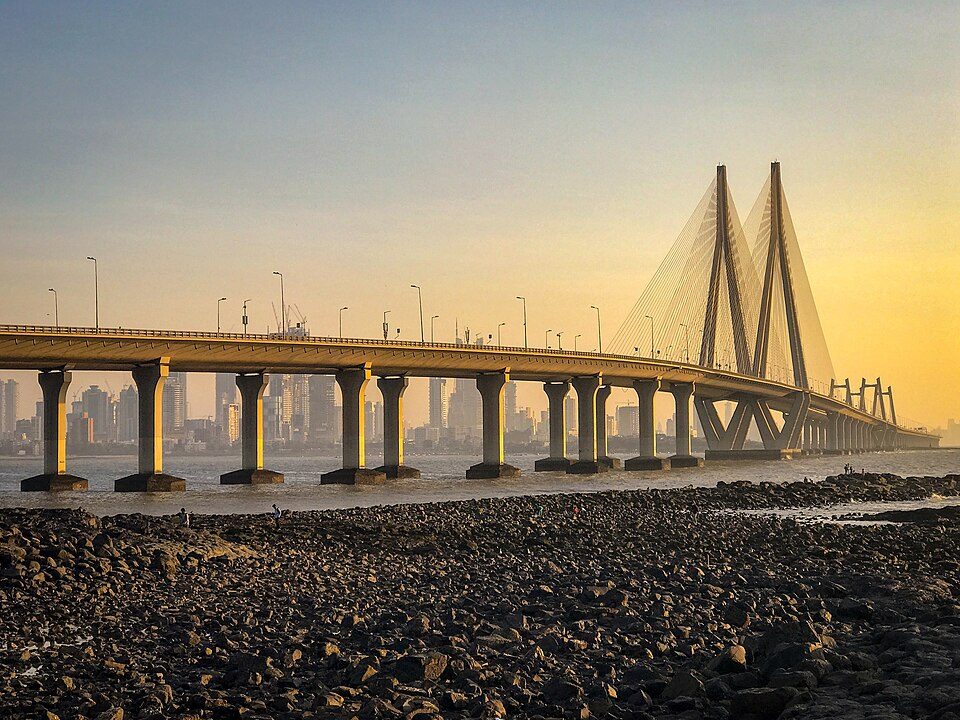
Mumbai, India is a submarine cable landing point in India (coordinates 19.0761°, 72.8759°). It serves 17 submarine cable systems, making it a major regional hub in India's international connectivity infrastructure.
Mumbai, also known as Bombay, is the capital city of the Indian state of Maharashtra. Mumbai is the financial capital and the most populous city proper of India, with an estimated population of 12.5 million (1.25 crore). Mumbai is the centre of the Mumbai Metropolitan Region, which is among the most populous metropolitan areas in the world with a population of over 23 million. Mumbai lies on the Konkan coast on the west coast of India and has a deep natural harbour. In 2008, Mumbai was named an alpha world city. Mumbai has the highest number of billionaires of any city in Asia. Wikipedia
Connected submarine cables
| Cable | RFS | Length | Owners |
|---|---|---|---|
| India Europe Xpress (IEX) | 2026 | 9,775 km | China Mobile, Reliance Jio Infocomm |
| Raman | 2026 | 7,376 km | Google, Sparkle, Zain Omantel International |
| SeaMeWe-6 | 2026 | 21,700 km | Bahrain Telecommunications Company (Batelco), Bangladesh Submarine Cable Company Limited (BSCCL), Bharti Airtel, … |
| 2Africa | 2024 | 45,000 km | Bayobab, China Mobile, Meta, … |
| India Asia Xpress (IAX) | 2024 | 5,791 km | China Mobile, Reliance Jio Infocomm |
| MIST | 2024 | 8,100 km | Orient Link |
| Asia Africa Europe-1 (AAE-1) | 2017 | 25,000 km | China Unicom, Djibouti Telecom, Hyalroute, … |
| Bay of Bengal Gateway (BBG) | 2016 | 8,100 km | AT&T, China Telecom, Dialog Axiata, … |
| Gulf Bridge International Cable System/Middle East North Africa Cable System (GBICS/MENA) | 2012 | 5,270 km | Gulf Bridge International |
| Europe India Gateway (EIG) | 2011 | 15,000 km | AT&T, Altice Portugal, BT, … |
| IMEWE | 2010 | 12,091 km | Bharti Airtel, Ogero, Orange, … |
| SEACOM/Tata TGN-Eurasia | 2009 | 15,000 km | SEACOM, Tata Communications |
| FALCON | 2006 | 10,300 km | FLAG |
| SeaMeWe-4 | 2005 | 20,000 km | Algerie Telecom, Bangladesh Submarine Cable Company Limited (BSCCL), Bharti Airtel, … |
| FLAG Europe-Asia (FEA) | 1997 | 28,000 km | FLAG |
| FEA | - | - | - |
| Project Waterworth | - | 50,000 km | Meta |
Operators landing at Mumbai, India
Cables landing at Mumbai, India are operated by 59 distinct consortium partners and carriers, including AT&T, Algerie Telecom, Altice Portugal, BT, Bahrain Telecommunications Company (Batelco), Bangladesh Submarine Cable Company Limited (BSCCL), Bayobab, Bharat Sanchar Nigam Ltd. (BSNL), Bharti Airtel, China Mobile, and 49 others. Each cable is typically jointly owned by a consortium of tier-one carriers and hyperscale operators who share construction costs and capacity; the operator mix reflects both regional incumbents and global players with interest in the routes served by this landing point.
Connectivity profile
From Mumbai, India, international traffic can reach 58 countries through 17 cable systems. Destinations include Algeria, Angola, Australia, Bahrain, Bangladesh, Brazil, Cambodia, China and 50 more. With multiple redundant paths, traffic at this landing point can reroute through alternative cables if any single system experiences an outage.
Monitoring status
GeoCables recorded 3 monitoring events on cables serving Mumbai, India in the past 90 days. Our monitoring network continuously samples latency from external probes to targets reachable via these cables.
About the cables
- India Europe Xpress (IEX) (2026) - India Europe Xpress (IEX) is a 9,775 km submarine cable connecting Mumbai to Marseille with nine intermediate landings across the Arabian Sea, Red Sea, Suez crossing, and Mediterranean. Read more →
- Raman (2026) - Raman is an intercontinental submarine cable system connecting Middle East and East Africa and South Asia, with 6 landing points across 5 countries including Aqaba, Jordan, Barka, Oman, Djibouti City, Djibouti, Duba, Saudi Arabia and others. The cable provides cross-continental connectivity, offering an important route for data traffic between Middle East and East Africa and South Asia. Read more →
- SeaMeWe-6 (2026) - SEA-ME-WE 6 is the sixth submarine cable in a series that has been laying fibre between Southeast Asia, the Middle East, and Western Europe since 1985. The original SEA-ME-WE (just SEA-ME-WE, no number) was commissioned in 1985 as one of the earliest long-haul submarine cables in the modern sense. SEA-ME-WE 2 followed in 1994, SEA-ME-WE 3 in 1999, SEA-ME-WE 4 in 2005, SEA-ME-WE 5 in 2016. Read more →
- 2Africa (2024) - 2Africa is a 45,000-kilometre submarine cable system that encircles the African continent and extends into the Middle East and Europe. At the time of its completion in 2024, it became the longest submarine cable ever built - by a margin of several thousand kilometres - and it remains the largest single system by landing count, with 46 landings across 33 countries. Read more →
- India Asia Xpress (IAX) (2024) - Based on 39 RIPE Atlas measurements from GeoCables monitoring infrastructure, March-April 2026. India Asia Xpress - IAX - is a submarine cable that came into service in 2024 under what is, by 2020s standards, an unusual ownership structure. Two owners: Reliance Jio Infocomm of India and China Mobile International of China. No hyperscaler investor. No consortium of traditional Western telecoms. Read more →
- MIST (2024) - Based on 47 RIPE Atlas measurements from GeoCables monitoring infrastructure, March-April 2026. When you read the technical sheet for the MIST cable - Malaysia-India-Singapore-Thailand, brought into service in 2024 by Orient Link - you'll find an unambiguous number: 8,100 kilometres of fibre, 12 pairs, five landing stations across four countries. Read more →
- Asia Africa Europe-1 (AAE-1) (2017) - Based on 47 RIPE Atlas measurements from GeoCables monitoring infrastructure, March-April 2026. AAE-1 - Asia-Africa-Europe-1 - is one of the largest single submarine cable systems in operation. It was brought into service in 2017 by a consortium of 19 telecommunications operators, ranging from China Unicom and Reliance Jio to Telecom Egypt and Pakistan Telecommunications Company. Read more →
- Bay of Bengal Gateway (BBG) (2016) - Bay of Bengal Gateway (BBG) is an 8,100-kilometre submarine cable that links the Middle East to Southeast Asia by way of the Indian subcontinent - and it does so without touching the Red Sea. Read more →
- Gulf Bridge International Cable System/Middle East North Africa Cable System (GBICS/MENA) (2012) - Gulf Bridge International Cable System/Middle East North Africa Cable System (GBICS/MENA) is an intercontinental submarine cable system connecting Middle East and South Asia, with 9 landing points across 9 countries including Al Daayen, Qatar, Al Faw, Iraq, Al Hidd, Bahrain, Al Khobar, Saudi Arabia and others. Read more →
- Europe India Gateway (EIG) (2011) - Europe India Gateway (EIG) is a 15,000 km submarine cable that connects twelve countries on three continents - the United Kingdom and Portugal at the European end, then Spain, France, Gibraltar, Monaco, Egypt, Saudi Arabia, Djibouti, Oman, the United Arab Emirates, and finally Mumbai, India. Ready for service in 2011, EIG has been in the ground for over a decade. Read more →
- IMEWE (2010) - IMEWE is a major intercontinental submarine cable system spanning 8 countries across North Africa, Europe, Middle East. With 9 landing points - including Alexandria, Catania, Fujairah, Jeddah, Karachi, and 4 more - it forms one of the backbone links carrying international internet traffic between continents. Read more →
- SEACOM/Tata TGN-Eurasia (2009) - SEACOM/Tata TGN-Eurasia is an intercontinental submarine cable system connecting East Africa and Middle East and Southern Africa, with 8 landing points across 8 countries including Dar Es Salaam, Tanzania, Djibouti City, Djibouti, Jeddah, Saudi Arabia, Maputo, Mozambique and others. Read more →
- FALCON (2006) - Every submarine cable has an owner. Most have had two. FALCON has survived three bankruptcies - and is still carrying traffic across fourteen countries, from Egypt to Sri Lanka, through some of the most politically complex waters on Earth. The Cable That Outlived Its Owners FALCON stands for FLAG Alcatel-Lucent Optical Network. Read more →
- SeaMeWe-4 (2005) - SeaMeWe-4 is a major intercontinental submarine cable system spanning 14 countries across North Africa, South Asia, Middle East. With 16 landing points - including Alexandria, Annaba, Bizerte, Chennai, Colombo, and 11 more - it forms one of the backbone links carrying international internet traffic between continents. Read more →
- FLAG Europe-Asia (FEA) (1997) - FLAG Europe-Asia (FEA) is a 28,000 km submarine cable system connecting the United Kingdom and Japan through twelve intervening countries across North Africa, the Middle East, South Asia, and East Asia. Read more →
- FEA - FEA is an intercontinental submarine cable system connecting Middle East and South Asia and Southeast Asia, with 8 landing points across 7 countries including Aqaba, Jordan, Fujairah, United Arab Emirates, Jeddah, Saudi Arabia, Mumbai, India and others. As a major intercontinental system spanning 7 nations, it serves as a critical artery for international data traffic between continents. Read more →
- Project Waterworth - Project Waterworth is an intercontinental submarine cable system connecting Southern Africa and South Asia and Oceania, with 9 landing points across 6 countries including Amanzimtoti, South Africa, Cape Town, South Africa, Chennai, India, Darwin, NT, Australia and others. Read more →
What next: Mumbai, India in the global directory of cable landing points; see surrounding routes on the interactive submarine cable map or follow live network monitoring.
Our measurements to Mumbai
Traceroutes from our own measurement points over the last 30 days: usual delay and number of network hops on the way to Mumbai.
- From Odessa: 62 ms, 20 hops, 15 traces
- From Minsk: 64 ms, 19 hops, 17 traces
- From Moscow: 67 ms, 19 hops, 17 traces
- From Rostov: 77 ms, 18 hops, 17 traces
- From Sevastopol: 78 ms, 18 hops, 17 traces
- From Saint Petersburg: 92 ms, 19 hops, 17 traces
- From Ekaterinburg: 94 ms, 11 hops, 6 traces
- From Jerusalem: 106 ms, 19 hops, 17 traces
- From Tbilisi: 110 ms, 19 hops, 17 traces
- From RIPE Atlas probes: 113 ms, 11 hops, 36 traces
- From Almaty: 145 ms, 19 hops, 17 traces
- From Kyiv: 157 ms, 14 hops, 7 traces
Last trace: 2026-10-15. Live network map
Other Landing Points in India
Landing Point
- CountryIN India
- Coordinates19.0761°N 72.8759°E
- Connected Cables18
See Real Cable Routes
View actual submarine cable routing from Mumbai, India - with backbone nodes, distance calculations, and latency estimates
Open Calculator →