Wilhelmshaven, Germany
Landing Point · DE Germany
Connected Cables
| Cable | Status |
|---|---|
| IOEMA | Planned |
| IOEMA-1 | Planned |
Live Performance
RTT measurements to this landing point from 2026-03-06 through 2026-09-09 - live ICMP round-trip time via our monitoring probes. Recomputed daily. ✓ No anomalies detected in the monitored period.
Measurement sources
| Probe | Location | Samples | Avg |
|---|---|---|---|
| own probe | Minsk BY | 15 | 26.0 ms |
| #6427 own probe | Sydney AU | 9 | 260.1 ms |
| own probe | Kyiv UA | 8 | 40.2 ms |
| #6487 | control probe | 6 | 157.3 ms |
| own probe | Almaty KZ | 6 | 89.0 ms |
| own probe | Tbilisi GE | 6 | 373.5 ms |
| own probe | Jerusalem IL | 5 | 34.3 ms |
| own probe | Odessa UA | 5 | 44.4 ms |
| own probe | Saint Petersburg RU | 4 | 34.9 ms |
| #6410 own probe | Sao Paulo BR | 3 | 194.3 ms |
| own probe | Sevastopol UA | 2 | 83.4 ms |
| own probe | Moscow RU | 1 | 35.1 ms |
About Wilhelmshaven, Germany
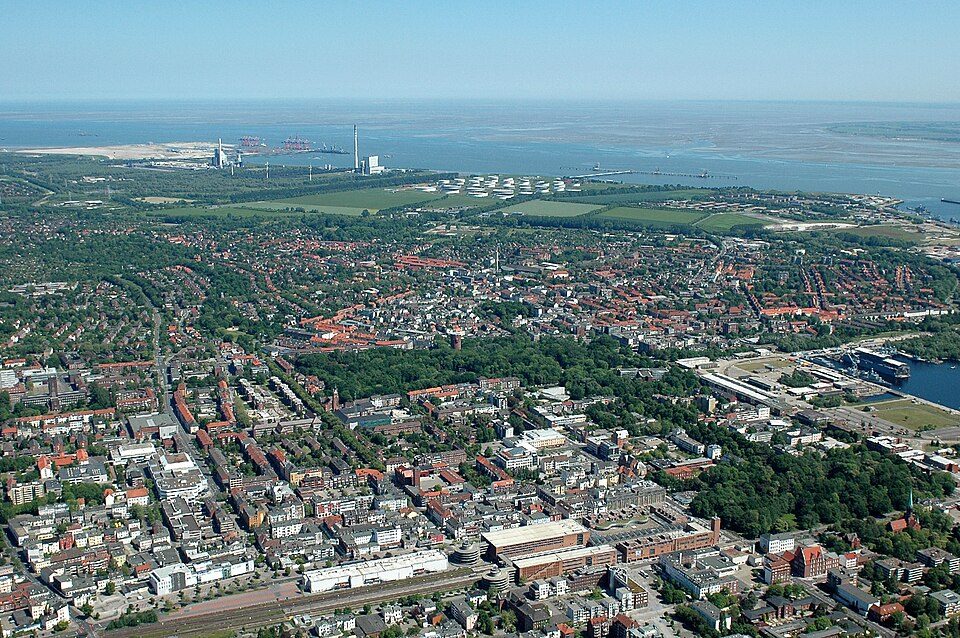
Wilhelmshaven: Submarine Cable Landing Point
Wilhelmshaven is a coastal town in Lower Saxony, Germany, situated on the western shore of the Jade Bight, a bay of the North Sea. Its direct exposure to the North Sea makes it a natural candidate for submarine cable landings connecting Germany with neighbouring countries across the region. Two submarine cables land at Wilhelmshaven, both currently in draft status, placing it among the more active emerging landing points on the German North Sea coast.
Both cables landing here - IOEMA and IOEMA-1 - link Germany to the same group of North Sea and North Atlantic countries: Denmark, the Netherlands, Norway, and the United Kingdom. This corridor positions Wilhelmshaven as a node within a regional North Sea network rather than an intercontinental gateway, supporting connectivity among closely interconnected European economies sharing maritime borders.
Cables Landing at Wilhelmshaven
IOEMA is a submarine cable with a total length of 1,620 km, scheduled for a ready-for-service date of 2028 and currently in draft status. In addition to Wilhelmshaven, it connects to landing points in Denmark, the Netherlands, Norway, and the United Kingdom, forming a multi-country North Sea ring or corridor among these five nations.
IOEMA-1 is a second submarine cable in draft status with the same country set as IOEMA, connecting Wilhelmshaven to Denmark, the Netherlands, Norway, and the United Kingdom. No length or RFS date is currently confirmed for IOEMA-1.
Regional Context
Germany hosts ten submarine cables spread across nine landing points. Among these, Rostock leads with three cables, while Wilhelmshaven ties with Konstanz at two cables each, placing it ahead of Friedrichshafen, Markgrafenheide, Meersburg, and Puttgarden, each of which hosts a single cable. Wilhelmshaven thus ranks in the upper portion of German landing points by cable count, sharing that position with Konstanz on the opposite end of the country.
Network Role
Wilhelmshaven functions as a two-cable landing point within the North Sea regional cable graph, with both IOEMA and IOEMA-1 serving the same five-country corridor: Germany, Denmark, the Netherlands, Norway, and the United Kingdom. Once IOEMA reaches its 2028 RFS date, Wilhelmshaven will transition from a planned to an active landing point, contributing two cable systems to Germany's overall submarine cable infrastructure. The relationship between IOEMA and IOEMA-1 - sharing an identical country set - suggests a degree of route redundancy or capacity diversification within the same geographic corridor.
As a North Sea landing point, Wilhelmshaven connects Germany into a cluster of northern European nations with dense maritime and economic ties. Within the broader German submarine cable map, its two-cable count gives it a meaningful position alongside Konstanz as one of only two German landing points outside Rostock to host more than a single cable system.
What next: Wilhelmshaven, Germany in the global directory of cable landing points; see surrounding routes on the interactive submarine cable map or follow live network monitoring.
Other Landing Points in Germany
Landing Point
- CountryDE Germany
- Coordinates53.5323°N 8.1069°E
- Connected Cables2
See Real Cable Routes
View actual submarine cable routing from Wilhelmshaven, Germany - with backbone nodes, distance calculations, and latency estimates
Open Calculator →