Rostock, Germany
Landing Point · DE Germany
Connected Cables
| Cable | Status |
|---|---|
| C-Lion1 | Active |
| Elektra-GlobalConnect 1 (GC1) | Active |
| GlobalConnect-KPN | Active |
Live Performance
RTT measurements to this landing point from 2026-03-10 through 2026-09-28 - live ICMP round-trip time via our monitoring probes. Recomputed daily. ✓ No anomalies detected in the monitored period.
Measurement sources
| Probe | Location | Samples | Avg |
|---|---|---|---|
| #258 | control probe | 33 | 30.2 ms |
| own probe | Minsk BY | 10 | 30.9 ms |
| #6427 own probe | Sydney AU | 7 | 257.7 ms |
| #6410 own probe | Sao Paulo BR | 4 | 196.1 ms |
| own probe | Odessa UA | 4 | 44.7 ms |
| own probe | Almaty KZ | 3 | 309.0 ms |
| own probe | Tbilisi GE | 3 | 52.3 ms |
| own probe | Jerusalem IL | 3 | 38.1 ms |
| own probe | Moscow RU | 3 | 34.1 ms |
| own probe | Saint Petersburg RU | 3 | 41.5 ms |
| own probe | Kyiv UA | 3 | 36.8 ms |
About Rostock, Germany
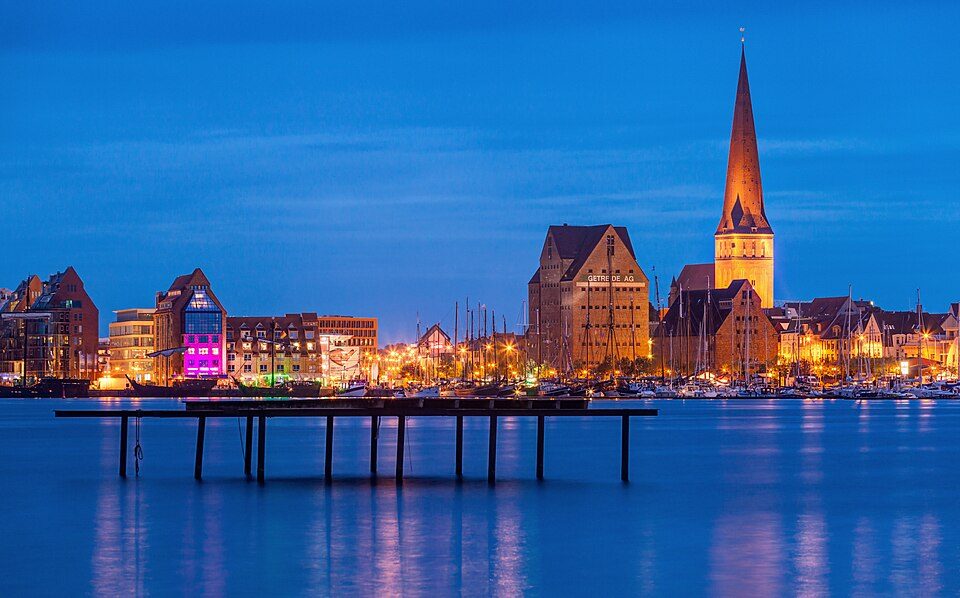
Rostock, Germany: Submarine Cable Landing Point
Rostock is a port city on Germany's Baltic Sea coast, located in the state of Mecklenburg-Western Pomerania. As the largest city in that state and a historically significant port, Rostock serves as one of nine submarine cable landing points in Germany. Three submarine cables make landfall here, making it one of the more connected landing points in the country by cable count.
The cables landing at Rostock establish connections along two distinct corridors: a short-haul regional link to Denmark across the Baltic Sea, served by two cables, and a longer intercontinental-class route northward to Finland via the Baltic, served by C-Lion1. Together, these cables position Rostock as a node connecting Germany to both its Scandinavian neighbors and the broader northern European submarine cable network.
Cables Landing at Rostock
C-Lion1 is a 1,172-kilometer submarine cable that reached ready-for-service status in 2016. It connects Rostock, Germany with Finland, running beneath the Baltic Sea. At over a thousand kilometers in length, it is by far the longest of the three cables landing at Rostock and the one that extends the greatest geographic reach from this landing point.
Elektra-GlobalConnect 1 (GC1) is a 44-kilometer cable that became ready for service in 2000. It links Rostock to Denmark, forming a short cross-Baltic connection between the two countries. Its modest length reflects the relatively narrow stretch of sea separating the German and Danish coastlines at this point.
GlobalConnect-KPN is a 43-kilometer cable that entered service in 2006. Like GC1, it connects Rostock to Denmark. The two Denmark-facing cables together provide a degree of redundancy on the Germany-Denmark segment of the Baltic submarine cable corridor.
Regional Context
Among Germany's nine submarine cable landing points, Rostock stands out with three cables, placing it alongside the more active nodes in the national network. Most other German landing points host only one or two cables - including Markgrafenheide, Meersburg, Friedrichshafen, and Puttgarden, each with a single cable, and Konstanz and Wilhelmshaven, each with two. Rostock's three cables make it one of the busiest landing points in Germany by cable count.
Network Role
Rostock functions as a multi-cable hub on the German Baltic coast, enabling connectivity in two directions: northward to Finland via C-Lion1 and westward to Denmark via GC1 and GlobalConnect-KPN. The pairing of two cables to Denmark on nearly identical short routes provides a measure of route diversity between the two countries, while C-Lion1 extends Rostock's reach significantly further into northern Europe.
Within Germany's overall submarine cable landscape - where ten cables land across nine points and the average cable length is 1,480 kilometers - Rostock's combination of a long-haul Baltic route and two short regional links to Denmark gives it a distinct profile. Its presence in the submarine cable graph strengthens Germany's Baltic Sea connectivity and ties the country's northeastern coast into the broader northern European network.
What next: Rostock, Germany in the global directory of cable landing points; see surrounding routes on the interactive submarine cable map or follow live network monitoring.
Other Landing Points in Germany
FAQ
Landing Point
- CountryDE Germany
- Coordinates54.0789°N 12.1324°E
- Connected Cables3
See Real Cable Routes
View actual submarine cable routing from Rostock, Germany - with backbone nodes, distance calculations, and latency estimates
Open Calculator →