Seattle, WA, United States
Landing Point · US United States
Connected Cables
| Cable | Status |
|---|---|
| AmeriCan-1 | Active |
| Whidbey Island-Seattle | Active |
Live Performance
RTT measurements to this landing point from 2026-04-10 through 2026-10-15 - live ICMP round-trip time via our monitoring probes. Recomputed daily. ✓ No anomalies detected in the monitored period.
Measurement sources
| Probe | Location | Samples | Avg |
|---|---|---|---|
| #13857 | control probe | 118 | 7.4 ms |
| own probe | Moscow RU | 14 | 165.5 ms |
| #7062 own probe | Cape Town ZA | 12 | 276.0 ms |
| own probe | Minsk BY | 8 | 176.0 ms |
| own probe | Saint Petersburg RU | 7 | 172.3 ms |
| own probe | Tbilisi GE | 2 | 165.1 ms |
| own probe | Jerusalem IL | 2 | 157.9 ms |
| #6427 own probe | Sydney AU | 1 | 189.3 ms |
| #6487 | control probe | 1 | 230.2 ms |
| #21802 | control probe | 1 | 54.0 ms |
| #28600 | control probe | 1 | 46.2 ms |
| #51694 | control probe | 1 | 60.4 ms |
| own probe | Almaty KZ | 1 | 222.3 ms |
| own probe | Sevastopol UA | 1 | 168.2 ms |
About Seattle, WA, United States
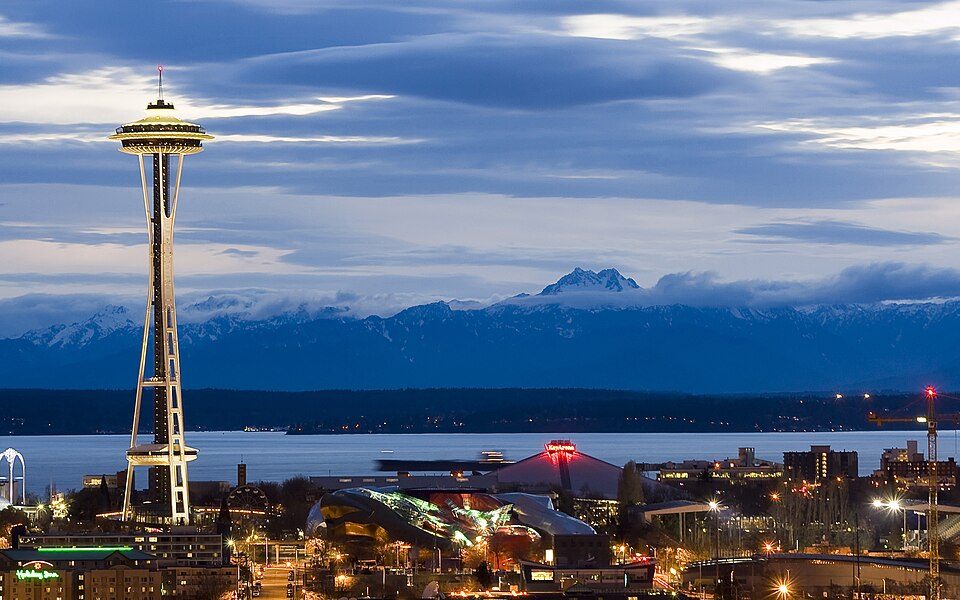
Seattle, WA, United States: Submarine Cable Landing Point
Seattle, Washington, sits along the eastern shore of Puget Sound in the Pacific Northwest region of the United States, making it a natural candidate for submarine cable infrastructure serving the broader coastal corridor of the region. As the most populous city in Washington state, Seattle provides a significant terrestrial network hub behind its marine cable connections. Two submarine cables land at Seattle, WA, linking the city to domestic and cross-border routes.
The two cables landing here serve distinct but related purposes. One connects Seattle into a short cross-border corridor with Canada, while the other forms a domestic intra-state link within the United States. Together they reflect Seattle's role as a regional node within the densely interconnected U.S. Pacific Northwest submarine cable geography rather than as a long-haul intercontinental terminus.
Cables Landing at Seattle, WA
AmeriCan-1 is a 140-kilometre submarine cable that reached ready-for-service status in 1999. It connects landing points in the United States and Canada, establishing a short transborder link across the maritime boundary between the two countries. At 140 km, it is a relatively compact system designed for near-coastal connectivity between the two neighbouring nations.
Whidbey Island-Seattle is a 44-kilometre domestic submarine cable, also entering service in 1999. It connects Seattle to Whidbey Island, both of which are located within the United States. This short domestic cable serves as an intra-state link, bridging Seattle on the mainland with the island community to its northwest via an underwater route through Puget Sound waters.
Regional Context
Within the United States, Seattle, WA, hosts 2 submarine cables, placing it in the upper 84th percentile of the country's 160 landing points by cable count. Major U.S. landing points such as Boca Raton, FL, and San Juan, PR, each host eight cables, while Hermosa Beach, CA, Kapolei, HI, and Myrtle Beach, SC, each host five. Seattle's two cables situate it as a smaller regional node compared to these higher-traffic landing points.
Network Role
Seattle, WA, functions as a focused regional landing point rather than a multi-cable international hub. Its two cables address specific short-haul needs: one providing a transborder connection to Canada and the other closing a domestic gap between Seattle and Whidbey Island. Both systems entered service simultaneously in 1999, suggesting a coordinated build-out of near-coastal submarine capacity in the Puget Sound area at that time.
In the broader U.S. submarine cable graph, Seattle's landing point represents the Pacific Northwest's direct participation in submarine connectivity at a regional scale. While it does not rival the high cable counts of the nation's busiest landing points, its presence confirms Seattle as a named node in the international submarine cable network, anchoring short cross-border and domestic routes along the northern Pacific coast of the United States.
What next: Seattle, WA, United States in the global directory of cable landing points; see surrounding routes on the interactive submarine cable map or follow live network monitoring.
Other Landing Points in United States
FAQ
Landing Point
- CountryUS United States
- Coordinates47.6036°N 122.3294°W
- Connected Cables2
See Real Cable Routes
View actual submarine cable routing from Seattle, WA, United States - with backbone nodes, distance calculations, and latency estimates
Open Calculator →