Kotzebue, AK, United States
Landing Point · US United States
Connected Cables
| Cable | Status |
|---|---|
| Quintillion Subsea Cable Network | Active |
Live Performance
RTT measurements to this landing point from 2026-05-01 through 2026-05-28 - live ICMP round-trip time via our monitoring probes. Recomputed daily. ✓ No anomalies detected in the monitored period.
Measurement sources
| Probe | Location | Samples | Avg |
|---|---|---|---|
| own probe | Minsk BY | 3 | 227.0 ms |
| own probe | Almaty KZ | 3 | 204.3 ms |
| own probe | Moscow RU | 3 | 133.0 ms |
| own probe | Tbilisi GE | 2 | 181.7 ms |
| own probe | Jerusalem IL | 2 | 160.8 ms |
| #6410 own probe | Sao Paulo BR | 1 | 138.7 ms |
| #7062 own probe | Cape Town ZA | 1 | 261.6 ms |
| own probe | Sevastopol UA | 1 | 178.5 ms |
About Kotzebue, AK, United States
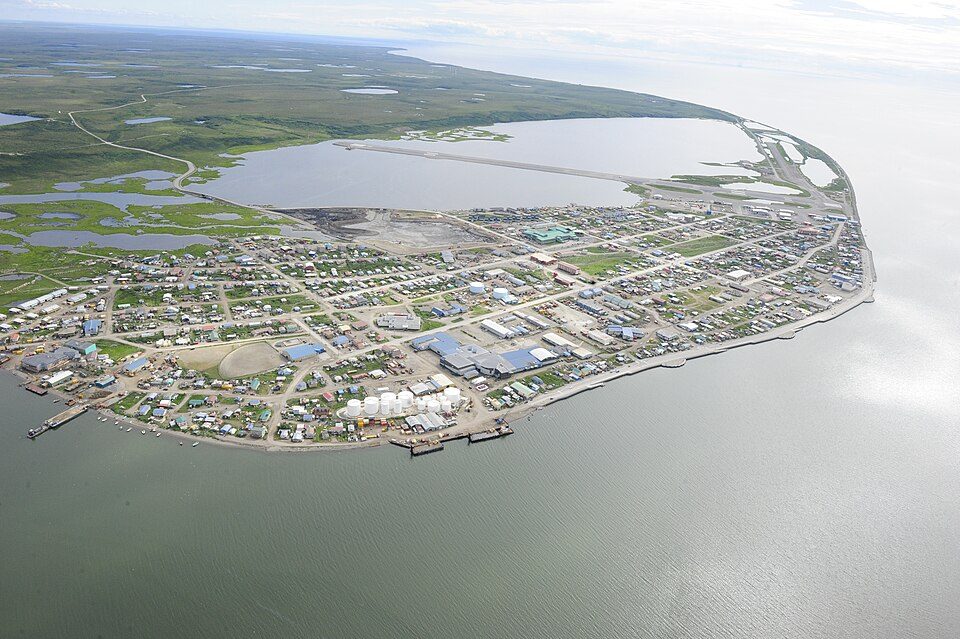
Kotzebue, AK: Submarine Cable Landing Point
Kotzebue, known also by its Iñupiaq name Qikiqtaġruk, is a city in the Northwest Arctic Borough of Alaska, United States, situated in one of the more remote coastal regions of the American Arctic. As the seat and largest community of the Northwest Arctic Borough, Kotzebue serves as an economic and transportation hub for the surrounding subregion. One submarine cable lands at this location, connecting Kotzebue to the broader domestic submarine cable network of Alaska.
The single cable serving Kotzebue is an intra-national connection, linking this Arctic community to other points within the United States. The corridor enabled here is a domestic one, extending connectivity along the Alaskan coastline rather than spanning intercontinental distances. For a remote Arctic city of approximately 3,100 residents, the presence of submarine cable infrastructure represents a meaningful component of its telecommunications landscape.
Cables Landing at Kotzebue, AK
The Quintillion Subsea Cable Network is the sole submarine cable landing at Kotzebue. Spanning approximately 1,900 kilometers, the system reached ready-for-service status in 2017 in draft status. All other endpoints on this cable are also located within the United States, making it a domestic Alaskan submarine cable system rather than an international one. The Quintillion Subsea Cable Network was designed to bring improved connectivity to communities along the Alaskan Arctic coast, and Kotzebue represents one of the landing points on this system.
Regional Context
Within the United States, submarine cable infrastructure is spread across 160 landing points hosting a total of 113 cables. Major hubs such as Boca Raton, FL and San Juan, PR each host eight cables, while Hermosa Beach, CA, Kapolei, HI, and Myrtle Beach, SC each host five. Kotzebue, with its single cable, ranks in the top 69 percent of United States landing points by cable count, reflecting the reality that many domestic landing points serve narrowly defined regional or local connectivity needs rather than functioning as multi-cable international gateways.
Network Role
Kotzebue functions as a single-cable terminus within the Quintillion Subsea Cable Network, a system dedicated to serving Alaska's remote Arctic coastal communities. The connection it hosts is entirely domestic in scope, linking this Northwest Arctic community to other Alaskan points along an approximately 1,900-kilometer route. This positions Kotzebue not as a hub for international data transit but as an endpoint that extends terrestrial-equivalent connectivity into a region of Alaska that would otherwise rely on alternative and often less reliable communications infrastructure.
Within the broader United States submarine cable graph, Kotzebue represents the kind of landing point that expands geographic reach into underserved areas. Its role in the network is one of domestic inclusion, ensuring that the Northwest Arctic Borough's largest community has a direct connection through submarine cable to the wider Alaskan and, by extension, national network.
What next: Kotzebue, AK, United States in the global directory of cable landing points; see surrounding routes on the interactive submarine cable map or follow live network monitoring.
Other Landing Points in United States
Landing Point
- CountryUS United States
- Coordinates66.8983°N 162.5967°W
- Connected Cables1
See Real Cable Routes
View actual submarine cable routing from Kotzebue, AK, United States - with backbone nodes, distance calculations, and latency estimates
Open Calculator →