Jacksonville, FL, United States
Landing Point · US United States
Connected Cables
| Cable | Status |
|---|---|
| America Movil Submarine Cable System-1 (AMX-1) | Active |
| Confluence-1 | Active |
| Pacific Caribbean Cable System (PCCS) | Active |
Live Performance
RTT measurements to this landing point from 2026-04-10 through 2026-10-16 - live ICMP round-trip time via our monitoring probes. Recomputed daily. ✓ No anomalies detected in the monitored period.
Measurement sources
| Probe | Location | Samples | Avg |
|---|---|---|---|
| #1000489 | control probe | 162 | 156.4 ms |
| #60154 | control probe | 66 | 112.9 ms |
| #1012769 | control probe | 57 | 104.9 ms |
| #6487 | control probe | 41 | 256.6 ms |
| #6410 own probe | Sao Paulo BR | 40 | 158.7 ms |
| own probe | Minsk BY | 39 | 194.6 ms |
| own probe | Saint Petersburg RU | 5 | 142.1 ms |
| #6427 own probe | Sydney AU | 2 | 223.6 ms |
| #12320 | control probe | 1 | 58.8 ms |
| #15687 | control probe | 1 | 61.9 ms |
| #54250 | control probe | 1 | 52.6 ms |
| #1010468 | control probe | 1 | 0.9 ms |
| own probe | Moscow RU | 1 | 142.1 ms |
About Jacksonville, FL, United States
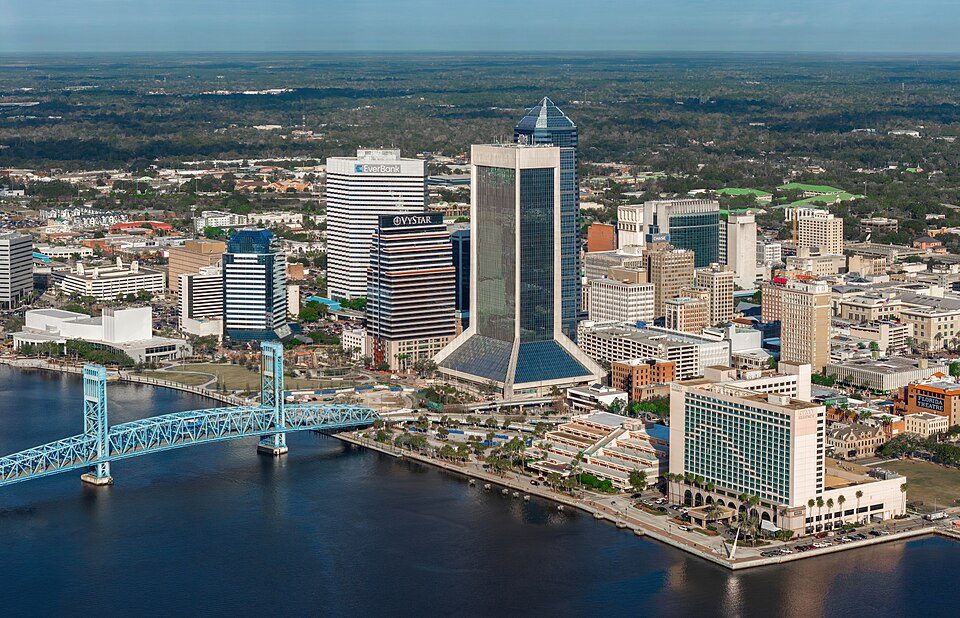
Jacksonville, FL: Submarine Cable Landing Point
Jacksonville, Florida, sits on the Atlantic coast of northeastern Florida and serves as a submarine cable landing point connecting the continental United States to the Caribbean Basin and Latin America. Three submarine cables land at Jacksonville, making it a notable node on the eastern seaboard of the United States. The cables here collectively reach destinations across the Caribbean, Central America, and South America, supporting a corridor that spans both intercontinental and regional connectivity.
Among the cables landing at Jacksonville, the America Movil Submarine Cable System-1 (AMX-1) stands out as the longest, extending 17,800 km and linking the United States to Brazil, Colombia, Costa Rica, the Dominican Republic, Guatemala, and Mexico. Alongside it, the Pacific Caribbean Cable System (PCCS) provides a complementary regional arc reaching Aruba, Colombia, Curaçao, Ecuador, and Panama. Together, these two systems position Jacksonville as a gateway to a broad sweep of the Western Hemisphere.
A third system, Confluence-1, is scheduled to enter service in 2026 and connects Jacksonville to other landing points within the United States, adding a domestic dimension to the port's cable portfolio.
Cables Landing at Jacksonville, FL
America Movil Submarine Cable System-1 (AMX-1) is a 17,800 km cable that entered service in 2014. From Jacksonville, it extends to Brazil, Colombia, Costa Rica, the Dominican Republic, Guatemala, and Mexico, forming one of the longer transoceanic systems in the Western Hemisphere that connects North America, the Caribbean, and South America in a single route.
Pacific Caribbean Cable System (PCCS) is a 6,163 km cable that entered service in 2015. It connects Jacksonville to Aruba, Colombia, Curaçao, Ecuador, and Panama, tracing a path through the Caribbean and down the Pacific coast of South America. Its presence alongside AMX-1 gives Jacksonville overlapping coverage of several Latin American markets.
Confluence-1 is a 2,571 km cable with a scheduled ready-for-service date of 2026. Its other endpoints are located within the United States, making it a domestic inter-landing-point system that will link Jacksonville to other U.S. cable infrastructure.
Regional Context
Within the United States, Jacksonville ranks among a broader set of Atlantic and Gulf-facing landing points. Nearby Florida peers such as Boca Raton carry eight cables each, reflecting a denser cable concentration further south along the peninsula. Jacksonville's three cables place it in the top 89% of the 167 U.S. landing points by cable count, a solid but modest position compared to high-density hubs in Florida, Puerto Rico, and the West Coast.
Network Role
Jacksonville functions as a multi-cable hub rather than a single-cable terminus, with its three systems covering two distinct roles: international connectivity to the Caribbean and Latin America via AMX-1 and PCCS, and domestic interconnection via the forthcoming Confluence-1. The two international cables together reach eight countries across the Caribbean, Central America, and South America, making Jacksonville a meaningful origination point for traffic moving between the northeastern United States and the broader Western Hemisphere.
As the United States hosts 113 submarine cables across 160 landing points, Jacksonville's three-cable profile represents a focused rather than dominant contribution to the national submarine network, yet its specific orientation toward Caribbean and Latin American endpoints gives it a distinct geographic role within the eastern U.S. cable map.
What next: Jacksonville, FL, United States in the global directory of cable landing points; see surrounding routes on the interactive submarine cable map or follow live network monitoring.
Other Landing Points in United States
FAQ
Landing Point
- CountryUS United States
- Coordinates30.3318°N 81.6557°W
- Connected Cables3
See Real Cable Routes
View actual submarine cable routing from Jacksonville, FL, United States - with backbone nodes, distance calculations, and latency estimates
Open Calculator →