Fortaleza, Brazil
Landing Point · BR Brazil
Connected Cables
| Cable | Status |
|---|---|
| America Movil Submarine Cable System-1 (AMX-1) | Active |
| BRUSA | Active |
| EllaLink | Active |
| GlobeNet | Active |
| Monet | Active |
| Project Waterworth | Planned |
| South America-1 (SAm-1) | Active |
| South American Crossing (SAC) | Active |
| South Atlantic Cable System (SACS) | Active |
| South Atlantic Inter Link (SAIL) | Active |
Live Performance
RTT measurements to this landing point from 2026-03-04 through 2026-10-16 - live ICMP round-trip time via our monitoring probes. Recomputed daily. ✓ No anomalies detected in the monitored period.
Measurement sources
| Probe | Location | Samples | Avg |
|---|---|---|---|
| #6410 own probe | Sao Paulo BR | 489 | 44.7 ms |
| #7062 own probe | Cape Town ZA | 479 | 102.0 ms |
| #60219 | control probe | 339 | 112.2 ms |
| #6487 | control probe | 279 | 253.3 ms |
| #6427 own probe | Sydney AU | 140 | 304.8 ms |
| #7493 | control probe | 132 | 112.7 ms |
| #6568 own probe | Singapore SG | 69 | 252.6 ms |
| #7050 | control probe | 51 | 242.4 ms |
| own probe | Balancer IL | 11 | 162.9 ms |
| own probe | Minsk BY | 7 | 245.4 ms |
| own probe | Almaty KZ | 7 | 285.2 ms |
| own probe | Tbilisi GE | 7 | 259.3 ms |
| own probe | Jerusalem IL | 4 | 243.3 ms |
| #64348 | control probe | 1 | 65.2 ms |
| own probe | Odessa UA | 1 | 274.9 ms |
About Fortaleza, Brazil
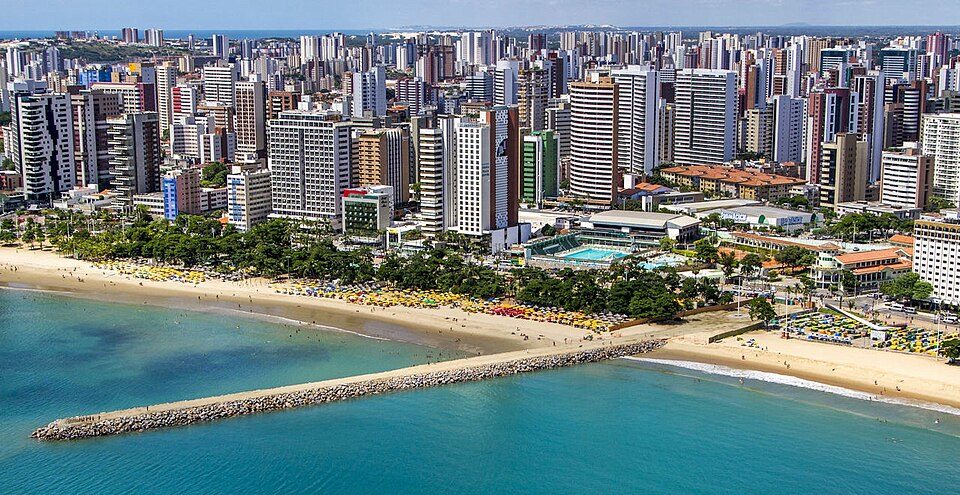
Fortaleza, Brazil: Submarine Cable Landing Point
Fortaleza is the state capital of Ceará, situated on the northeastern coast of Brazil. As a coastal city facing the Atlantic Ocean, it occupies a geographically significant position for submarine cable routing, sitting at a crossroads between South America, North America, Europe, Africa, and beyond. Ten submarine cables land at Fortaleza, making it the most connected submarine cable landing point in Brazil and one of the most connected in the entire South Atlantic region.
Among the cables serving Fortaleza, Project Waterworth stands out as an intercontinental system reaching across to Australia, India, Malaysia, South Africa, and the United States, while EllaLink represents a direct transatlantic link to Europe via Portugal, Morocco, Mauritania, and Cape Verde. Together, the cables landing here span corridors connecting South America to North America, Europe, Africa, and the Indo-Pacific, enabling Fortaleza to function as a multi-directional hub in the global submarine cable network.
The cables at Fortaleza collectively cover intra-South American coastal routes, transatlantic connections to Europe and Africa, and transoceanic links to North America and the Asia-Pacific region. This breadth of connectivity across intercontinental, regional, and transatlantic corridors distinguishes Fortaleza from any other landing point in Brazil.
Cables Landing at Fortaleza, Brazil
Project Waterworth is a cable spanning approximately 50,000 km, currently in draft status. In addition to Fortaleza, it connects to Australia, India, Malaysia, South Africa, and the United States, making it one of the longest systems serving this landing point and enabling direct links between South America and the Indo-Pacific and African regions.
South America-1 (SAm-1) spans 25,000 km and reached ready-for-service status in 2001. The cable connects Fortaleza with other landing points in Argentina, Chile, Colombia, the Dominican Republic, and Ecuador, forming a significant intra-regional network along the western and northern coasts of South America as well as the Caribbean.
GlobeNet spans 23,500 km and entered service in 2000. It links Fortaleza to Bermuda, Colombia, the United States, and Venezuela, providing a long-standing transatlantic and Caribbean route from northeastern Brazil to North America.
South American Crossing (SAC) extends 20,000 km and also entered service in 2000. The cable connects Fortaleza to Argentina, Chile, Colombia, Panama, and Peru, covering both Atlantic and Pacific coasts of South America and extending northward to Central America.
America Movil Submarine Cable System-1 (AMX-1) spans 17,800 km and reached service in 2014. It connects Fortaleza to Colombia, Costa Rica, the Dominican Republic, Guatemala, and Mexico, reinforcing links between northeastern Brazil and Central America and the Caribbean.
BRUSA is an 11,000 km cable that entered service in 2018. It connects Fortaleza directly to the United States and to other landing points in Brazil, providing a focused North Atlantic route from the Brazilian northeast.
Monet spans 10,556 km and entered service in 2017. It connects Fortaleza to the United States and to other Brazilian landing points, adding further transatlantic capacity on the Brazil-North America corridor.
EllaLink spans 6,200 km and entered service in 2021. It connects Fortaleza to Cape Verde, French Guiana, Mauritania, Morocco, and Portugal, providing a direct transatlantic link between South America and Europe, with intermediate connections along the West African coast.
South Atlantic Cable System (SACS) extends 6,165 km and entered service in 2018. It connects Fortaleza to Angola, creating a direct South Atlantic link between northeastern Brazil and southern Africa.
South Atlantic Inter Link (SAIL) spans 5,800 km and reached service in 2020. It connects Fortaleza to Cameroon, adding a further direct cross-Atlantic route to Central Africa from the Brazilian coast.
Regional Context
Within Brazil's submarine cable infrastructure of 16 cables across 31 landing points, Fortaleza leads all landing points with 10 cables. The next largest landing point is Rio de Janeiro with 8 cables, followed by Santos with 4, and Salvador with 3. Fortaleza's cable count is more than double that of Santos and triple that of Salvador, reflecting the northeastern city's strong position as Brazil's primary Atlantic-facing terminus for both transatlantic and transcontinental submarine systems.
Network Role
Fortaleza operates as a major multi-cable hub rather than a single-cable terminus, hosting ten submarine systems that collectively reach North America, Europe, Africa, and the Indo-Pacific. The landing point anchors both long-established routes - such as GlobeNet and SAC from 2000 - and more recent systems like EllaLink, SACS, and SAIL that have expanded Brazil's direct connectivity to Europe and sub-Saharan Africa. The combination of intra-South American coastal cables, direct transatlantic links, and Indo-Pacific connections via Project Waterworth gives Fortaleza a uniquely broad reach within the South Atlantic cable graph.
No other landing point in Brazil connects simultaneously to as many distinct continental regions. Fortaleza's position at the northeastern tip of South America, projecting into the Atlantic, makes it the natural convergence point for cables routing between the Americas, Europe, and Africa, and its growing role in Indo-Pacific connectivity further extends its relevance in the global submarine cable network.
What next: Fortaleza, Brazil in the global directory of cable landing points; see surrounding routes on the interactive submarine cable map or follow live network monitoring.
Incident history
Significant incidents on cables landing here, each with its own report.
Other Landing Points in Brazil
FAQ
Landing Point
- CountryBR Brazil
- Coordinates3.7185°S 38.5430°W
- Connected Cables10
See Real Cable Routes
View actual submarine cable routing from Fortaleza, Brazil - with backbone nodes, distance calculations, and latency estimates
Open Calculator →