Afuá, Brazil
Landing Point · BR Brazil
Connected Cables
| Cable | Status |
|---|---|
| Norte Conectado (Infovia 03) | Active |
Live Performance
RTT measurements to this landing point from 2026-03-26 through 2026-10-03 - live ICMP round-trip time via our monitoring probes. Recomputed daily. ✓ No anomalies detected in the monitored period.
Measurement sources
| Probe | Location | Samples | Avg |
|---|---|---|---|
| own probe | Minsk BY | 9 | 246.5 ms |
| own probe | Almaty KZ | 7 | 292.7 ms |
| own probe | Tbilisi GE | 6 | 262.2 ms |
| own probe | Jerusalem IL | 6 | 256.5 ms |
| #6410 own probe | Sao Paulo BR | 3 | 16.2 ms |
| #6427 own probe | Sydney AU | 3 | 313.4 ms |
| #7062 own probe | Cape Town ZA | 3 | 360.2 ms |
| #6487 | control probe | 2 | 351.8 ms |
| #1009006 | control probe | 1 | 54.0 ms |
| #1010767 | control probe | 1 | 236.0 ms |
| own probe | Sevastopol UA | 1 | 297.3 ms |
| own probe | Moscow RU | 1 | 259.4 ms |
| own probe | Saint Petersburg RU | 1 | 276.2 ms |
| #1016724 | control probe | 1 | 18.8 ms |
About Afuá, Brazil
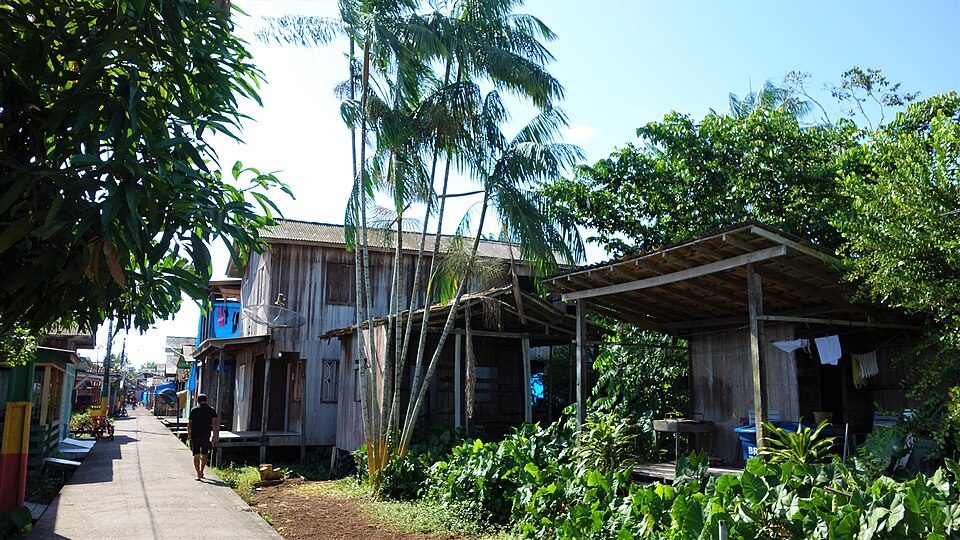
Afuá, Brazil: Submarine Cable Landing Point
Afuá is a municipality in the state of Pará, Brazil, situated in the Marajó mesoregion within the microregion of Furos de Breves. As a coastal and riverine community on the Amazon estuary, Afuá hosts one submarine cable landing, connecting it to Brazil's growing domestic submarine cable network. That cable is Norte Conectado (Infovia 03), a domestic system linking points entirely within Brazil.
The presence of a submarine cable landing in Afuá reflects Brazil's broader effort to extend fiber-optic connectivity to more remote municipalities spread across its 64 landing points. With Norte Conectado (Infovia 03) scheduled for readiness in 2025, Afuá is positioned to receive improved digital connectivity through a purpose-built domestic corridor.
Cables Landing at Afuá
Norte Conectado (Infovia 03) is a domestic Brazilian submarine cable with a length of 600 km. Scheduled to reach ready-for-service status in 2025 and currently at draft status, this system connects landing points exclusively within Brazil. It does not extend to any foreign country. The cable represents part of a national connectivity initiative designed to reach municipalities that have historically had limited access to high-capacity fiber-optic infrastructure.
Regional Context
Within Brazil's submarine cable landscape, Afuá sits at the lower end of the scale by cable count. Major hubs such as Fortaleza with 10 cables and Rio de Janeiro with 8 cables handle the bulk of Brazil's international and domestic submarine traffic, while Santos, Praia Grande, and Salvador each host between three and five cables. Autazes, like Afuá, hosts two or fewer cables, suggesting that both represent second-tier domestic connectivity nodes rather than major international gateways. Afuá ranks within the top 81 percent of Brazil's 74 landing points by cable count, placing it among the majority of landing points that host only one or two systems.
Network Role
Afuá functions as a single-cable terminus within Brazil's domestic submarine cable graph. The Norte Conectado (Infovia 03) system, at 600 km, operates entirely within Brazilian territory, meaning Afuá's role is oriented toward domestic connectivity rather than international traffic exchange. This positions the landing point as part of an intra-national corridor rather than a transoceanic route.
Brazil's overall submarine cable infrastructure spans 22 cables across 64 landing points, with an average cable length of 4,840 km - considerably longer than the 600 km Norte Conectado (Infovia 03) segment, underscoring that Afuá's connection is a regional domestic link. In the broader Brazilian submarine cable graph, Afuá represents an endpoint in an effort to bring fiber-optic infrastructure to municipalities in the Amazon estuary region that lie far from the country's established international landing hubs.
What next: Afuá, Brazil in the global directory of cable landing points; see surrounding routes on the interactive submarine cable map or follow live network monitoring.
Other Landing Points in Brazil
Landing Point
- CountryBR Brazil
- Coordinates0.1571°S 50.3883°W
- Connected Cables1
See Real Cable Routes
View actual submarine cable routing from Afuá, Brazil - with backbone nodes, distance calculations, and latency estimates
Open Calculator →