El Segundo, CA, United States
Landing Point · US United States
Connected Cables
| Cable | Status |
|---|---|
| Curie | Active |
| Pacific Light Cable Network (PLCN) | Active |
Live Performance
RTT measurements to this landing point from 2026-04-10 through 2026-10-16 - live ICMP round-trip time via our monitoring probes. Recomputed daily. ✓ No anomalies detected in the monitored period.
Measurement sources
| Probe | Location | Samples | Avg |
|---|---|---|---|
| #11257 | control probe | 104 | 180.6 ms |
| #65175 | control probe | 86 | 188.7 ms |
| #6652 | control probe | 12 | 208.2 ms |
| #7062 own probe | Cape Town ZA | 7 | 247.2 ms |
| own probe | Minsk BY | 7 | 202.7 ms |
| own probe | Saint Petersburg RU | 4 | 169.5 ms |
| #1015467 | control probe | 3 | 315.7 ms |
| own probe | Moscow RU | 3 | 160.0 ms |
| #7032 | control probe | 2 | 171.2 ms |
| #6410 own probe | Sao Paulo BR | 1 | 138.9 ms |
| #6487 | control probe | 1 | 229.6 ms |
| #21181 | control probe | 1 | 172.1 ms |
| #1015469 | control probe | 1 | 284.7 ms |
About El Segundo, CA, United States
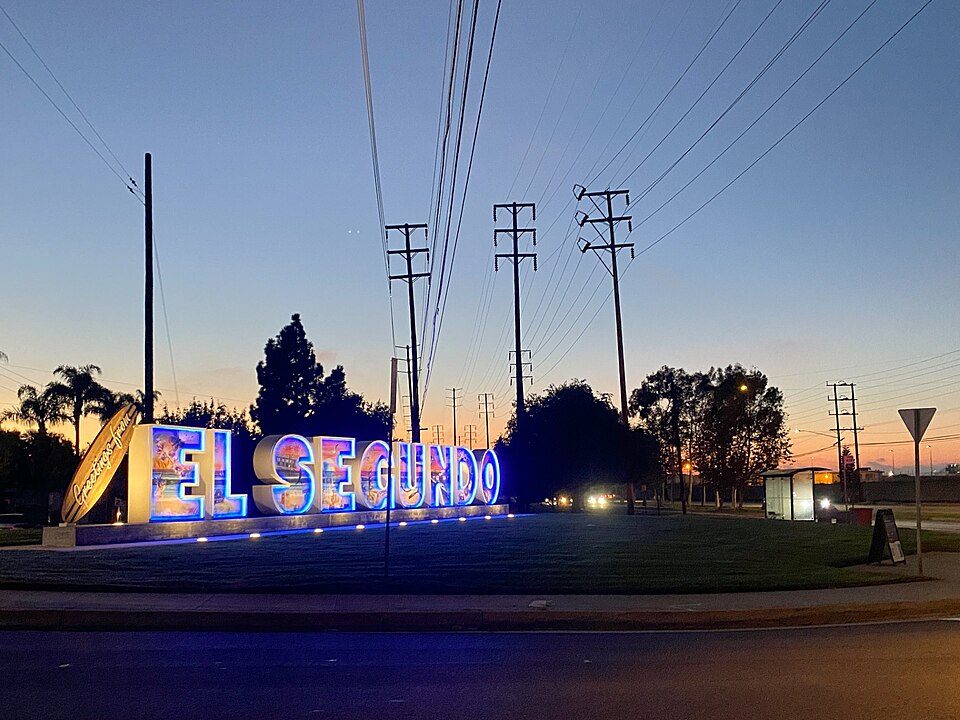
El Segundo, CA, United States: Submarine Cable Landing Point
El Segundo is a city in Los Angeles County, California, situated on Santa Monica Bay in the South Bay region of Southern California. Despite its modest population of around 17,000 residents, the city hosts a significant concentration of industrial and commercial activity, and its Pacific coastline positions it as a landing point for long-haul transoceanic submarine cables. Two submarine cables come ashore at El Segundo, connecting the United States to destinations across both the Pacific Ocean and the eastern Pacific corridor along South America.
The two cables landing at El Segundo represent distinct transoceanic corridors. The Pacific Light Cable Network (PLCN) extends westward across the Pacific to the Philippines and Taiwan, while Curie runs southward along the Americas to Panama and Chile. Together, these systems place El Segundo at the intersection of trans-Pacific and inter-American submarine cable routes, linking the continental United States to major economies in East and Southeast Asia as well as South America's Pacific coast.
Cables Landing at El Segundo
The Pacific Light Cable Network (PLCN) is a submarine cable system spanning approximately 11,806 kilometres, with a ready-for-service (RFS) date of 2022. In addition to El Segundo, PLCN connects to landing points in the Philippines and Taiwan, establishing a direct trans-Pacific link between the western coast of the United States and two significant nodes in East and Southeast Asia.
The Curie cable system spans approximately 10,476 kilometres and reached RFS in 2020. Curie connects El Segundo to Panama and Chile, extending southward along the Pacific coast of the Americas. The cable's route covers a substantial length of the eastern Pacific, linking the United States to two South American and Central American endpoints on the continent's Pacific-facing shore.
Regional Context
Within the United States submarine cable network, El Segundo ranks among a broader set of landing points distributed across the country's Atlantic, Gulf, and Pacific coastlines. With two cables, El Segundo hosts fewer systems than peers such as Hermosa Beach, California, which serves five cables, or Grover Beach, California, which serves four. Among California's landing points specifically, El Segundo contributes a distinct set of international connections that complement rather than duplicate the routes served by neighbouring sites.
Network Role
El Segundo functions as a dual-corridor terminus, anchoring one cable to the trans-Pacific route toward East and Southeast Asia and a second to the South American Pacific coast via Central America. The PLCN system provides a direct path to the Philippines and Taiwan, while Curie extends connectivity southward to Panama and Chile. Neither cable shares endpoint countries with the other, meaning El Segundo's two systems collectively reach four distinct foreign territories across two separate ocean corridors.
As a two-cable landing point in a country that hosts 113 submarine cables across 160 landing points, El Segundo occupies a focused but geographically broad role. Its position on Santa Monica Bay gives it access to both the northern and southern arcs of trans-Pacific and eastern Pacific cable routing, making it a point where intercontinental connectivity between the United States, Asia, and South America converges on the Southern California coast.
What next: El Segundo, CA, United States in the global directory of cable landing points; see surrounding routes on the interactive submarine cable map or follow live network monitoring.
Other Landing Points in United States
FAQ
Landing Point
- CountryUS United States
- Coordinates33.9199°N 118.4160°W
- Connected Cables2
See Real Cable Routes
View actual submarine cable routing from El Segundo, CA, United States - with backbone nodes, distance calculations, and latency estimates
Open Calculator →