Chania, Greece
Landing Point · GR Greece
Connected Cables
| Cable | Status |
|---|---|
| ANDROMEDA | Planned |
| Asia Africa Europe-1 (AAE-1) | Active |
| Blue | Active |
| MedNautilus Submarine System | Active |
| Silphium | Active |
Live Performance
RTT measurements to this landing point from 2026-03-06 through 2026-09-14 - live ICMP round-trip time via our monitoring probes. Recomputed daily. ✓ No anomalies detected in the monitored period.
Measurement sources
| Probe | Location | Samples | Avg |
|---|---|---|---|
| #11522 | control probe | 39 | 18.7 ms |
| own probe | Jerusalem IL | 21 | 94.1 ms |
| #6427 own probe | Sydney AU | 14 | 336.5 ms |
| own probe | Balancer IL | 14 | 101.2 ms |
| own probe | Minsk BY | 7 | 57.0 ms |
| own probe | Tbilisi GE | 7 | 81.8 ms |
| own probe | Almaty KZ | 6 | 112.5 ms |
| own probe | Sevastopol UA | 3 | 99.7 ms |
| #6410 own probe | Sao Paulo BR | 2 | 267.2 ms |
| own probe | Moscow RU | 2 | 60.5 ms |
| own probe | Odessa UA | 1 | 79.6 ms |
About Chania, Greece
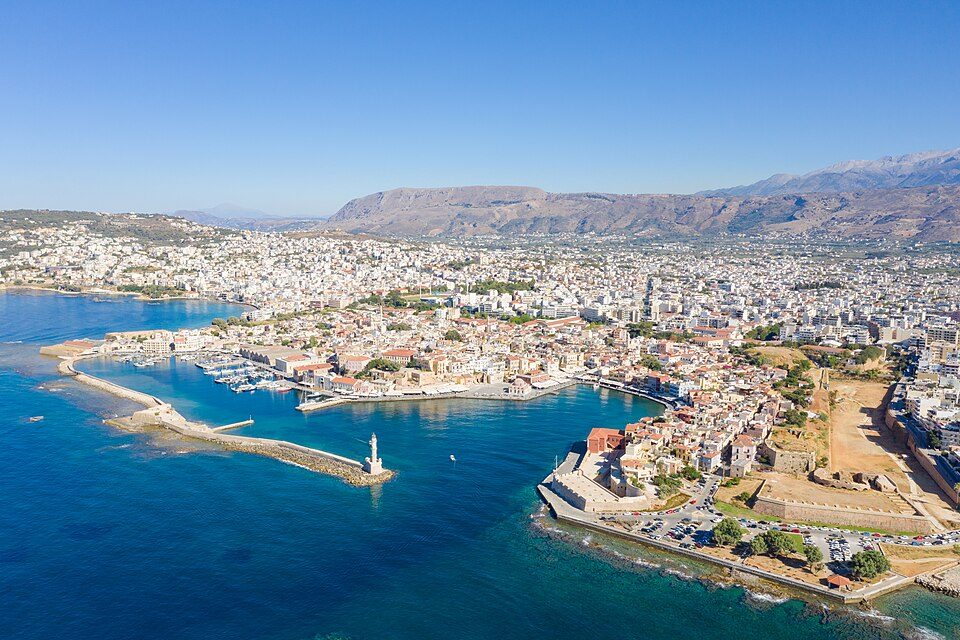
Chania: Submarine Cable Landing Point
Chania is a city on the northwestern coast of Crete, the largest island in Greece, and serves as the capital of the Chania regional unit. Positioned along the Mediterranean Sea, it functions as one of Greece's most connected submarine cable landing points, with five submarine cables coming ashore here. This places Chania among the leading landing points in the country by cable count, alongside Athens and Tympaki, which each host four cables.
The cables landing at Chania span a broad geographic reach, connecting Crete to destinations across the Eastern Mediterranean, the Middle East, North Africa, and as far as South and Southeast Asia. The Asia Africa Europe-1 (AAE-1) system is among the most geographically extensive, while regional systems such as Blue and MedNautilus Submarine System tie Chania into a dense web of Eastern Mediterranean connectivity. Together, these cables enable both intercontinental and regional data exchange across the Mediterranean corridor.
Cables Landing at Chania
Asia Africa Europe-1 (AAE-1) is a 25,000 km system that reached its ready-for-service (RFS) date in 2017. It connects Chania to Cambodia, China, Djibouti, Egypt, France, and India, making it the longest cable system landing in Chania and one that extends the city's reach across multiple continents, from Southeast Asia through the Indian subcontinent and into the Gulf of Aden and East Africa before terminating in Western Europe.
MedNautilus Submarine System spans 7,000 km and became operational in 2001. It connects Chania to Cyprus, other points in Greece, Israel, Italy, and Turkey, forming a significant Eastern Mediterranean ring that links several of the region's key economies and island territories.
Blue is a 5,055 km cable that reached its RFS date in 2023, making it the most recently activated system at this landing point. It connects Chania to Cyprus, France, Israel, Italy, and Jordan, extending Mediterranean reach toward the Levant and Western Europe.
Silphium is a shorter 425 km cable that became operational in 2013. It connects Chania directly to Libya, providing a dedicated bilateral link across the central Mediterranean between Crete and the North African coast.
ANDROMEDA connects Chania to Israel, Italy, and Jordan. No length or RFS date is currently published for this system.
Regional Context
Within Greece's submarine cable infrastructure - which spans 20 cables across 36 landing points - Chania stands as the most connected single landing point in the country with five cables. Athens and Tympaki follow with four cables each, while Mykonos and Naousa host three apiece. Chania's position on Crete's northwestern coast distinguishes it from mainland Greek landing points, anchoring major Mediterranean and long-haul systems at an island location.
Network Role
Chania functions as a multi-cable hub rather than a single-cable terminus, aggregating five distinct systems that collectively serve destinations across Southern Europe, the Eastern Mediterranean, the Levant, North Africa, and Asia. The combination of long-haul systems such as AAE-1 and regional systems such as Blue, MedNautilus, Silphium, and ANDROMEDA means that Chania supports both intercontinental traffic flows and shorter intra-Mediterranean routes. The presence of cables linking to Libya via Silphium adds a direct North Africa dimension that relatively few Greek landing points share.
In the broader Greek and Eastern Mediterranean submarine cable graph, Chania represents the highest-density landing point in the country, knitting together routes that span from Southeast Asia to Western Europe while also maintaining shorter bilateral connections to neighboring states. Its role as Crete's primary cable gateway positions it as a distinct node in the regional network, separate from the mainland Greek landing points clustered around Athens.
What next: Chania, Greece in the global directory of cable landing points; see surrounding routes on the interactive submarine cable map or follow live network monitoring.
Incident history
Significant incidents on cables landing here, each with its own report.
Other Landing Points in Greece
FAQ
Landing Point
- CountryGR Greece
- Coordinates35.5118°N 24.0122°E
- Connected Cables5
See Real Cable Routes
View actual submarine cable routing from Chania, Greece - with backbone nodes, distance calculations, and latency estimates
Open Calculator →