Batam, Indonesia
Landing Point · ID Indonesia
Connected Cables
| Cable | Status |
|---|---|
| Apricot | Active |
| Asia Connect Cable-1 (ACC-1) | Planned |
| Asia United Gateway East (AUG East) | Planned |
| Barat Timur Indonesia-2 (BTI-2) | Planned |
| Batam Dumai Melaka (BDM) | Active |
| Batam Sarawak Internet Cable System (BaSICS) | Active |
| Batam Singapore Cable System (BSCS) | Active |
| Candle | Planned |
| Hawaiki Nui 1 | Planned |
| Indonesia Global Gateway (IGG) System | Active |
| ION Cable System-1 (ICS1) | Planned |
| Jakarta-Bangka-Batam-Singapore (B2JS) | Active |
| Jakarta-Bangka-Bintan-Batam-Singapore (B3JS) | Active |
| JaSuKa | Active |
| Matrix Cable System | Active |
| Moratelindo International Cable System-1 (MIC-1) | Active |
| Palapa Ring West | Active |
| PGASCOM | Active |
| SEAX-1 | Active |
| Thailand-Indonesia-Singapore (TIS) | Active |
| Trans Global Cable System (TGCS) | Active |
Live Performance
RTT measurements to this landing point from 2026-03-01 through 2026-10-27 - live ICMP round-trip time via our monitoring probes. Recomputed daily.
Measurement sources
| Probe | Location | Samples | Avg |
|---|---|---|---|
| #65822 | control probe | 506 | 107.3 ms |
| #13022 | control probe | 317 | 138.4 ms |
| #6410 own probe | Sao Paulo BR | 207 | 336.5 ms |
| own probe | Almaty KZ | 189 | 256.2 ms |
| #6427 own probe | Sydney AU | 135 | 278.5 ms |
| #14843 | control probe | 78 | 6.4 ms |
| own probe | Minsk BY | 75 | 204.3 ms |
| own probe | Jerusalem IL | 73 | 188.2 ms |
| #6487 | control probe | 71 | 17.7 ms |
| #7062 | control probe | 71 | 312.8 ms |
| own probe | Tbilisi GE | 64 | 280.3 ms |
| #7102 | control probe | 63 | 73.5 ms |
| #12441 | control probe | 52 | 103.0 ms |
| own probe | Moscow RU | 35 | 199.0 ms |
| own probe | Odessa UA | 34 | 207.7 ms |
| own probe | Balancer IL | 34 | 166.2 ms |
| own probe | Kyiv UA | 34 | 280.2 ms |
| own probe | Sevastopol UA | 31 | 229.5 ms |
| own probe | Rostov RU | 27 | 243.9 ms |
| #6568 own probe | Singapore SG | 23 | 5.5 ms |
About Batam, Indonesia
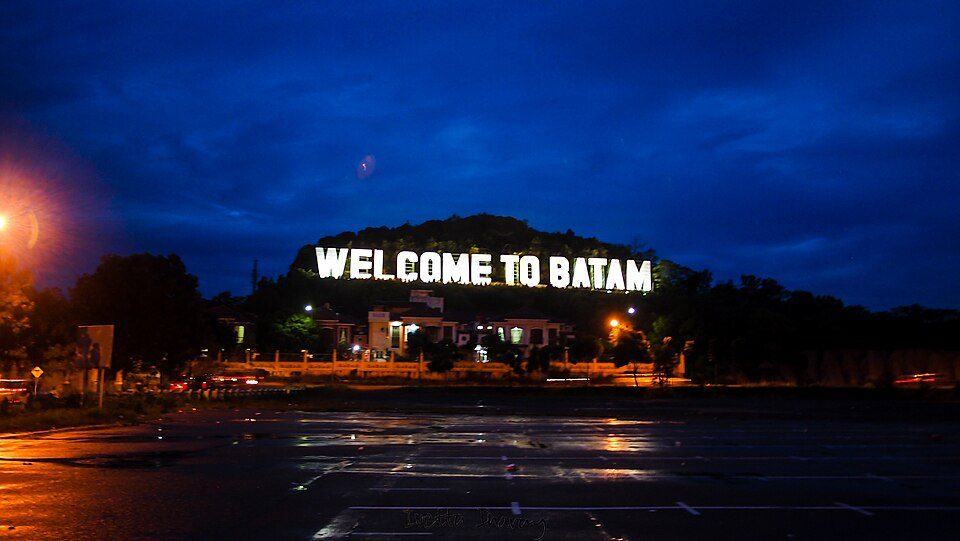
Batam, Indonesia: Submarine Cable Landing Point
Batam is the largest city in the Riau Islands province of Indonesia, situated in a position that places it in close proximity to Singapore and within the broader maritime corridor of Southeast Asia. As a submarine cable landing point, Batam hosts ten submarine cables, making it the single most connected landing point in Indonesia by cable count. This concentration of infrastructure reflects Batam's geographic position at the intersection of regional and intercontinental routes linking Southeast Asia, East Asia, and the Pacific.
Among the cables landing at Batam, the Asia Connect Cable-1 (ACC-1) and Apricot represent two of the more expansive systems, connecting Batam to destinations spanning Australia, Guam, Japan, the Philippines, Singapore, Taiwan, and Timor-Leste. Alongside several shorter regional systems, Batam serves both as a terminus for intra-Indonesian connectivity and as a node on longer intercontinental routes crossing toward East Asia and the Pacific.
Cables Landing at Batam, Indonesia
Asia Connect Cable-1 (ACC-1) is a 19,000 km system with a scheduled ready-for-service (RFS) date of 2028. It connects Batam to landing points in Australia, Guam, the Philippines, Singapore, and Timor-Leste, in addition to other Indonesian landings.
Apricot spans 11,972 km and reached RFS in 2025. The cable links Batam to Guam, Japan, the Philippines, Singapore, and Taiwan, forming a significant trans-Pacific-adjacent corridor across the Asia-Pacific region.
Hawaiki Nui 1 is a 10,000 km system scheduled for RFS in 2027. It connects Batam to Australia, Papua New Guinea, Singapore, the Solomon Islands, and Timor-Leste, enabling connectivity across Melanesia and the southwestern Pacific.
Asia United Gateway East (AUG East) is an 8,900 km cable with an RFS date of 2029. It links Batam to Brunei, Japan, Malaysia, the Philippines, Singapore, and South Korea, covering much of the northeastern and southeastern Asian coastal corridor.
Candle measures 8,000 km and is scheduled for RFS in 2028. The system connects Batam to Japan, Malaysia, the Philippines, Singapore, and Taiwan.
Palapa Ring West is a 1,980 km domestic cable that reached RFS in 2018, connecting Batam to other landing points within Indonesia.
Trans Global Cable System (TGCS) spans 1,200 km with an RFS date of 2026, connecting Batam to other Indonesian landing points.
Matrix Cable System is a 1,055 km cable that entered service in 2008, linking Batam to Singapore and other Indonesian locations.
Jakarta-Bangka-Bintan-Batam-Singapore (B3JS) is a 1,031 km system with an RFS date of 2012, connecting Batam to Jakarta, other Indonesian points, and Singapore.
Thailand-Indonesia-Singapore (TIS) spans 968 km and has been in service since 2003, making it the earliest cable at this landing point. It connects Batam to Singapore and Thailand.
Regional Context
Within Indonesia's submarine cable network of 40 cables across 97 landing points, Batam stands as the most connected single landing point in the country, hosting ten cables compared to seven at Jakarta and seven at Tanjung Pakis. Manado follows with five cables, while Anyer, Dumai, and Kuala Tungkal each host three. Batam's cable count places it well ahead of the national average across Indonesian landing points.
Network Role
Batam functions as a multi-cable hub rather than a simple terminus, hosting a mix of long-haul intercontinental systems and shorter regional and domestic cables. The intercontinental cables - ACC-1, Apricot, Hawaiki Nui 1, AUG East, and Candle - collectively reach Australia, Guam, Japan, Papua New Guinea, the Philippines, Singapore, South Korea, Taiwan, and Timor-Leste, enabling Batam to participate in both the East Asian and Pacific cable corridors. The regional cables, including B3JS, Matrix, TIS, Palapa Ring West, and TGCS, connect Batam to Singapore, Thailand, and multiple domestic Indonesian landing points.
Batam's position as Indonesia's most cable-dense landing point, combining domestic, regional, and intercontinental systems, makes it a significant node in the regional submarine cable graph, where routes between Southeast Asia, East Asia, and the Pacific converge at a single coastal city in the Riau Islands.
What next: Batam, Indonesia in the global directory of cable landing points; see surrounding routes on the interactive submarine cable map or follow live network monitoring.
Incident history
Significant incidents on cables landing here, each with its own report.
- Indonesia Global Gateway (IGG) System: latency up to 2.4× normal, 5 Sep 2026 (resolved)
- Batam Sarawak Internet Cable System (BaSICS): latency up to 2.2× normal, 5 Sep 2026 (resolved)
- Palapa Ring West cable: latency up to 2.7× normal, 5 Sep 2026 (resolved)
- Matrix Cable System: latency up to 2.4× normal, 15 Aug 2026 (resolved)
- Matrix Cable System: latency up to 2.2× normal, 28 Jul 2026 (resolved)
Other Landing Points in Indonesia
FAQ
Landing Point
- CountryID Indonesia
- Coordinates1.0668°N 104.0166°E
- Connected Cables21
See Real Cable Routes
View actual submarine cable routing from Batam, Indonesia - with backbone nodes, distance calculations, and latency estimates
Open Calculator →