Vaitape, French Polynesia
Landing Point · PF French Polynesia
Connected Cables
| Cable | Status |
|---|---|
| Honotua | Active |
| Manatua | Active |
Live Performance
RTT measurements to this landing point from 2026-03-10 through 2026-10-15 - live ICMP round-trip time via our monitoring probes. Recomputed daily. ✓ No anomalies detected in the monitored period.
Measurement sources
| Probe | Location | Samples | Avg |
|---|---|---|---|
| own probe | Jerusalem IL | 7 | 293.4 ms |
| #6410 own probe | Sao Paulo BR | 5 | 263.7 ms |
| #6427 own probe | Sydney AU | 5 | 240.3 ms |
| #6487 | control probe | 4 | 322.1 ms |
| #52614 | control probe | 4 | 5.2 ms |
| #1014350 | control probe | 4 | 3.3 ms |
| own probe | Minsk BY | 4 | 306.1 ms |
| own probe | Balancer IL | 4 | 294.4 ms |
| own probe | Almaty KZ | 3 | 326.3 ms |
| own probe | Tbilisi GE | 3 | 313.9 ms |
| #6568 own probe | Singapore SG | 1 | 268.5 ms |
| own probe | Sevastopol UA | 1 | 297.3 ms |
| own probe | Moscow RU | 1 | 271.5 ms |
| own probe | DVM IL | 1 | 296.6 ms |
About Vaitape, French Polynesia
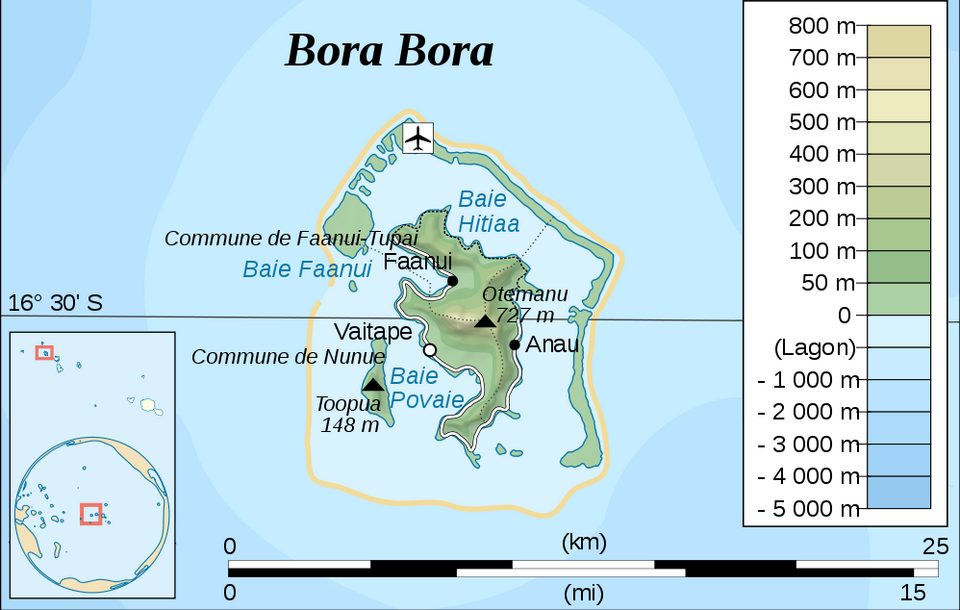
Vaitape: Submarine Cable Landing Point
Vaitape is the largest settlement on Bora Bora Island in French Polynesia, situated approximately 210 kilometres northwest of Papeete. As a submarine cable landing point, it connects the island to both transpacific and intra-Pacific regional networks. Two submarine cables come ashore at Vaitape, making it one of the more active landing points in French Polynesia's archipelago-wide cable infrastructure.
The two cables serving Vaitape represent distinct connectivity corridors. One extends northeast toward the United States, providing a transpacific link, while the other reaches westward across the central Pacific to link several island nations including the Cook Islands, Niue, and Samoa. Together, these systems position Vaitape as a node that bridges both intercontinental and intra-regional submarine cable routes within the South Pacific.
Cables Landing at Vaitape
Honotua is a submarine cable measuring 4,805 kilometres that reached ready-for-service status in 2010. It connects landing points in French Polynesia with the United States, forming a transpacific link between the islands of French Polynesia and the North American mainland. Honotua was the first submarine cable to land in French Polynesia, marking a significant moment in the territory's international connectivity history.
Manatua is a submarine cable measuring 3,634 kilometres that reached ready-for-service status in 2020. It connects landing points across several Pacific island nations, linking French Polynesia with the Cook Islands, Niue, and Samoa. This regional system spans the central South Pacific and provides direct submarine cable connectivity among smaller island communities that had previously relied on more indirect routing.
Regional Context
Within French Polynesia's submarine cable landscape - which encompasses 8 cables distributed across 23 landing points - Vaitape ranks among the more connected sites, hosting 2 cables and placing in the top 91 percent of landing points in the territory by cable count. Papenoo leads all French Polynesian landing points with 4 cables, followed by Faratea with 3, while Hitia'a matches Vaitape's count of 2. Several other landing points in the territory, including Arutua, Fakarava, and Hao, each host a single cable.
Network Role
Vaitape functions as a dual-corridor landing point, simultaneously anchoring a transpacific route toward the United States via Honotua and a regional inter-island route connecting to the Cook Islands, Niue, and Samoa via Manatua. This combination means that Vaitape is not simply a terminus for a single cable but rather a junction where transpacific and intra-Pacific South Pacific routes intersect on Bora Bora Island.
The presence of both a long-haul transpacific cable and a shorter regional system at the same landing point gives Vaitape a role that extends beyond purely local connectivity, allowing traffic to move between the broader Pacific island region and North America through a single geographic node. In the wider submarine cable graph of French Polynesia and the central South Pacific, this positions Vaitape as a meaningful secondary hub outside of the main concentration of cables found at Papenoo and Faratea.
What next: Vaitape, French Polynesia in the global directory of cable landing points; see surrounding routes on the interactive submarine cable map or follow live network monitoring.
Other Landing Points in French Polynesia
Landing Point
- CountryPF French Polynesia
- Coordinates16.5063°S 151.7495°W
- Connected Cables2
See Real Cable Routes
View actual submarine cable routing from Vaitape, French Polynesia - with backbone nodes, distance calculations, and latency estimates
Open Calculator →