Trapani, Italy
Landing Point · IT Italy
Connected Cables
| Cable | Status |
|---|---|
| Piano Isole Minori | Active |
| Trapani-Kelibia 2 (KELTRA-2) | Active |
Live Performance
RTT measurements to this landing point from 2026-03-07 through 2026-10-14 - live ICMP round-trip time via our monitoring probes. Recomputed daily.
Measurement sources
| Probe | Location | Samples | Avg |
|---|---|---|---|
| #504 | control probe | 247 | 75.1 ms |
| own probe | Sevastopol UA | 10 | 104.4 ms |
| #6427 own probe | Sydney AU | 9 | 288.2 ms |
| own probe | Odessa UA | 9 | 71.0 ms |
| own probe | Minsk BY | 8 | 95.9 ms |
| own probe | Almaty KZ | 7 | 282.7 ms |
| own probe | Tbilisi GE | 7 | 223.4 ms |
| own probe | Jerusalem IL | 6 | 263.5 ms |
| own probe | Moscow RU | 3 | 71.1 ms |
| own probe | Kyiv UA | 2 | 72.9 ms |
| #6487 | control probe | 1 | 169.8 ms |
| own probe | Saint Petersburg RU | 1 | 81.8 ms |
About Trapani, Italy
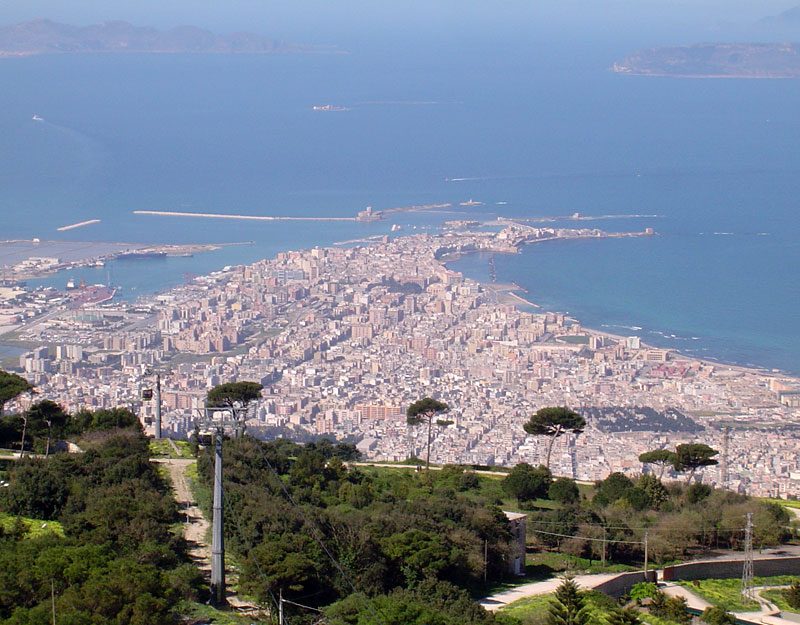
Trapani, Italy: Submarine Cable Landing Point
Trapani is a coastal city in western Sicily, situated on a crescent-shaped peninsula between the Tyrrhenian Sea and the Mediterranean Sea. Its geographic position at the western tip of Sicily, facing directly toward the North African coast, makes it a natural terminus for submarine cables crossing the central Mediterranean. Two submarine cables currently land at Trapani, connecting the city to both the Italian island network and the North African country of Tunisia.
The two cables landing here serve distinct corridor types. One is an intra-Italian connection forming part of the island interconnection network, while the other is a cross-Mediterranean link reaching Tunisia. Together they position Trapani as a point where domestic Italian submarine infrastructure and international Mediterranean connectivity converge.
Cables Landing at Trapani, Italy
Piano Isole Minori is an 830 km cable with a ready-for-service date of 2024, currently in draft status. This cable connects multiple Italian landing points, forming part of Italy's internal submarine network linking the mainland and its minor islands. As an intra-Italian cable, it reinforces connectivity among Italian territories across the surrounding seas.
Trapani-Kelibia 2 (KELTRA-2) is a 209 km cable that entered service in 2007, also currently listed in draft status. This cable links Trapani directly to Kelibia in Tunisia, spanning the Strait of Sicily and establishing a direct submarine path between Italy and the North African coast. At 209 km, it is a relatively short cross-Mediterranean link, reflecting the narrow maritime distance between western Sicily and the Tunisian cape.
Regional Context
Within Italy's network of 55 submarine cable landing points, Trapani hosts 2 cables, placing it in the same tier as Civitavecchia and Lampedusa by cable count. It sits well behind the leading Italian hubs - Mazara del Vallo with 9 cables, Genoa with 7, and Catania with 5 - but nonetheless contributes a distinct cross-Mediterranean route that few other Sicilian landing points replicate in precisely the same direction.
Network Role
Trapani functions as a two-cable landing point with a dual role: it serves as a node on Italy's internal island-linking cable system through Piano Isole Minori, and as the Italian terminus of the KELTRA-2 cable connecting to Tunisia. This combination means Trapani is neither a single-purpose domestic terminal nor a large multi-cable international hub, but rather a modest junction where regional and cross-Mediterranean submarine paths meet.
Within the broader Mediterranean submarine cable graph, Trapani's direct link to Tunisia across the Strait of Sicily represents a discrete Italy-North Africa connection that complements the denser cable concentrations found at nearby Sicilian and southern Italian landing points.
What next: Trapani, Italy in the global directory of cable landing points; see surrounding routes on the interactive submarine cable map or follow live network monitoring.
Our measurements to Trapani
Traceroutes from our own measurement points over the last 30 days: usual delay and number of network hops on the way to Trapani.
- From RIPE Atlas probes: 45 ms, 9 hops, 21 traces
Last trace: 2026-10-14. Live network map
Other Landing Points in Italy
FAQ
Landing Point
- CountryIT Italy
- Coordinates38.0183°N 12.5136°E
- Connected Cables2
See Real Cable Routes
View actual submarine cable routing from Trapani, Italy - with backbone nodes, distance calculations, and latency estimates
Open Calculator →