Santos, Brazil
Landing Point · BR Brazil
5
Connected Cables
BR
Country
23.96°
Latitude
46.33°
Longitude
Ctrl + Scroll to zoom
Connected Cables
| Cable | Status |
|---|---|
| Junior | Active |
| Monet | Active |
| South America-1 (SAm-1) | Active |
| South American Crossing (SAC) | Active |
| Tannat | Active |
Live Performance
1,869
measurements
39
probes
228
days monitored
303.9
ms avg RTT
14
anomalies
RTT measurements to this landing point from 2026-03-01 through 2026-10-16 - live ICMP round-trip time via our monitoring probes. Recomputed daily.
Measurement sources
| Probe | Location | Samples | Avg |
|---|---|---|---|
| #6982 | control probe | 325 | 334.3 ms |
| #61587 | control probe | 311 | 370.7 ms |
| #329 | control probe | 284 | 296.7 ms |
| #6818 | control probe | 129 | 325.9 ms |
| #6639 | control probe | 125 | 336.7 ms |
| #14843 | control probe | 113 | 292.7 ms |
| #1012403 | control probe | 55 | 116.4 ms |
| #1012996 | control probe | 46 | 143.0 ms |
| #65595 | control probe | 42 | 320.8 ms |
| #10515 | control probe | 40 | 139.7 ms |
| #65655 | control probe | 39 | 301.4 ms |
| #1011228 | control probe | 39 | 392.2 ms |
| own probe | Tbilisi GE | 37 | 262.9 ms |
| own probe | Minsk BY | 36 | 227.3 ms |
| own probe | Almaty KZ | 36 | 285.6 ms |
| own probe | Jerusalem IL | 35 | 270.9 ms |
| own probe | Moscow RU | 26 | 234.0 ms |
| own probe | Sevastopol UA | 24 | 263.1 ms |
| #7102 | control probe | 20 | 349.5 ms |
| #55079 | control probe | 19 | 281.3 ms |
About Santos, Brazil
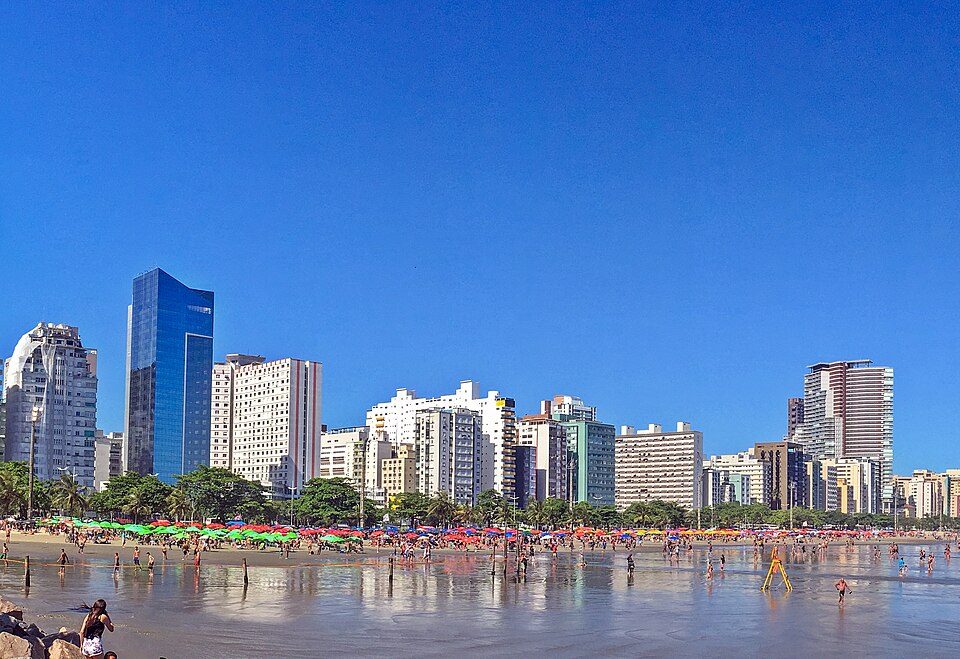
Santos, Brazil: A Gateway for Submarine Connectivity
Santos, a historic coastal city in the state of São Paulo, Brazil, is not only renowned for its rich cultural heritage and bustling port but also serves as a significant hub for submarine cable connectivity. With five submarine cables landing here, Santos ranks among the top landing points in Brazil, hosting nearly 23% of the country’s total cables.A Strategic Landing Point
Santos plays a pivotal role in Brazil's digital infrastructure. The five cables landing here - South America-1 (SAm-1), South American Crossing (SAC), Monet, Tannat, and Junior - connect Brazil to neighboring countries and beyond, enabling international and regional data exchange. These cables provide links to destinations as diverse as Argentina, Uruguay, the United States, and several other South American nations. While Santos hosts fewer cables than Fortaleza (10 cables) or Rio de Janeiro (8 cables), it still stands out for its connectivity. Unlike Praia Grande or Salvador, which host three cables each, Santos is firmly positioned as a regional hub with a broader reach. This is reflected in its inclusion in major international cable systems like Monet and SAm-1, which connect Brazil directly to the United States and other countries across South America.The Cables That Land in Santos
One of the standout cables landing in Santos is the South America-1 (SAm-1), a 25,000 km system operational since 2001. It links Santos to 15 other landing points across South America and the Caribbean, including Fortaleza, Rio de Janeiro, and Valparaíso, Chile. Similarly, the South American Crossing (SAC), operational since 2000, spans 20,000 km and connects Santos to 10 other points, such as St. Croix and Buenaventura. The Monet cable, launched in 2017, is a modern addition that connects Santos to Boca Raton, Florida, and Fortaleza, offering high-speed connectivity to the United States. The Tannat cable, operational since 2018, strengthens ties between Santos, Argentina, and Uruguay, while the Junior cable links Santos directly to Rio de Janeiro, providing a shorter domestic route.Latency and Performance
GeoCables’ monitoring reveals that Santos performs well in terms of latency. Across 1,368 completed checks from 36 source cities, the average round-trip latency to Santos is 302 ms, with the best observed latency being an impressive 1 ms. This highlights Santos’ efficiency as a landing point for data exchange, supporting both international and domestic traffic.Connectivity in Context
Brazil’s submarine cable network is extensive, with 22 cables landing across 64 points. Santos’ five cables place it in the top 97% of landing points in terms of cable count, underscoring its importance in the national infrastructure. While cities like Fortaleza and Rio de Janeiro may host more cables, Santos’ strategic location and diverse connections make it a key part of Brazil’s digital landscape.Conclusion
Santos is more than a city with a storied past - it is a modern gateway for connectivity. Its submarine cables link Brazil to the world, supporting industries, communication, and technological growth. Whether connecting to neighboring countries or bridging continents, Santos plays a key role in keeping Brazil connected.What next: Santos, Brazil in the global directory of cable landing points; see surrounding routes on the interactive submarine cable map or follow live network monitoring.
Incident history
Significant incidents on cables landing here, each with its own report.
- South American Crossing (SAC) cable: latency up to 2.4× normal, 3 Jul 2026 (resolved)
- Tannat cable: latency up to 4.9× normal, 17 Apr 2026 (resolved)
Other Landing Points in Brazil
BR Afuá, Brazil
0.1571°S 50.3883°W
BR Alenquer, Brazil
1.9450°S 54.7360°W
BR Almeirim, Brazil
1.5284°S 52.5778°W
BR Alvarães, Brazil
3.2146°S 64.8121°W
BR Amaturá, Brazil
3.3621°S 68.1972°W
BR Aracajú, Brazil
10.9096°S 37.0748°W
BR Atafona, Brazil
21.6312°S 41.0272°W
BR Atalaia do Norte, Brazil
4.3664°S 70.1932°W
BR Autazes, Brazil
3.5803°S 59.1317°W
BR Auxiliadora, Brazil
6.2496°S 61.8383°W
BR Bagre, Brazil
1.8988°S 50.2091°W
BR Barcelos, Brazil
0.9741°S 62.9258°W
FAQ
Landing Point
- CountryBR Brazil
- Coordinates23.9618°S 46.3281°W
- Connected Cables5
See Real Cable Routes
View actual submarine cable routing from Santos, Brazil - with backbone nodes, distance calculations, and latency estimates
Open Calculator →
Submarine cables
Land fiber
Live probes