Palembang, Indonesia
Landing Point · ID Indonesia
Connected Cables
| Cable | Status |
|---|---|
| Sumatera Bangka Cable System (SBCS) | Active |
Live Performance
RTT measurements to this landing point from 2026-04-01 through 2026-10-03 - live ICMP round-trip time via our monitoring probes. Recomputed daily. ✓ No anomalies detected in the monitored period.
Measurement sources
| Probe | Location | Samples | Avg |
|---|---|---|---|
| #6410 own probe | Sao Paulo BR | 28 | 371.8 ms |
| #6427 own probe | Sydney AU | 28 | 249.7 ms |
| own probe | Almaty KZ | 22 | 267.2 ms |
| own probe | Jerusalem IL | 13 | 226.2 ms |
| #7062 own probe | Cape Town ZA | 7 | 313.0 ms |
| #6487 | control probe | 6 | 19.1 ms |
| own probe | Tbilisi GE | 4 | 301.5 ms |
| own probe | Minsk BY | 3 | 286.5 ms |
| #24204 | control probe | 2 | 6.2 ms |
| #60672 | control probe | 2 | 7.9 ms |
| #1003139 | control probe | 2 | 12.4 ms |
| own probe | Moscow RU | 2 | 207.0 ms |
About Palembang, Indonesia
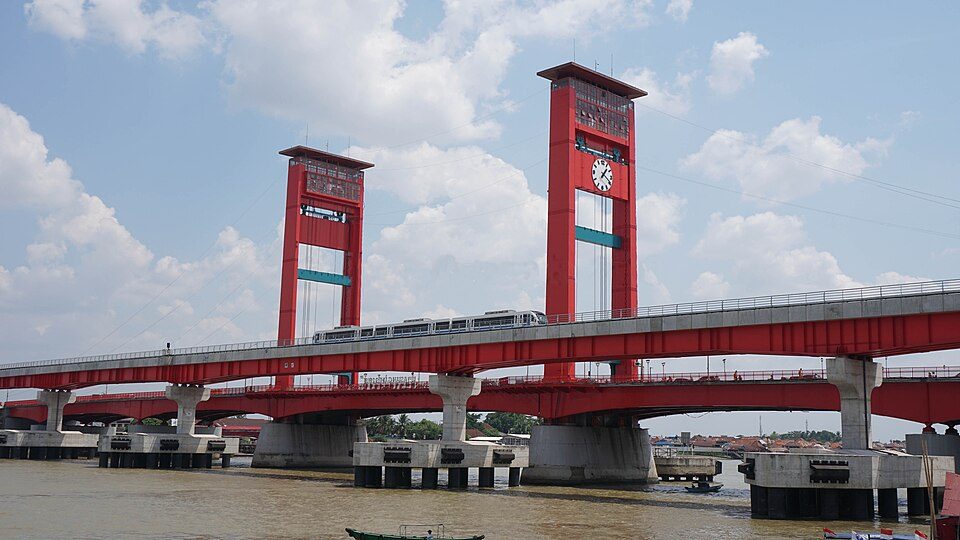
Palembang: Submarine Cable Landing Point
Palembang is the capital of South Sumatra province and the second most populous city on the island of Sumatra, situated on both banks of the Musi River in the eastern lowlands of southern Sumatra. As a coastal-adjacent city within a densely connected archipelago, Palembang serves as a submarine cable landing point within Indonesia's broader national cable network. One submarine cable lands here, the Sumatera Bangka Cable System, connecting Palembang to other points within Indonesia.
The single cable landing at Palembang establishes an intra-national corridor, linking the city to other Indonesian endpoints rather than to international destinations. This places Palembang within the category of domestic connectivity nodes, supporting inter-island or inter-regional data transmission within the Indonesian archipelago. Indonesia as a whole hosts 70 submarine cables across 139 landing points, reflecting the country's dependence on submarine infrastructure to bind together its dispersed islands, and Palembang represents one node in that wider national fabric.
Cables Landing at Palembang
Sumatera Bangka Cable System (SBCS) is the sole submarine cable landing at Palembang. Spanning 57 kilometres, it reached ready-for-service status in 2014 and is listed with a draft designation. All other endpoints on the SBCS are located within Indonesia, confirming its role as a purely domestic cable linking Indonesian locations. At 57 kilometres, it is a notably short system by regional standards - Indonesia's average submarine cable length is 2,814 kilometres - reflecting its function as a short inter-island or coastal connection rather than a long-haul international link.
Regional Context
Among Indonesia's submarine cable landing points, Palembang hosts a single cable, placing it in the top 62 percent of the country's 143 landing points by cable count. This positions it well below major Indonesian hubs such as Batam, which lands 20 cables, Jakarta with 9, Tanjung Pakis with 9, and Manado with 8, but it remains a recognised part of the national submarine cable geography. Its role is more specialised than those larger hubs, focused on short-range domestic connectivity rather than serving as a gateway to international routes.
Network Role
Palembang functions as a single-cable terminus within Indonesia's submarine cable network. The Sumatera Bangka Cable System connects Palembang to other domestic Indonesian locations across a short 57-kilometre span, supporting regional data flow between Sumatra and neighbouring Indonesian territories. This configuration makes Palembang a point-to-point domestic node rather than a multi-cable hub with diverse international reach.
Within the Indonesian submarine cable graph - one of the most extensive in Southeast Asia - short domestic cables like the SBCS serve the practical purpose of connecting populous inland and coastal cities to the broader inter-island network. Palembang's presence as a landing point for this cable reflects the role that Sumatra's major urban centres play in anchoring domestic submarine connectivity across the archipelago.
What next: Palembang, Indonesia in the global directory of cable landing points; see surrounding routes on the interactive submarine cable map or follow live network monitoring.
Other Landing Points in Indonesia
Landing Point
- CountryID Indonesia
- Coordinates2.9910°S 104.7573°E
- Connected Cables1
See Real Cable Routes
View actual submarine cable routing from Palembang, Indonesia - with backbone nodes, distance calculations, and latency estimates
Open Calculator →