Lingang, China
Landing Point · CN China
Connected Cables
| Cable | Status |
|---|---|
| New Cross Pacific (NCP) Cable System | Active |
| Southeast Asia-Japan Cable 2 (SJC2) | Active |
Live Performance
RTT measurements to this landing point from 2026-03-15 through 2026-10-07 - live ICMP round-trip time via our monitoring probes. Recomputed daily. ✓ No anomalies detected in the monitored period.
Measurement sources
| Probe | Location | Samples | Avg |
|---|---|---|---|
| own probe | Almaty KZ | 11 | 182.9 ms |
| own probe | Tbilisi GE | 11 | 311.4 ms |
| #6410 own probe | Sao Paulo BR | 8 | 321.5 ms |
| #7062 own probe | Cape Town ZA | 8 | 325.0 ms |
| #6487 | control probe | 5 | 162.9 ms |
| #1016690 | control probe | 5 | 27.3 ms |
| #1005736 | control probe | 4 | 22.4 ms |
| own probe | Minsk BY | 4 | 180.9 ms |
| own probe | Moscow RU | 4 | 188.4 ms |
| #1015574 | control probe | 4 | 13.2 ms |
| own probe | Jerusalem IL | 3 | 248.0 ms |
| #1017045 | control probe | 2 | 30.4 ms |
| #6568 own probe | Singapore SG | 1 | 67.5 ms |
| own probe | Sevastopol UA | 1 | 177.1 ms |
| own probe | Ekaterinburg RU | 1 | 125.8 ms |
About Lingang, China
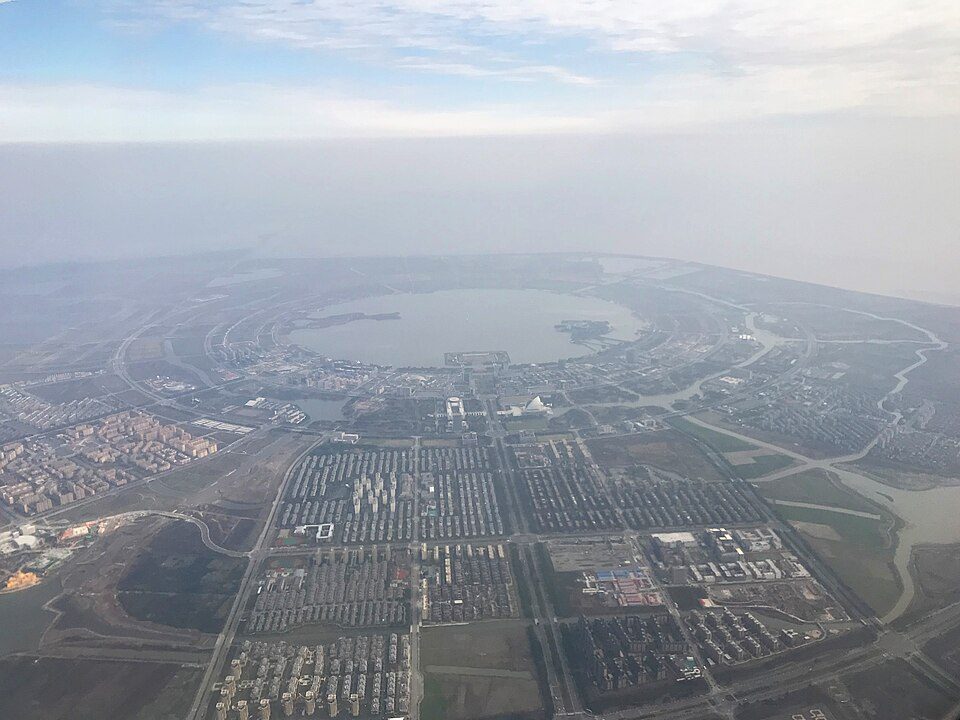
Lingang, China: Submarine Cable Landing Point
Lingang is a submarine cable landing point situated in the Pudong New Area of Shanghai, China, at the southeastern tip of the municipality along the East China Sea coast. Two submarine cables land at Lingang, connecting China to a network of partners across the Asia-Pacific region and onward to the United States. The cables landing here collectively serve both transpacific and intra-Asian corridors, making Lingang a landing point with broad geographic reach.
The two cables at Lingang - the New Cross Pacific (NCP) Cable System and the Southeast Asia-Japan Cable 2 (SJC2) - together link China to Japan, South Korea, Taiwan, Singapore, Thailand, and the United States. This combination of transpacific and Southeast Asian connectivity places Lingang at the intersection of two distinct cable corridors, one oriented toward the North Pacific and one running through Southeast Asia toward Japan.
Cables Landing at Lingang, China
New Cross Pacific (NCP) Cable System is 13,618 km in length and reached ready-for-service (RFS) status in 2018. The cable connects landing points across China, Japan, South Korea, Taiwan, and the United States, forming a transpacific link that spans the North Pacific Ocean. Lingang serves as one of the Chinese termination points on this system.
Southeast Asia-Japan Cable 2 (SJC2) spans 10,500 km and has an RFS year of 2025. The cable connects China, Japan, Singapore, South Korea, Taiwan, and Thailand, running through Southeast Asian waters. SJC2 extends Lingang's reach into Southeast Asia, linking it to Singapore and Thailand in addition to the Northeast Asian partners shared with NCP.
Regional Context
Within China's submarine cable network - which comprises 24 cables across 24 landing points - Lingang ranks among the more modestly connected nodes, hosting 2 cables and placing within the top 79% of Chinese landing points by cable count. Landing points such as Chung Hom Kok and Tseung Kwan O each host six cables, while Chongming and Nanhui each host four, positioning those sites as more densely connected hubs within the same national network. Lingang shares its two-cable count with Lantau Island, the least-connected among the listed regional peers.
Network Role
Lingang functions as a dual-cable landing point serving two geographically distinct corridors: the transpacific route via NCP and the Southeast Asia-to-Japan route via SJC2. Between the two systems, the landing point has connections to seven distinct countries - China, Japan, South Korea, Taiwan, the United States, Singapore, and Thailand - a notably wide country reach for a landing point hosting only two cables. The NCP system, at over 13,600 km, provides one of the longer transpacific links terminating in the Shanghai area, while SJC2, completed in 2025, adds a newer generation of intra-Asian capacity.
Although Lingang is not among China's highest-capacity landing hubs by cable count, its participation in both a transpacific and a Southeast Asian cable system means that a single landing point contributes to connectivity in two major submarine cable corridors simultaneously. Within the regional submarine cable graph, this dual-corridor role distinguishes Lingang from single-corridor landing points of comparable cable count.
What next: Lingang, China in the global directory of cable landing points; see surrounding routes on the interactive submarine cable map or follow live network monitoring.
Incident history
Significant incidents on cables landing here, each with its own report.
Other Landing Points in China
Landing Point
- CountryCN China
- Coordinates30.9357°N 121.8961°E
- Connected Cables2
See Real Cable Routes
View actual submarine cable routing from Lingang, China - with backbone nodes, distance calculations, and latency estimates
Open Calculator →