Horseshoe Bay, BC, Canada
Landing Point · CA Canada
Connected Cables
| Cable | Status |
|---|---|
| Vancouver-Bowen Island-Vancouver Island | Active |
Live Performance
RTT measurements to this landing point from 2026-07-11 through 2026-08-10 - live ICMP round-trip time via our monitoring probes. Recomputed daily. ✓ No anomalies detected in the monitored period.
Measurement sources
| Probe | Location | Samples | Avg |
|---|---|---|---|
| #7062 own probe | Cape Town ZA | 9 | 214.4 ms |
| own probe | Moscow RU | 9 | 106.5 ms |
| own probe | Saint Petersburg RU | 8 | 102.6 ms |
| own probe | Minsk BY | 4 | 105.7 ms |
| #6487 | control probe | 3 | 198.1 ms |
| own probe | Kyiv UA | 2 | 109.5 ms |
| #33355 | control probe | 1 | 2.4 ms |
| #50726 | control probe | 1 | 1.8 ms |
| #54737 | control probe | 1 | 14.1 ms |
| own probe | Rostov RU | 1 | 151.5 ms |
| own probe | Odessa UA | 1 | 117.4 ms |
About Horseshoe Bay, BC, Canada
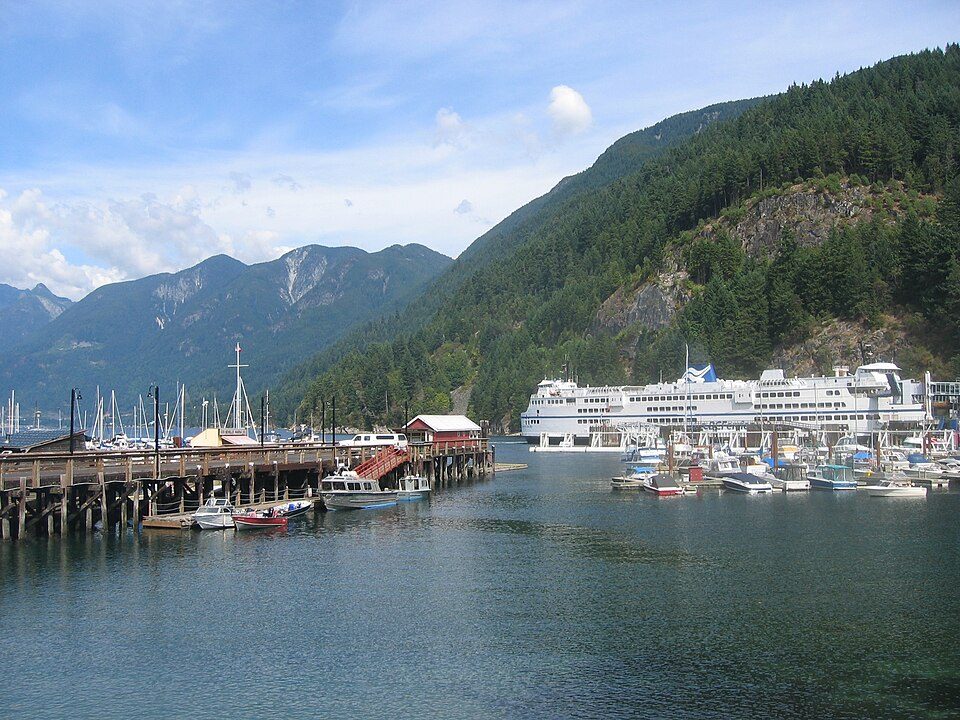
Horseshoe Bay, BC, Canada: Submarine Cable Landing Point
Horseshoe Bay is a community in West Vancouver, British Columbia, situated at the entrance to Howe Sound along Canada's Pacific coast. As a submarine cable landing point, it serves as a terminus for one submarine cable connecting locations entirely within Canada. That cable, the Vancouver-Bowen Island-Vancouver Island system, links Horseshoe Bay to other points along the British Columbia coastline, enabling domestic connectivity within the province's complex geography of islands and inlets.
The cable landing here supports intra-Canadian, regional connectivity rather than intercontinental links. With British Columbia's coastline characterized by numerous islands and fjords, submarine cables play a practical role in bridging communities that are difficult to reach by land-based infrastructure alone. Horseshoe Bay, already a significant transportation node on the BC mainland, extends that connective function into the submarine cable domain.
Cables Landing at Horseshoe Bay, BC, Canada
The Vancouver-Bowen Island-Vancouver Island cable is the single submarine cable landing at Horseshoe Bay. Spanning 75 kilometres, it reached ready-for-service status in 2019. All endpoints on this cable are located within Canada, making it a domestic system serving the British Columbia region. The cable's name indicates connections between the Vancouver area, Bowen Island, and Vancouver Island, forming a short but regionally significant link across the waters of the southern BC coast.
Regional Context
Within Canada's submarine cable infrastructure - which spans 21 cables across 155 landing points - Horseshoe Bay hosts a single cable, placing it among the more modestly served landing points in the country. Several other Canadian landing points carry two cables, including Vancouver, BC, Prince Rupert, BC, Halifax, NS, Kangiqsujuaq, QC, and Puvirnituq, QC, while Addenbroke Island, BC similarly hosts one cable. Horseshoe Bay ranks in the top 97 percent of Canada's 155 landing points by cable count, reflecting the broad distribution of single-cable terminals across the country's coastline.
Network Role
Horseshoe Bay functions as a single-cable terminus within a domestic British Columbia submarine cable corridor. The Vancouver-Bowen Island-Vancouver Island system, at 75 kilometres, is well below the Canadian average cable length of 259 kilometres, underscoring its role as a short-haul, intra-provincial link rather than a long-distance or international route. It serves the specific geographic challenge of maintaining connectivity between mainland communities and the islands of the southern BC coast.
In the broader Canadian submarine cable graph, Horseshoe Bay represents one of many coastal access points that together knit together a geographically dispersed national network. Its presence as a landing point for a regionally focused domestic cable illustrates how submarine infrastructure in Canada extends well beyond international gateways to address local and inter-island connectivity needs.
What next: Horseshoe Bay, BC, Canada in the global directory of cable landing points; see surrounding routes on the interactive submarine cable map or follow live network monitoring.
Other Landing Points in Canada
Landing Point
- CountryCA Canada
- Coordinates49.3748°N 123.2765°W
- Connected Cables1
See Real Cable Routes
View actual submarine cable routing from Horseshoe Bay, BC, Canada - with backbone nodes, distance calculations, and latency estimates
Open Calculator →