Esquimalt, BC, Canada
Landing Point · CA Canada
Connected Cables
| Cable | Status |
|---|---|
| AmeriCan-1 | Active |
Live Performance
RTT measurements to this landing point from 2026-03-10 through 2026-09-30 - live ICMP round-trip time via our monitoring probes. Recomputed daily. ✓ No anomalies detected in the monitored period.
Measurement sources
| Probe | Location | Samples | Avg |
|---|---|---|---|
| own probe | Minsk BY | 4 | 104.1 ms |
| own probe | Moscow RU | 4 | 109.0 ms |
| #6487 | control probe | 2 | 188.5 ms |
| #7062 own probe | Cape Town ZA | 2 | 218.6 ms |
| #50446 | control probe | 2 | 58.7 ms |
| #53828 | control probe | 2 | 1.9 ms |
| #60388 | control probe | 2 | 23.9 ms |
| own probe | Almaty KZ | 2 | 173.3 ms |
| own probe | Tbilisi GE | 2 | 133.0 ms |
| own probe | Saint Petersburg RU | 2 | 101.1 ms |
| #6427 own probe | Sydney AU | 1 | 166.3 ms |
| own probe | Jerusalem IL | 1 | 131.1 ms |
| own probe | Sevastopol UA | 1 | 140.5 ms |
| own probe | Kyiv UA | 1 | 111.2 ms |
About Esquimalt, BC, Canada
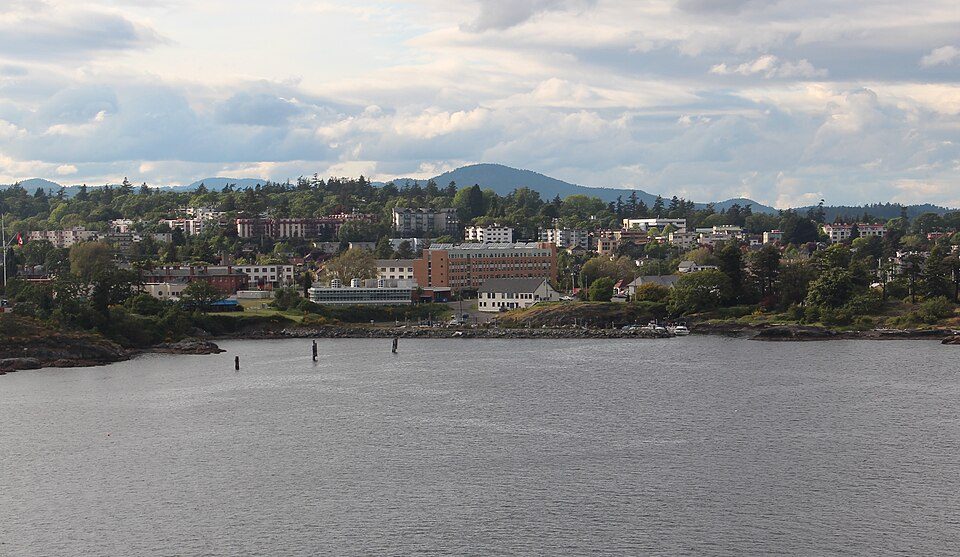
Esquimalt, BC, Canada: Submarine Cable Landing Point
Esquimalt is a municipality situated at the southern tip of Vancouver Island, British Columbia, Canada, bordered to the south by the Strait of Juan de Fuca. Its position along this coastal waterway places it within reach of submarine cable routes connecting Canada and the United States. One submarine cable lands at Esquimalt, establishing a direct undersea link between the two countries along the Pacific coast of North America.
The single cable landing here, AmeriCan-1, operates along a short cross-border corridor, reflecting the geographic proximity of Vancouver Island to the northwestern United States. This connection represents a regional, cross-border corridor rather than a transoceanic intercontinental route.
Cables Landing at Esquimalt, BC, Canada
AmeriCan-1 is a submarine cable with a length of 140 km, reaching its ready-for-service status in 1999. The cable connects Canada and the United States, with Esquimalt serving as the Canadian terminus on this route. Its relatively short length is consistent with a near-coastal link spanning the maritime boundary between the two neighbouring countries along the Pacific seaboard.
Regional Context
Within Canada's submarine cable infrastructure, Esquimalt is one of 155 landing points across the country and hosts a single cable, placing it among the more modestly connected landing points nationally. On Vancouver Island and the broader British Columbia coast, Esquimalt sits alongside Prince Rupert, BC, and Vancouver, BC, each of which lands two cables, as well as Addenbroke Island, BC, which also hosts a single cable. Esquimalt's landing thus reflects a pattern seen at several British Columbia coastal points, where individual sites support targeted, specific cable routes rather than concentrations of multiple systems.
Network Role
Esquimalt functions as a single-cable terminus, serving as the Canadian endpoint of the AmeriCan-1 system and enabling a direct undersea connection to the United States along the Pacific coast. The 140 km cable represents one of the shorter submarine links in Canada's overall network, which averages 259 km per cable, underscoring its role as a compact cross-border connector rather than a long-haul deep-sea route.
Within the regional submarine cable graph, Esquimalt occupies a defined but narrowly scoped position: a point connecting Vancouver Island to the United States via a single short system. Its presence as a distinct landing point on the southern coast of Vancouver Island, separate from nearby Vancouver, illustrates how submarine cable infrastructure in Canada is distributed across numerous coastal sites, each anchoring specific bilateral or regional connections.
What next: Esquimalt, BC, Canada in the global directory of cable landing points; see surrounding routes on the interactive submarine cable map or follow live network monitoring.
Other Landing Points in Canada
Landing Point
- CountryCA Canada
- Coordinates48.4301°N 123.4146°W
- Connected Cables1
See Real Cable Routes
View actual submarine cable routing from Esquimalt, BC, Canada - with backbone nodes, distance calculations, and latency estimates
Open Calculator →