Darwin, NT, Australia
Landing Point · AU Australia
Connected Cables
| Cable | Status |
|---|---|
| Asia Connect Cable-1 (ACC-1) | Planned |
| Bosun | Planned |
| Hawaiki Nui 1 | Planned |
| North-West Cable System | Active |
| Project Waterworth | Planned |
Live Performance
RTT measurements to this landing point from 2026-03-01 through 2026-10-18 - live ICMP round-trip time via our monitoring probes. Recomputed daily.
Measurement sources
| Probe | Location | Samples | Avg |
|---|---|---|---|
| #6427 own probe | Sydney AU | 390 | 83.2 ms |
| #7242 | control probe | 389 | 275.0 ms |
| #6410 own probe | Sao Paulo BR | 387 | 349.5 ms |
| #6487 | control probe | 303 | 79.5 ms |
| #50604 | control probe | 228 | 289.3 ms |
| #7401 | control probe | 85 | 408.9 ms |
| own probe | Almaty KZ | 75 | 296.3 ms |
| #12496 | control probe | 73 | 295.5 ms |
| #1033 | control probe | 67 | 131.8 ms |
| #724 | control probe | 65 | 291.2 ms |
| #650 | control probe | 61 | 242.6 ms |
| #33205 | control probe | 60 | 256.8 ms |
| #61350 | control probe | 55 | 287.4 ms |
| #1015164 | control probe | 49 | 333.3 ms |
| #53346 | control probe | 43 | 223.1 ms |
| #6944 | control probe | 41 | 288.4 ms |
| #13081 | control probe | 40 | 271.3 ms |
| #1000734 | control probe | 38 | 353.3 ms |
| #2501 | control probe | 37 | 167.3 ms |
| #11522 | control probe | 34 | 300.4 ms |
About Darwin, NT, Australia
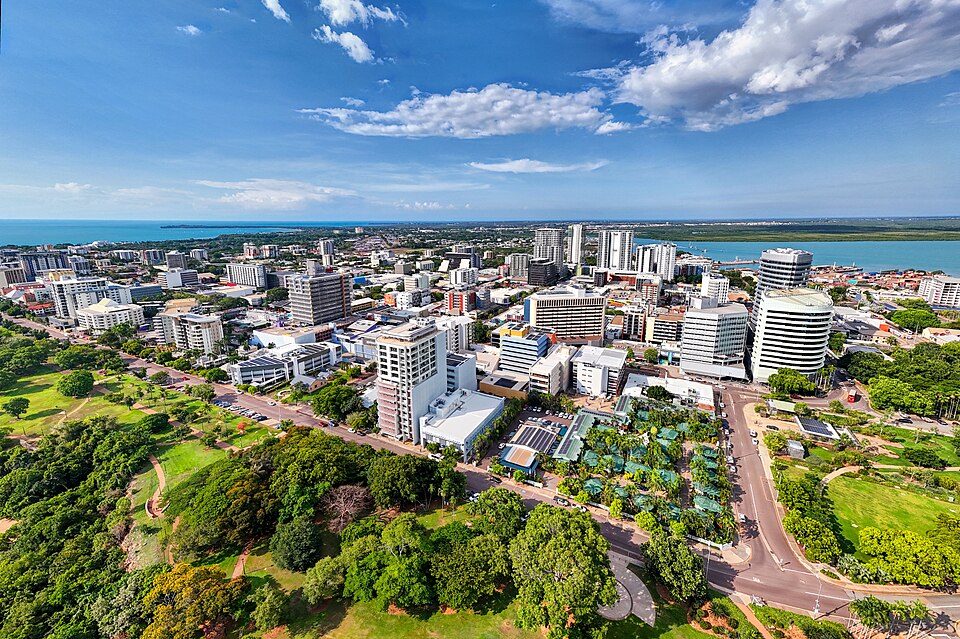
Darwin, NT, Australia: Submarine Cable Landing Point
Darwin is the capital city of Australia's Northern Territory, situated on the country's northern coastline facing the Timor Sea. As the northernmost of Australia's capital cities, Darwin occupies a geographically distinctive position that places it closer to Southeast Asia than to Australia's more populous eastern and southern cities. Five submarine cables land at Darwin, making it one of Australia's more significant cable landing points and the primary gateway for subsea connectivity along the country's northern coast.
The cables landing at Darwin span a broad range of corridors, from short domestic and near-regional links to some of the longest submarine cable systems in the world. They collectively connect Darwin to destinations across Southeast Asia, the Pacific, the Indian Ocean, and beyond. Among the most notable systems are Project Waterworth, a 50,000 km cable planned to link Australia with Brazil, India, Malaysia, South Africa, and the United States, and the Asia Connect Cable-1 (ACC-1), a 19,000 km system scheduled for readiness in 2028 that connects Darwin to Guam, Indonesia, the Philippines, Singapore, Timor-Leste, and the United States.
Cables Landing at Darwin, NT, Australia
Project Waterworth is a 50,000 km submarine cable system currently at draft stage. In addition to Darwin, it lands in Brazil, India, Malaysia, South Africa, and the United States, establishing one of the longest intercontinental cable routes in existence and linking Australia to both Atlantic-facing economies and the Indian subcontinent.
Asia Connect Cable-1 (ACC-1) is a 19,000 km system with a planned ready-for-service date of 2028. It connects Darwin to Guam, Indonesia, the Philippines, Singapore, Timor-Leste, and the United States, forming a broad intra-Asia-Pacific corridor with onward reach to North America.
Hawaiki Nui 1 is a 10,000 km cable with a planned ready-for-service date of 2027. It connects Darwin to Indonesia, Papua New Guinea, Singapore, Solomon Islands, and Timor-Leste, as well as to another landing point within Australia, providing regional connectivity across the southwest Pacific and into Southeast Asia.
North-West Cable System is a 2,100 km domestic cable that reached service in 2016. It connects Darwin to other landing points within Australia, supporting intra-national submarine connectivity along the country's northwestern coast.
Bosun is a cable with a planned ready-for-service date of 2027 that connects Darwin to Christmas Island, providing a dedicated subsea link between the Northern Territory and the Australian external territory located in the Indian Ocean.
Regional Context
Among Australia's 27 submarine cable landing points, Darwin ranks in the top tier by cable count, hosting five systems alongside Sydney's ten and matching Perth's five. While Sydney and its surrounding New South Wales landing points handle the greatest concentration of Australia's submarine cable traffic, Darwin's northern position gives it a distinct role serving corridors that other Australian landing points do not cover. Its combination of domestic, near-regional, and intercontinental cables places it as Australia's leading northern gateway.
Network Role
Darwin functions as a multi-cable hub rather than a single-cable terminus, terminating systems that collectively span domestic, regional, and intercontinental corridors. The domestic North-West Cable System and the short Bosun link to Christmas Island anchor Darwin's near-proximity role, while ACC-1 and Hawaiki Nui 1 extend its reach across Southeast Asia and the southwest Pacific. Project Waterworth, once operational, would extend Darwin's connectivity across the Indian Ocean and Atlantic-facing regions, connecting it to South America and Africa for the first time via a direct subsea route.
Darwin's position in the Australian submarine cable graph is defined by its northward orientation: it is the landing point through which Australia's cable network most directly interfaces with Southeast Asia, Timor-Leste, and onward routes to the Pacific and Indian Ocean regions.
What next: Darwin, NT, Australia in the global directory of cable landing points; see surrounding routes on the interactive submarine cable map or follow live network monitoring.
Incident history
Significant incidents on cables landing here, each with its own report.
- Bosun cable: latency up to 2.3× normal, 5 Sep 2026 (resolved)
- North-West Cable System: latency up to 2× normal, 5 Sep 2026 (resolved)
Other Landing Points in Australia
FAQ
Landing Point
- CountryAU Australia
- Coordinates12.4675°S 130.8431°E
- Connected Cables5
See Real Cable Routes
View actual submarine cable routing from Darwin, NT, Australia - with backbone nodes, distance calculations, and latency estimates
Open Calculator →