Busan, South Korea
Landing Point · KR South Korea
Connected Cables
| Cable | Status |
|---|---|
| APCN-2 | Active |
| Asia Pacific Gateway (APG) | Active |
| E2A | Planned |
| EAC-C2C | Active |
| FLAG North Asia Loop/REACH North Asia Loop | Active |
| I-AM Cable | Planned |
| JAKO | Planned |
| Korea-Japan Cable Network (KJCN) | Active |
| New Cross Pacific (NCP) Cable System | Active |
| Southeast Asia-Japan Cable 2 (SJC2) | Active |
Live Performance
RTT measurements to this landing point from 2026-03-03 through 2026-09-26 - live ICMP round-trip time via our monitoring probes. Recomputed daily. ✓ No anomalies detected in the monitored period.
Measurement sources
| Probe | Location | Samples | Avg |
|---|---|---|---|
| #34380 | control probe | 71 | 21.2 ms |
| own probe | Almaty KZ | 41 | 272.8 ms |
| #6410 own probe | Sao Paulo BR | 33 | 284.0 ms |
| #6487 | control probe | 29 | 60.9 ms |
| #11982 | control probe | 21 | 63.2 ms |
| own probe | Moscow RU | 12 | 195.3 ms |
| own probe | Tbilisi GE | 11 | 313.9 ms |
| own probe | Minsk BY | 10 | 200.8 ms |
| own probe | Jerusalem IL | 9 | 310.9 ms |
| #7062 own probe | Cape Town ZA | 3 | 327.3 ms |
| own probe | Sevastopol UA | 3 | 235.7 ms |
| #13819 | control probe | 2 | 50.9 ms |
| #64216 | control probe | 2 | 3.7 ms |
| #20822 | control probe | 1 | 3.2 ms |
| #50802 | control probe | 1 | 9.6 ms |
| #1017752 | control probe | 1 | 2.5 ms |
About Busan, South Korea
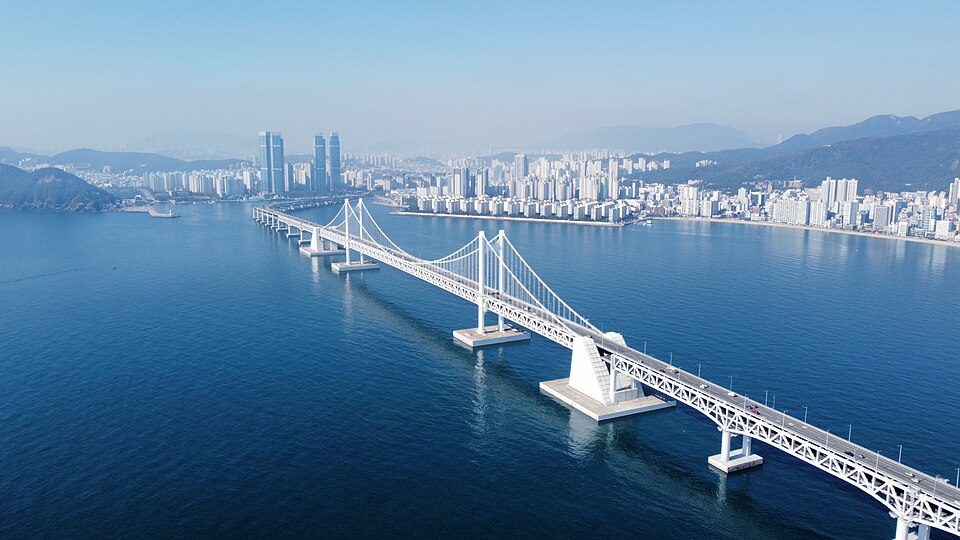
Busan, South Korea is a submarine cable landing point in South Korea (coordinates 35.1701°, 128.9993°). It serves 10 submarine cable systems, making it a major regional hub in South Korea's international connectivity infrastructure.
Busan, officially Busan Metropolitan City, is the second most populous city in South Korea, after Seoul; it has a population of over 3.3 million as of 2024. Alternatively romanized as Pusan, it is the economic, cultural and educational center of southeastern South Korea, with its port being South Korea's busiest and the sixth-busiest in the world. The surrounding "Southeastern Maritime Industrial Region" is South Korea's largest industrial area. The large volumes of port traffic and urban population in excess of 1 million makes Busan a Large-Port metropolis using the Southampton System of Port-City classification. As of 2025, Busan Port is the primary port in Korea and the world's sixth-largest container port. Wikipedia
Connected submarine cables
| Cable | RFS | Length | Owners |
|---|---|---|---|
| E2A | 2029 | 12,500 km | Chunghwa Telecom, SK Broadband, Softbank, … |
| I-AM Cable | 2029 | 8,100 km | Intra‑Asia Marine Networks Co., Ltd. |
| JAKO | 2027 | 260 km | Amazon Web Services, Arteria, Dreamline, … |
| Southeast Asia-Japan Cable 2 (SJC2) | 2025 | 10,500 km | China Mobile, Chunghwa Telecom, DongHwa Telecom, … |
| New Cross Pacific (NCP) Cable System | 2018 | 13,618 km | China Mobile, China Telecom, China Unicom, … |
| Asia Pacific Gateway (APG) | 2016 | 10,400 km | China Mobile, China Telecom, China Unicom, … |
| EAC-C2C | 2002 | 36,500 km | Telstra |
| Korea-Japan Cable Network (KJCN) | 2002 | 500 km | KT, NTT, QTNet, … |
| APCN-2 | 2001 | 19,000 km | AT&T, BT, China Telecom, … |
| FLAG North Asia Loop/REACH North Asia Loop | 2001 | 9,504 km | FLAG, PCCW, Telstra |
Operators landing at Busan, South Korea
Cables landing at Busan, South Korea are operated by 40 distinct consortium partners and carriers, including AT&T, Amazon Web Services, Arteria, BT, China Mobile, China Telecom, China Unicom, Chunghwa Telecom, DongHwa Telecom, Dreamline, and 30 others. Each cable is typically jointly owned by a consortium of tier-one carriers and hyperscale operators who share construction costs and capacity; the operator mix reflects both regional incumbents and global players with interest in the routes served by this landing point.
Connectivity profile
From Busan, South Korea, international traffic can reach 10 countries through 10 cable systems. Destinations include China, Japan, Malaysia, Philippines, Singapore, South Korea, Taiwan, Thailand and 2 more. With multiple redundant paths, traffic at this landing point can reroute through alternative cables if any single system experiences an outage.
Monitoring status
GeoCables recorded 2 monitoring events on cables serving Busan, South Korea in the past 90 days. Our monitoring network continuously samples latency from external probes to targets reachable via these cables.
About the cables
- E2A (2029) - E2A is a cross-regional submarine cable connecting South Korea, Japan, United States, Taiwan. Its 6 landing points at Busan, Itoshima, Maruyama, Morro Bay, Tomakomai, and 1 more bridge the networks of East Asia, North America, providing an important path for international data traffic. Read more →
- I-AM Cable (2029) - I-AM Cable is a cross-regional submarine cable connecting South Korea, Singapore, Japan, Malaysia. Its 6 landing points at Busan, Changi, Fukuoka, Minamiboso, Sedili, and 1 more bridge the networks of East Asia, Southeast Asia, providing an important path for international data traffic. Read more →
- JAKO (2027) - JAKO is a point-to-point submarine cable linking South Korea and Japan. Landing at Busan, Fukuoka, it provides a direct fiber-optic path between the two countries, serving as both a primary data route and a redundancy option for neighboring cable systems. Read more →
- Southeast Asia-Japan Cable 2 (SJC2) (2025) - Southeast Asia Japan Cable 2 (SJC2) is a submarine cable ready for service in 2025, connecting ten landing stations across eight jurisdictions in East and Southeast Asia: Busan in South Korea, Chikura and Shima in Japan, Fangshan and Tanshui in Taiwan, Chung Hom Kok in Hong Kong, Lingang in mainland China, Quy Nhon in Vietnam, Songkhla in Thailand, and Changi South in Singapore. Read more →
- New Cross Pacific (NCP) Cable System (2018) - New Cross Pacific (NCP) Cable System is an intercontinental submarine cable system connecting East Asia and North America, with 7 landing points across 5 countries including Busan, South Korea, Chongming, China, Lingang, China, Maruyama, Japan and others. The cable provides cross-continental connectivity, offering an important route for data traffic between East Asia and North America. Read more →
- Asia Pacific Gateway (APG) (2016) - Asia Pacific Gateway (APG) is a 10,400-kilometre submarine cable system that connects eight East and Southeast Asian countries. It entered service in 2016 and today links eleven landing stations across mainland China, Hong Kong, Japan, South Korea, Taiwan, Malaysia, Singapore, Thailand, and Vietnam. Read more →
- EAC-C2C (2002) - EAC-C2C is a 36,500 km submarine cable system forming a ring around East Asia, with sixteen landing stations across seven countries and territories: Japan, South Korea, China, Taiwan, Hong Kong, the Philippines, and Singapore. Read more →
- Korea-Japan Cable Network (KJCN) (2002) - Korea-Japan Cable Network (KJCN) is a point-to-point submarine cable linking South Korea and Japan. Landing at Busan, Fukuoka, Kitakyushu, it provides a direct fiber-optic path between the two countries, serving as both a primary data route and a redundancy option for neighboring cable systems. Read more →
- APCN-2 (2001) - Asia Pacific Cable Network 2 (APCN-2) is a 19,000 km submarine cable commissioned in December 2001, forming a ring around East and Southeast Asia. It has ten landing stations across seven countries and territories: Katong in Singapore, Cherating in Malaysia, Batangas in the Philippines, Lantau Island in Hong Kong, Shantou and Chongming in mainland China, Tanshui in Taiwan, Chikura and Kitaibaraki Read more →
- FLAG North Asia Loop/REACH North Asia Loop (2001) - FLAG North Asia Loop (FLAG-NAL), also known as REACH North Asia Loop, is a 9,504 km submarine cable that has been connecting the major East Asian telecom hubs since 2001. Its four landings form a loop around the North Asian maritime region: Tong Fuk in Hong Kong, Toucheng in Taiwan, Busan in South Korea, and Wada in Japan. Read more →
What next: Busan, South Korea in the global directory of cable landing points; see surrounding routes on the interactive submarine cable map or follow live network monitoring.
Incident history
Significant incidents on cables landing here, each with its own report.
- New Cross Pacific (NCP) Cable System: latency up to 2.7× normal, 17 Aug 2026 (resolved)
- Asia Pacific Gateway (APG) cable: latency up to 2.3× normal, 17 Apr 2026 (resolved)
- Asia Pacific Gateway (APG) cable: latency up to 2.5× normal, 17 Apr 2026 (resolved)
Other Landing Points in South Korea
FAQ
Landing Point
- CountryKR South Korea
- Coordinates35.1701°N 128.9993°E
- Connected Cables10
See Real Cable Routes
View actual submarine cable routing from Busan, South Korea - with backbone nodes, distance calculations, and latency estimates
Open Calculator →