Qalhat, Oman
Landing Point · OM Oman
Connected Cables
| Cable | Status |
|---|---|
| SeaMeWe-5 | Active |
| Tata TGN-Gulf | Active |
Live Performance
RTT measurements to this landing point from 2026-03-06 through 2026-10-04 - live ICMP round-trip time via our monitoring probes. Recomputed daily. ✓ No anomalies detected in the monitored period.
Measurement sources
| Probe | Location | Samples | Avg |
|---|---|---|---|
| #55079 | control probe | 38 | 202.2 ms |
| own probe | Tbilisi GE | 7 | 211.0 ms |
| own probe | Jerusalem IL | 7 | 163.0 ms |
| #6410 own probe | Sao Paulo BR | 5 | 299.6 ms |
| #6427 own probe | Sydney AU | 5 | 486.5 ms |
| own probe | Balancer IL | 4 | 160.9 ms |
| #6944 | control probe | 3 | 8.3 ms |
| #65614 | control probe | 3 | 9.1 ms |
| own probe | Almaty KZ | 3 | 201.4 ms |
| #1015229 | control probe | 3 | 3.4 ms |
| own probe | Minsk BY | 2 | 159.8 ms |
About Qalhat, Oman
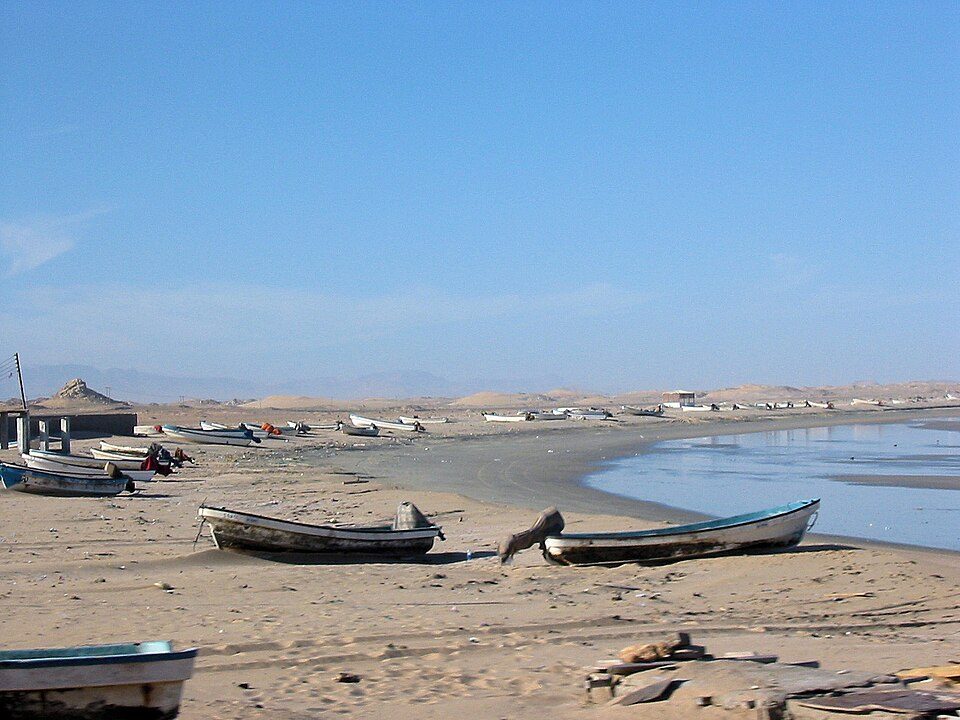
Qalhat, Oman: Submarine Cable Landing Point
Qalhat is a coastal village in Oman, situated more than 20 kilometres north of Sur on the country's eastern seaboard. As a submarine cable landing point, Qalhat connects Oman to two distinct cable systems, one oriented toward the Gulf region and one spanning intercontinental distances between Southeast Asia and Western Europe. Together, these two cables make Qalhat a point where both regional Gulf connectivity and long-haul international routing converge on Omani shores.
The two cables landing at Qalhat serve markedly different geographic corridors. SeaMeWe-5 extends Qalhat's reach across the Indian Ocean and beyond, linking Oman to countries including Bangladesh, Indonesia, Djibouti, Egypt, Italy, and France. The Tata TGN-Gulf system, by contrast, connects Qalhat to its immediate Gulf neighbourhood, reaching Bahrain, Qatar, Saudi Arabia, and the United Arab Emirates. The combination positions Qalhat as both a gateway to the broader Indo-European cable corridor and a node in the Arabian Gulf's regional mesh.
Cables Landing at Qalhat
SeaMeWe-5 is a 20,000-kilometre submarine cable system that reached ready-for-service status in 2016. In addition to Qalhat, the cable connects landing points in Bangladesh, Djibouti, Egypt, France, Indonesia, and Italy, spanning the route from Southeast Asia through the Indian Ocean, the Red Sea, and onward into the Mediterranean to Western Europe. The cable's length and the range of countries it serves place it firmly in the intercontinental category.
Tata TGN-Gulf is a 4,031-kilometre cable system that became ready for service in 2012. The cable links Qalhat to Bahrain, Qatar, Saudi Arabia, and the United Arab Emirates, forming a ring or mesh across the Arabian Gulf. Its shorter length reflects its regional scope, serving intra-Gulf connectivity among some of the Arabian Peninsula's most active economies.
Regional Context
Within Oman's submarine cable infrastructure - which encompasses 19 cables across eight landing points - Qalhat sits in the middle of the national hierarchy by cable count. Barka leads with eight cables, followed by Al Seeb and Salalah with six each, while Qalhat shares its two-cable count with Khasab and Muscat, with only Al Bustan hosting fewer. Qalhat's two cables nonetheless span a notably broad geographic range, combining intercontinental and Gulf-regional reach within a single landing point.
Network Role
Qalhat functions as a dual-corridor landing point: one cable extends eastward toward South and Southeast Asia and westward through the Red Sea toward Europe, while the other traces a tighter arc around the Arabian Gulf. This means that Qalhat is not a single-purpose terminus but a location where two logistically distinct cable architectures - one intercontinental, one regional - share an Omani landfall. The SeaMeWe-5 system provides Qalhat with one of its longest cable connections among all Omani landing points, while Tata TGN-Gulf anchors Qalhat firmly within Gulf-regional routing.
In the broader Omani submarine cable graph, Qalhat's pairing of a long-haul system with a Gulf-ring cable gives it a connectivity profile that spans geographic scales few two-cable landing points can claim.
What next: Qalhat, Oman in the global directory of cable landing points; see surrounding routes on the interactive submarine cable map or follow live network monitoring.
Incident history
Significant incidents on cables landing here, each with its own report.
- Tata TGN-Gulf cable: latency up to 2.2× normal, 2 Sep 2026 (resolved)
- SeaMeWe-5 cable: latency up to 2.2× normal, 31 Jul 2026 (resolved)
Other Landing Points in Oman
Landing Point
- CountryOM Oman
- Coordinates22.7000°N 59.3667°E
- Connected Cables2
See Real Cable Routes
View actual submarine cable routing from Qalhat, Oman - with backbone nodes, distance calculations, and latency estimates
Open Calculator →