Khasab, Oman
Landing Point · OM Oman
Connected Cables
| Cable | Status |
|---|---|
| FALCON | Active |
| OMRAN/EPEG | Active |
Live Performance
RTT measurements to this landing point from 2026-03-06 through 2026-08-31 - live ICMP round-trip time via our monitoring probes. Recomputed daily. ✓ No anomalies detected in the monitored period.
Measurement sources
| Probe | Location | Samples | Avg |
|---|---|---|---|
| #65614 | control probe | 35 | 53.1 ms |
| own probe | Tbilisi GE | 6 | 210.7 ms |
| own probe | Jerusalem IL | 5 | 167.1 ms |
| #6410 own probe | Sao Paulo BR | 4 | 303.4 ms |
| #6427 own probe | Sydney AU | 4 | 167.9 ms |
| own probe | Balancer IL | 4 | 161.5 ms |
| own probe | Minsk BY | 3 | 156.4 ms |
| own probe | Almaty KZ | 3 | 200.7 ms |
| own probe | Moscow RU | 1 | 154.6 ms |
About Khasab, Oman
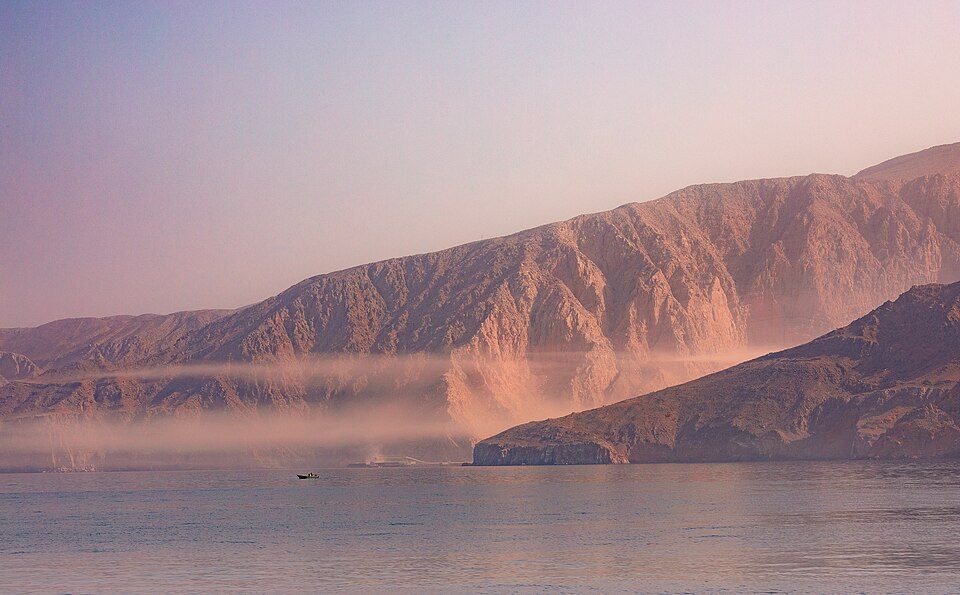
Khasab, Oman: Submarine Cable Landing Point
Khasab is the capital of the Musandam Governorate, an exclave of Oman situated at the tip of the Musandam Peninsula, bordering the United Arab Emirates near the Strait of Hormuz. Its coastal position along one of the world's most strategically active waterways makes it a natural site for submarine cable infrastructure. Two submarine cables land at Khasab, connecting Oman to a range of countries across the Gulf region, the Middle East, and South Asia.
The two cables landing at Khasab serve distinct corridors. The first, FALCON, is a long-haul system spanning 10,300 km that links Khasab to Bahrain, Egypt, India, Iran, Iraq, and Kuwait, establishing an intercontinental arc stretching from the Gulf of Oman through the Persian Gulf and toward the Red Sea and Indian subcontinent. The second, OMRAN/EPEG, is a shorter regional system of 600 km connecting Oman directly to Iran, reinforcing the bilateral connectivity across the Strait of Hormuz. Together, these two systems give Khasab a dual role as both a regional Gulf hub and a node on a broader intercontinental route.
Cables Landing at Khasab, Oman
FALCON is a submarine cable system measuring 10,300 km in length, which reached ready-for-service status in 2006. In addition to Khasab, Oman, FALCON connects Bahrain, Egypt, India, Iran, Iraq, and Kuwait. This makes it a wide-reaching system spanning both the Persian Gulf and the broader Gulf of Oman corridor, linking Gulf states to South Asia and the Red Sea region in a single cable network.
OMRAN/EPEG is a shorter submarine cable system of 600 km, which reached ready-for-service status in 2013. The cable connects Khasab, Oman to Iran, providing a direct cross-strait link between the two countries across the Strait of Hormuz. As a regional system, it complements the longer FALCON route by offering a dedicated bilateral connection at considerably shorter distance.
Regional Context
Within Oman's submarine cable infrastructure - which spans 19 cables across 8 landing points - Khasab ranks in the middle tier by cable count, hosting 2 cables. It sits alongside Muscat and Qalhat, which also host 2 cables each, while larger hubs such as Barka (8 cables), Al Seeb (6 cables), and Salalah (6 cables) account for the majority of Oman's cable capacity. Khasab's geographic position in the Musandam exclave distinguishes it from other Omani landing points through its direct proximity to the Strait of Hormuz and Iran.
Network Role
Khasab functions as a two-cable landing point serving two complementary connectivity roles. Through FALCON, it participates in an intercontinental system connecting the Gulf states, South Asia, and the Red Sea region, linking six countries across a 10,300 km route. Through OMRAN/EPEG, it maintains a shorter, direct cross-strait connection to Iran, covering 600 km. This pairing means Khasab supports both long-haul international routing and near-regional bilateral connectivity from the same coastal location.
In the wider Omani and Gulf submarine cable graph, Khasab's position at the Musandam Peninsula places it as the northernmost Omani landing point, the one closest to the Persian Gulf's entrance. Its role as the terminus of FALCON's Gulf segment and as one endpoint of OMRAN/EPEG gives the Musandam Governorate a distinct presence in the regional cable map that no other Omani landing point, given their southern and eastern coastal positions, is geographically positioned to replicate.
What next: Khasab, Oman in the global directory of cable landing points; see surrounding routes on the interactive submarine cable map or follow live network monitoring.
Incident history
Significant incidents on cables landing here, each with its own report.
Other Landing Points in Oman
Landing Point
- CountryOM Oman
- Coordinates26.1813°N 56.2468°E
- Connected Cables2
See Real Cable Routes
View actual submarine cable routing from Khasab, Oman - with backbone nodes, distance calculations, and latency estimates
Open Calculator →