Lowestoft, United Kingdom
Landing Point · GB United Kingdom
Connected Cables
| Cable | Status |
|---|---|
| Circe North | Active |
| IOEMA | Planned |
| Scylla | Active |
| Tampnet South | Active |
| Ulysses 2 | Active |
| Zeus | Active |
Live Performance
RTT measurements to this landing point from 2026-04-11 through 2026-10-13 - live ICMP round-trip time via our monitoring probes. Recomputed daily. ✓ No anomalies detected in the monitored period.
Measurement sources
| Probe | Location | Samples | Avg |
|---|---|---|---|
| #13081 | control probe | 88 | 33.3 ms |
| own probe | Minsk BY | 78 | 74.4 ms |
| #6427 own probe | Sydney AU | 77 | 279.1 ms |
| own probe | Moscow RU | 43 | 50.9 ms |
| #37 | control probe | 41 | 38.0 ms |
| own probe | Kyiv UA | 27 | 41.8 ms |
| #21552 | control probe | 25 | 29.6 ms |
| #3 | control probe | 12 | 36.3 ms |
| own probe | Saint Petersburg RU | 9 | 41.8 ms |
| #18 | control probe | 1 | 17.0 ms |
| own probe | Almaty KZ | 1 | 98.6 ms |
| own probe | Tbilisi GE | 1 | 71.5 ms |
| own probe | Jerusalem IL | 1 | 69.8 ms |
About Lowestoft, United Kingdom
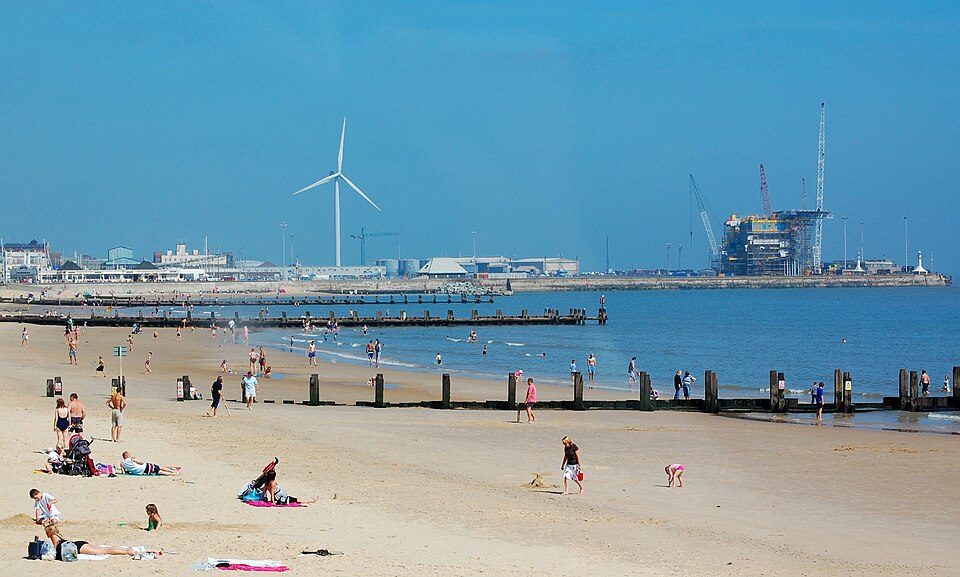
Lowestoft, United Kingdom: Submarine Cable Landing Point
Lowestoft is a coastal town in East Suffolk, England, positioned as the most easterly settlement in the United Kingdom. Its location on the North Sea coast places it naturally along the short-distance cable corridors connecting Britain to continental Europe, particularly the Netherlands, as well as longer routes reaching into Scandinavia. Six submarine cables land at Lowestoft, making it one of the more active landing points in the United Kingdom by cable count.
The cables landing here span a range of eras and purposes, from the late 1990s systems connecting to the Netherlands and Norway, to newer cables commissioned in the 2020s. The most geographically extensive cable landing at Lowestoft is Tampnet South, which runs 1,751 km to Norway, while the forthcoming IOEMA system will link the location into a broader North Sea network spanning Denmark, Germany, the Netherlands, and Norway. Together, these cables establish Lowestoft as a node in both bilateral North Sea routes and a wider multi-country European corridor.
Cables Landing at Lowestoft
Tampnet South is a 1,751 km cable with a ready-for-service year of 1999, connecting Lowestoft to Norway. It represents the longest route among the cables landing at this location and extends Lowestoft's reach into the northern North Sea.
IOEMA is a 1,620 km cable with a projected ready-for-service year of 2028. It connects the United Kingdom - including Lowestoft - with Denmark, Germany, the Netherlands, and Norway, forming a multi-country North Sea ring or corridor across several major European cable markets.
Scylla is a 204 km cable that became ready for service in 2021, linking Lowestoft to the Netherlands. Its relatively short length reflects the direct cross-North Sea geometry between the English east coast and the Dutch coast.
Circe North is a 203 km cable with a ready-for-service year of 1999, also connecting Lowestoft to the Netherlands. It is one of the earlier cables at this landing point and mirrors the route geometry of Scylla.
Ulysses 2 became ready for service in 1997 and connects Lowestoft to the Netherlands. It is among the earliest cables at this landing point, predating the later generation of North Sea systems.
Zeus became ready for service in 2022 and connects Lowestoft to the Netherlands. It is the most recently commissioned operational cable at this landing point, continuing the established pattern of direct links between Lowestoft and the Dutch coast.
Regional Context
Among United Kingdom landing points, Lowestoft's six cables place it in the top tier by volume, ahead of peers such as Broadstairs, Porthcurno, Southport, and Dumpton Gap, and on par with or exceeding Blackpool's four cables, though below Bude's eight cables. Its concentration of North Sea routes gives it a distinct character compared to Atlantic-facing landing points such as Bude or Porthcurno.
Network Role
Lowestoft functions as a multi-cable hub rather than a single-cable terminus, hosting six cables that collectively connect the United Kingdom to the Netherlands, Norway, Denmark, and Germany. Four of its six cables terminate in the Netherlands alone, establishing a dense bilateral link between the English east coast and continental Europe across the southern North Sea. The addition of IOEMA, expected in 2028, will extend this network to include Denmark and Germany within a single system.
This concentration of North Sea cables at a single east-coast location gives Lowestoft a measurable role in the broader European submarine cable graph, where geographic proximity between the UK and the Low Countries supports multiple independent cable systems along similar corridors.
What next: Lowestoft, United Kingdom in the global directory of cable landing points; see surrounding routes on the interactive submarine cable map or follow live network monitoring.
Our measurements to Lowestoft
Traceroutes from our own measurement points over the last 30 days: usual delay and number of network hops on the way to Lowestoft.
- From RIPE Atlas probes: 37 ms, 9 hops, 40 traces
Last trace: 2026-10-16. Live network map
Other Landing Points in United Kingdom
FAQ
Landing Point
- CountryGB United Kingdom
- Coordinates52.4714°N 1.7292°E
- Connected Cables6
See Real Cable Routes
View actual submarine cable routing from Lowestoft, United Kingdom - with backbone nodes, distance calculations, and latency estimates
Open Calculator →