Lae, Papua New Guinea
Landing Point · PG Papua New Guinea
Connected Cables
| Cable | Status |
|---|---|
| Kumul Domestic Submarine Cable System | Active |
Live Performance
RTT measurements to this landing point from 2026-04-08 through 2026-09-27 - live ICMP round-trip time via our monitoring probes. Recomputed daily. ✓ No anomalies detected in the monitored period.
Measurement sources
| Probe | Location | Samples | Avg |
|---|---|---|---|
| own probe | Almaty KZ | 9 | 224.2 ms |
| own probe | Minsk BY | 6 | 195.2 ms |
| own probe | Tbilisi GE | 6 | 230.5 ms |
| own probe | Jerusalem IL | 6 | 252.6 ms |
| own probe | Moscow RU | 4 | 163.2 ms |
| #6410 own probe | Sao Paulo BR | 3 | 383.1 ms |
| #6427 own probe | Sydney AU | 3 | 354.5 ms |
| #7062 own probe | Cape Town ZA | 3 | 319.4 ms |
| #50365 | control probe | 3 | 350.9 ms |
| #6487 | control probe | 2 | 152.7 ms |
| own probe | Sevastopol UA | 2 | 213.4 ms |
| own probe | Saint Petersburg RU | 2 | 255.3 ms |
About Lae, Papua New Guinea
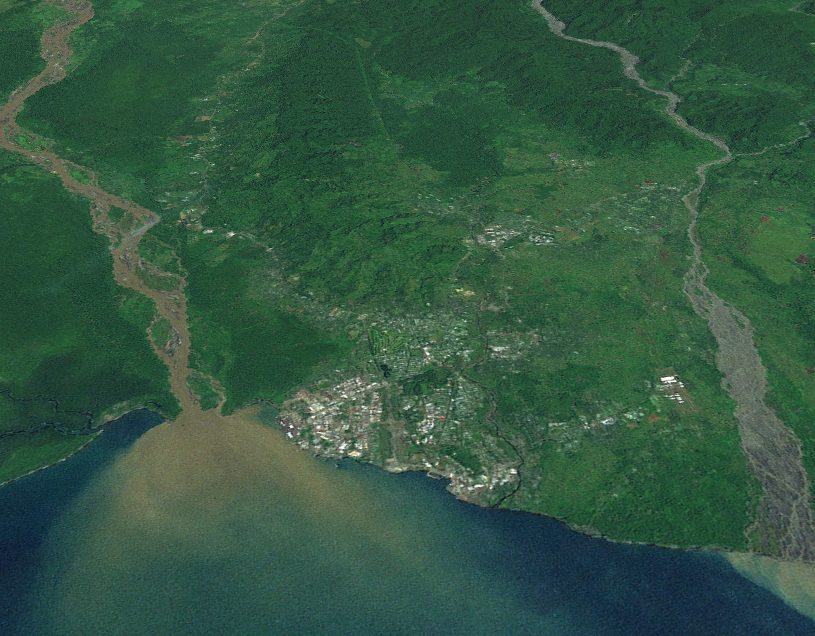
Lae: Submarine Cable Landing Point
Lae is the capital of Morobe Province and the second-largest city in Papua New Guinea, situated near the delta of the Markham River on the northern coast of Huon Gulf. As the country's largest cargo port and primary industrial centre, Lae occupies a significant position on Papua New Guinea's northern coastline. One submarine cable lands at Lae, connecting the city to the broader domestic and regional submarine cable network.
That cable, the Kumul Domestic Submarine Cable System, links Lae to other points within Papua New Guinea and extends to Indonesia, establishing a corridor that spans both domestic inter-island connectivity and a cross-border link between Papua New Guinea and its western neighbour. This places Lae within an intra-national and regional network rather than a purely intercontinental one.
Cables Landing at Lae
The Kumul Domestic Submarine Cable System is the sole submarine cable serving Lae. With a total length of 5,457 kilometres, the system reached ready-for-service status in 2019 and remains listed at draft status. Beyond Lae, the cable connects other landing points within Papua New Guinea and extends to Indonesia, making it a system designed primarily to improve domestic inter-island connectivity across Papua New Guinea while also providing a link to Indonesian territory. The cable's considerable length reflects the dispersed geography of Papua New Guinea's islands and its reach toward the Indonesian archipelago.
Regional Context
Within Papua New Guinea, Lae is one of fifteen submarine cable landing points, hosting a single cable alongside peers such as Alotau, Arawa, Daru, and Kavieng, each of which also hosts one cable. Madang hosts two cables, while Port Moresby stands as the most connected landing point in the country with four cables. Lae's single-cable status places it in the middle tier of Papua New Guinea's landing point hierarchy, sharing that standing with several other provincial centres across the country.
Network Role
Lae functions as a single-cable terminus within the Kumul Domestic Submarine Cable System, rather than as a multi-cable hub. Its connection through that system ties the city into a network serving multiple Papua New Guinean landing points and reaching into Indonesia, enabling both intra-national communication across geographically separated communities and a cross-border link westward. The cable's 2019 ready-for-service date makes Lae's submarine connectivity relatively recent within Papua New Guinea's cable history, which dates back to 2009.
In the regional submarine cable graph, Lae's role is that of a domestic-oriented node: a major urban and port centre connected through a single long-haul domestic system rather than through multiple competing international routes. Its position as Papua New Guinea's second-largest city and primary cargo port, served by one cable shared with several other national and Indonesian endpoints, underscores the relatively early stage of submarine cable diversification across Papua New Guinea's provincial landing points.
What next: Lae, Papua New Guinea in the global directory of cable landing points; see surrounding routes on the interactive submarine cable map or follow live network monitoring.
Other Landing Points in Papua New Guinea
Landing Point
- CountryPG Papua New Guinea
- Coordinates6.7428°S 146.9930°E
- Connected Cables1
See Real Cable Routes
View actual submarine cable routing from Lae, Papua New Guinea - with backbone nodes, distance calculations, and latency estimates
Open Calculator →