Katong, Singapore
Landing Point · SG Singapore
Connected Cables
| Cable | Status |
|---|---|
| APCN-2 | Active |
Live Performance
RTT measurements to this landing point from 2026-03-02 through 2026-10-16 - live ICMP round-trip time via our monitoring probes. Recomputed daily.
Measurement sources
| Probe | Location | Samples | Avg |
|---|---|---|---|
| #7433 | control probe | 236 | 105.1 ms |
| own probe | Almaty KZ | 18 | 262.3 ms |
| #6410 own probe | Sao Paulo BR | 15 | 327.8 ms |
| #6487 | control probe | 14 | 1.0 ms |
| #6427 own probe | Sydney AU | 7 | 126.5 ms |
| #7062 own probe | Cape Town ZA | 7 | 311.8 ms |
| own probe | Tbilisi GE | 6 | 315.3 ms |
| own probe | Minsk BY | 4 | 214.5 ms |
| own probe | Jerusalem IL | 3 | 175.5 ms |
| own probe | Moscow RU | 3 | 195.7 ms |
| #4429 | control probe | 2 | 41.1 ms |
| #6676 | control probe | 2 | 1.4 ms |
| #62994 | control probe | 2 | 3.7 ms |
| own probe | Sevastopol UA | 2 | 230.6 ms |
| own probe | Rostov RU | 1 | 232.5 ms |
| own probe | Odessa UA | 1 | 202.1 ms |
| own probe | Balancer IL | 1 | 165.4 ms |
| own probe | Kyiv UA | 1 | 276.3 ms |
About Katong, Singapore
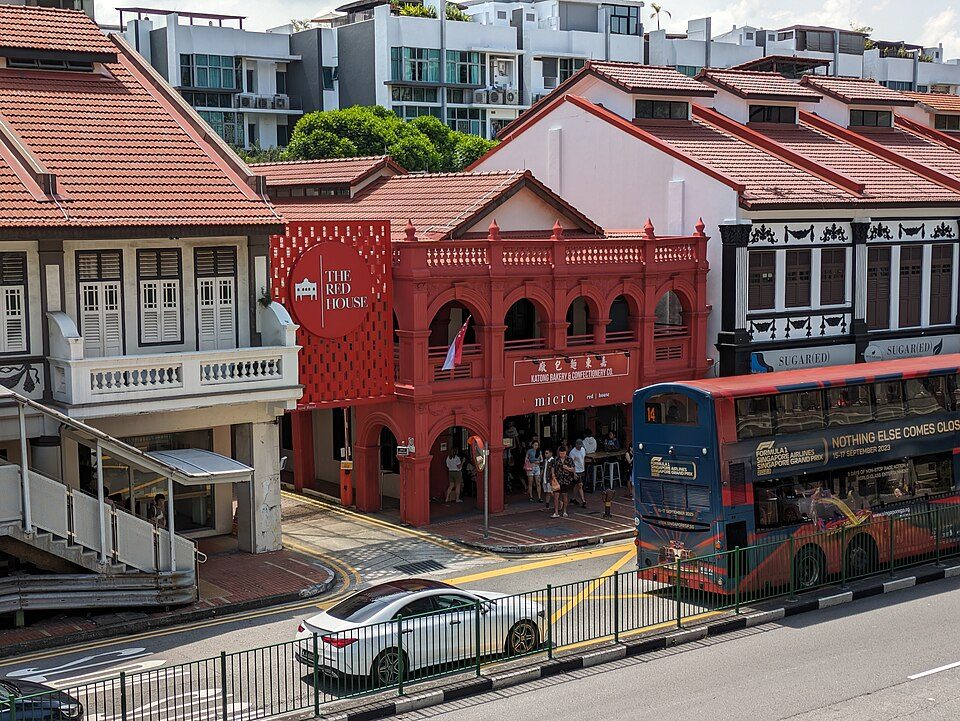
Katong, Singapore: Submarine Cable Landing Point
Katong is a residential neighbourhood in the eastern portion of Singapore's Central Region, situated within the Marine Parade planning area and stretching from the Fort Road area to the Joo Chiat area. Although land reclamation projects carried out from the 1960s to the 1970s extended the coastline southward toward East Coast Park, Katong retains its connection to Singapore's maritime geography as a submarine cable landing point. One submarine cable makes landfall here, linking Singapore to a network of East and Southeast Asian economies across the western Pacific.
That cable is APCN-2, a major intra-Asian system that connects Singapore to China, Japan, Malaysia, the Philippines, South Korea, and Taiwan. Its presence at Katong places this neighbourhood within a corridor that spans both Southeast Asia and Northeast Asia, enabling direct submarine connectivity between Singapore and some of the region's largest digital economies. For a relatively compact residential district, Katong's role in the submarine cable graph is firmly regional and intercontinental in character.
Cables Landing at Katong, Singapore
APCN-2 (Asia Pacific Cable Network 2) is a submarine cable system with a total length of 19,000 km, ready for service in 2001. The cable connects Singapore with China, Japan, Malaysia, the Philippines, South Korea, and Taiwan, forming a ring-like network across the western Pacific. At 19,000 km, APCN-2 is significantly longer than the average cable landing in Singapore, which stands at approximately 9,192 km, reflecting the system's broad geographic reach across multiple East and Southeast Asian nations.
Regional Context
Within Singapore's submarine cable infrastructure, Katong is one of eight landing points sharing a total of 44 cables. The country's busiest landing points - Tuas with 16 cables and Changi North with 11 - handle the bulk of Singapore's submarine cable traffic, while Changi, Changi South, and Tanah Merah host between four and six cables each. Katong, hosting a single cable, ranks alongside Sakra Island at the lower end of the distribution by cable count, though it nonetheless participates in the national network that has been active since 2001.
Network Role
Katong functions as a single-cable terminus within Singapore's broader submarine cable ecosystem. Through APCN-2, it provides direct submarine connectivity linking Singapore to six other Asian nations - spanning Southeast Asia via Malaysia and the Philippines, and reaching into Northeast Asia through China, Japan, South Korea, and Taiwan. This positions Katong as a contributor to the trans-Asian submarine corridor that ties together the region's principal digital economies along the western Pacific rim.
As a single-cable landing point in a country where multi-cable hubs dominate, Katong represents a specialised node rather than a central aggregation point. Its value within the regional submarine cable graph lies in the geographic reach that APCN-2 provides, extending Singapore's direct submarine connections northward through the South China Sea and onward into the East China Sea and Sea of Japan.
What next: Katong, Singapore in the global directory of cable landing points; see surrounding routes on the interactive submarine cable map or follow live network monitoring.
Our measurements to Katong
Traceroutes from our own measurement points over the last 30 days: usual delay and number of network hops on the way to Katong.
- From RIPE Atlas probes: 94 ms, 10 hops, 14 traces
Last trace: 2026-10-15. Live network map
Other Landing Points in Singapore
Landing Point
- CountrySG Singapore
- Coordinates1.3093°N 103.9047°E
- Connected Cables1
See Real Cable Routes
View actual submarine cable routing from Katong, Singapore - with backbone nodes, distance calculations, and latency estimates
Open Calculator →