Cabinda, Angola
Landing Point · AO Angola
Connected Cables
| Cable | Status |
|---|---|
| Unitel North Submarine Cable (UNSC) | Active |
Live Performance
RTT measurements to this landing point from 2026-03-08 through 2026-10-16 - live ICMP round-trip time via our monitoring probes. Recomputed daily. ✓ No anomalies detected in the monitored period.
Measurement sources
| Probe | Location | Samples | Avg |
|---|---|---|---|
| own probe | Jerusalem IL | 10 | 82.3 ms |
| #6427 own probe | Sydney AU | 9 | 206.2 ms |
| #7062 own probe | Cape Town ZA | 9 | 142.9 ms |
| own probe | Balancer IL | 7 | 115.3 ms |
| #6487 | control probe | 5 | 49.1 ms |
| #65091 | control probe | 5 | 19.5 ms |
| #60850 | control probe | 4 | 287.1 ms |
| own probe | Almaty KZ | 3 | 86.5 ms |
| #6568 own probe | Singapore SG | 2 | 259.4 ms |
| #60418 | control probe | 2 | 205.4 ms |
| #64655 | control probe | 2 | 267.9 ms |
| #65825 | control probe | 2 | 267.0 ms |
| own probe | Minsk BY | 2 | 2.6 ms |
| own probe | Tbilisi GE | 2 | 25.0 ms |
| own probe | Moscow RU | 2 | 73.2 ms |
| own probe | DVM IL | 2 | 151.4 ms |
About Cabinda, Angola
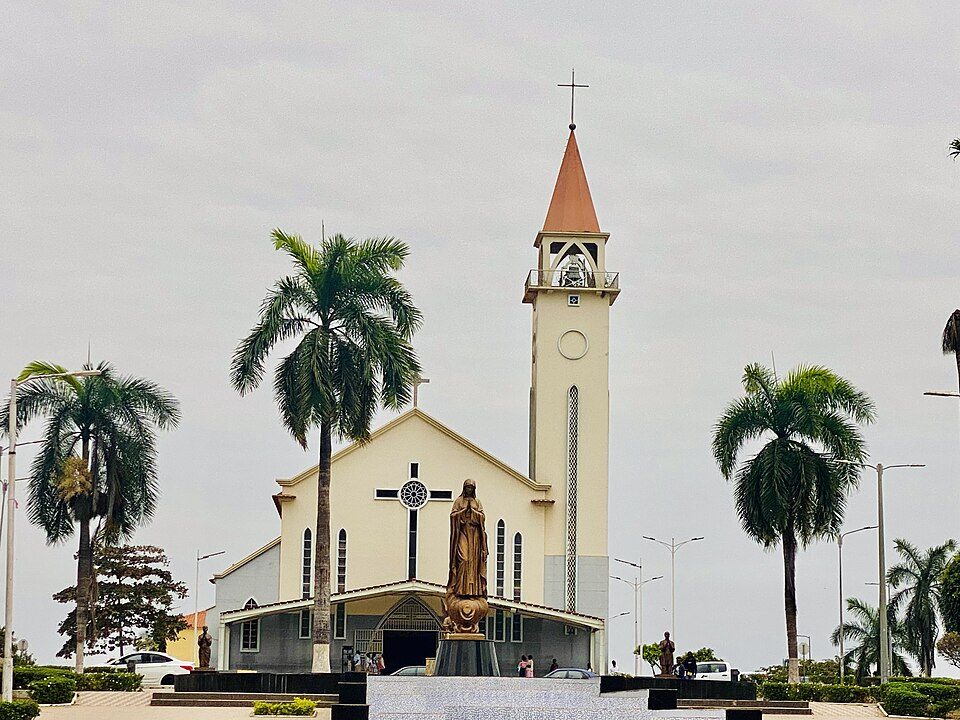
Cabinda, Angola: Submarine Cable Landing Point
Cabinda is a city and municipality located in Cabinda Province, an exclave of Angola situated on the Atlantic coast. As an exclave geographically separated from the main territory of Angola, Cabinda's connection to submarine cable infrastructure carries particular significance for domestic connectivity. One submarine cable lands at Cabinda, linking it directly to the broader Angolan coastal network.
The single cable serving Cabinda is the Unitel North Submarine Cable (UNSC), a domestic Angola-to-Angola route that positions Cabinda within a national submarine network rather than an intercontinental corridor. This makes Cabinda a terminus on an intra-national cable system, enabling direct undersea connectivity between the exclave and other Angolan landing points along the Atlantic coast.
Cables Landing at Cabinda, Angola
The Unitel North Submarine Cable (UNSC) is the sole submarine cable landing at Cabinda. Spanning approximately 1,145 km, the cable reached ready-for-service (RFS) status in 2023, though its status is noted as draft. Both endpoints of the UNSC are located within Angola, making it a purely domestic submarine cable. The cable provides a direct undersea link between Cabinda and other Angolan coastal locations, connecting the province's exclave geography to the rest of the country via a dedicated undersea route.
Regional Context
Angola's submarine cable infrastructure spans seven landing points, with Cabinda hosting one of those connections alongside peers including Sangano, Cacongo, Cacuaco, Luanda, N'zeto, and Soyo. Among these seven landing points, Sangano stands out as the most connected, with two cables landing there. Cabinda, along with Cacongo, Cacuaco, Luanda, N'zeto, and Soyo, each host a single cable, placing Cabinda in the mid-to-lower tier of Angola's landing point network by cable count.
Network Role
Cabinda functions as a single-cable terminus within Angola's domestic submarine cable graph. The UNSC, completed in 2023, provides the exclave with an undersea connection to the Angolan mainland coast, addressing the geographic separation that Cabinda's exclave status creates. Rather than serving as a hub for international or intercontinental traffic, Cabinda's role is focused on intra-national connectivity, ensuring that the province maintains a direct, dedicated undersea link to the rest of the country.
Within Angola's broader submarine cable landscape - where the average cable length across all five cables exceeds 10,000 km - the UNSC's 1,145 km length reflects its domestic, coastal character. The addition of Cabinda to Angola's network of seven landing points reinforces the country's strategy of extending submarine cable access along its Atlantic coastline, including its geographically distinct northern exclave.
What next: Cabinda, Angola in the global directory of cable landing points; see surrounding routes on the interactive submarine cable map or follow live network monitoring.
Other Landing Points in Angola
Landing Point
- CountryAO Angola
- Coordinates5.5565°S 12.1898°E
- Connected Cables1
See Real Cable Routes
View actual submarine cable routing from Cabinda, Angola - with backbone nodes, distance calculations, and latency estimates
Open Calculator →