Salinas, Ecuador
Landing Point · EC Ecuador
Connected Cables
| Cable | Status |
|---|---|
| South Pacific Cable System (SPCS)/Mistral | Active |
Live Performance
RTT measurements to this landing point from 2026-03-23 through 2026-10-16 - live ICMP round-trip time via our monitoring probes. Recomputed daily. ✓ No anomalies detected in the monitored period.
Measurement sources
| Probe | Location | Samples | Avg |
|---|---|---|---|
| own probe | Almaty KZ | 7 | 248.9 ms |
| #7062 own probe | Cape Town ZA | 5 | 350.8 ms |
| #6410 own probe | Sao Paulo BR | 4 | 147.7 ms |
| #6487 | control probe | 4 | 289.7 ms |
| own probe | Minsk BY | 4 | 233.3 ms |
| own probe | Saint Petersburg RU | 3 | 212.0 ms |
| own probe | Tbilisi GE | 2 | 215.8 ms |
| own probe | Jerusalem IL | 2 | 228.9 ms |
| #6568 own probe | Singapore SG | 1 | 318.0 ms |
| #7580 | control probe | 1 | 30.2 ms |
| #54084 | control probe | 1 | 8.9 ms |
| own probe | Sevastopol UA | 1 | 235.6 ms |
About Salinas, Ecuador
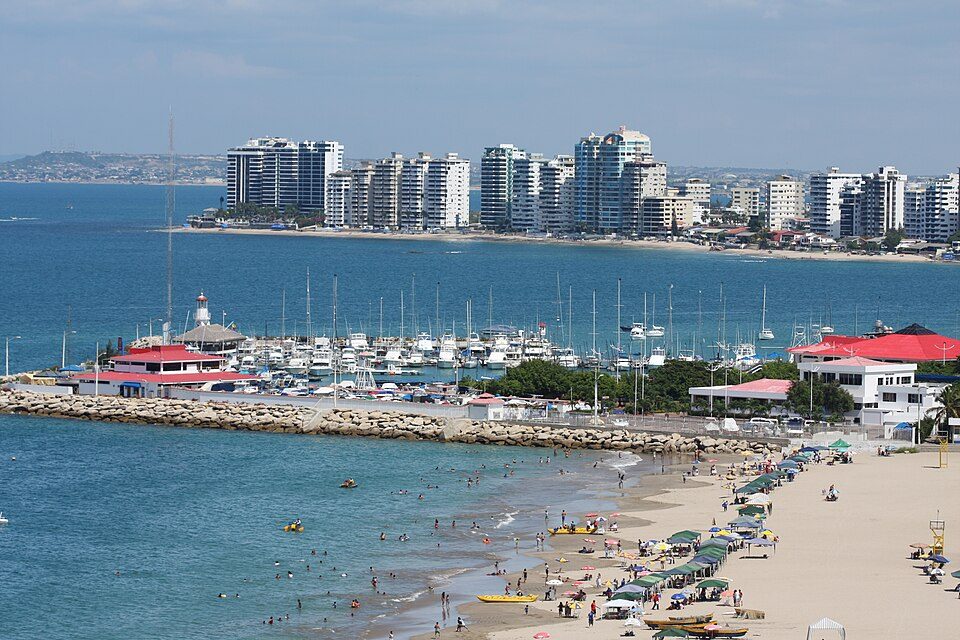
Salinas, Ecuador: Submarine Cable Landing Point
Salinas is a coastal city in the Province of Santa Elena, Ecuador, situated at the westernmost point of mainland Ecuador along the Pacific coast. Its position on the open Pacific makes it a natural terminus for transoceanic submarine cable infrastructure. One submarine cable lands at Salinas, connecting Ecuador into a regional network that spans the western coast of South America and extends northward toward Central America.
The single cable serving Salinas is the South Pacific Cable System (SPCS)/Mistral, which links Ecuador with Chile, Peru, and Guatemala. This system enables connectivity along the Pacific corridor of South America and into Central America, supporting both regional inter-country communications and broader intercontinental routing across the eastern Pacific rim.
Cables Landing at Salinas
The South Pacific Cable System (SPCS)/Mistral is a 7,300-kilometre submarine cable system that entered service in 2021. In addition to Salinas, Ecuador, the cable lands in Chile, Peru, and Guatemala. Its route connects multiple countries along the Pacific coast of South America and Central America, forming a continuous Pacific-facing corridor from the south of the continent northward toward Guatemala. With a ready-for-service date of 2021, it is among the more recently commissioned cable systems serving the region.
Regional Context
Within Ecuador, submarine cable infrastructure is distributed across three landing points. Punta Carnero hosts two cables, making it the most connected landing point in the country, while both Salinas and Ancon each host a single cable. Salinas therefore shares the lower tier of Ecuador's landing point hierarchy by cable count, though its position at the country's westernmost point gives it a distinct geographic footprint on the Pacific coast.
Network Role
Salinas functions as a single-cable terminus within Ecuador's submarine cable network, serving as the national anchor point for the South Pacific Cable System (SPCS)/Mistral. Through this cable, Salinas provides a direct Pacific coastal link connecting Ecuador to Peru and Chile to the south and to Guatemala to the north, enabling routing across multiple national borders along one of the most geographically coherent submarine cable corridors in the western hemisphere.
As a single-cable landing point, Salinas does not operate as a multi-cable hub in the way that Punta Carnero does within Ecuador. Nevertheless, its role as the sole Ecuadorian terminus for a 7,300-kilometre transnational system means it contributes a distinct node to the regional submarine cable graph, extending Ecuador's Pacific connectivity toward Central America through a route not duplicated at any other Ecuadorian landing point.
What next: Salinas, Ecuador in the global directory of cable landing points; see surrounding routes on the interactive submarine cable map or follow live network monitoring.
Other Landing Points in Ecuador
Landing Point
- CountryEC Ecuador
- Coordinates2.2285°S 81.0091°W
- Connected Cables1
See Real Cable Routes
View actual submarine cable routing from Salinas, Ecuador - with backbone nodes, distance calculations, and latency estimates
Open Calculator →