Punta del Este, Uruguay
Landing Point · UY Uruguay
Connected Cables
| Cable | Status |
|---|---|
| Firmina | Active |
Live Performance
RTT measurements to this landing point from 2026-04-10 through 2026-10-08 - live ICMP round-trip time via our monitoring probes. Recomputed daily. ✓ No anomalies detected in the monitored period.
Measurement sources
| Probe | Location | Samples | Avg |
|---|---|---|---|
| own probe | Almaty KZ | 9 | 252.2 ms |
| #6410 own probe | Sao Paulo BR | 8 | 24.2 ms |
| #6427 own probe | Sydney AU | 8 | 316.2 ms |
| #7062 own probe | Cape Town ZA | 8 | 299.5 ms |
| #6487 | control probe | 7 | 301.8 ms |
| own probe | Tbilisi GE | 3 | 269.4 ms |
| own probe | Jerusalem IL | 3 | 217.3 ms |
| own probe | Minsk BY | 2 | 183.1 ms |
| own probe | Moscow RU | 2 | 193.2 ms |
| #6568 own probe | Singapore SG | 1 | 340.3 ms |
About Punta del Este, Uruguay
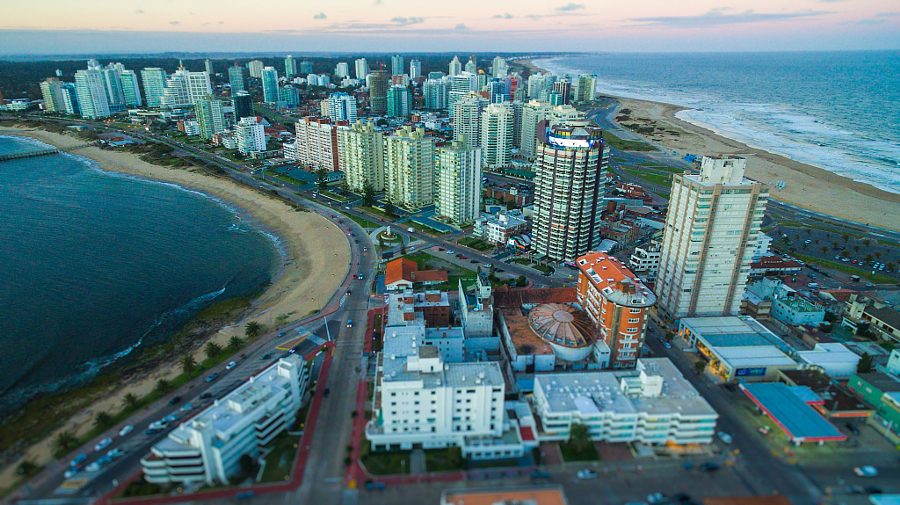
Punta del Este, Uruguay: Submarine Cable Landing Point
Punta del Este is a coastal city situated on a peninsula along the Atlantic Coast in the Maldonado Department of southeastern Uruguay. Its position on the South Atlantic seaboard makes it a natural point of contact for submarine cable infrastructure connecting South America to North America and beyond. One submarine cable lands at Punta del Este, linking Uruguay directly into a transoceanic corridor that spans the western Atlantic.
That cable is Firmina, a long-distance system stretching 14,517 kilometres that connects Uruguay with Argentina, Brazil, and the United States. Through this single connection, Punta del Este participates in a corridor running the full length of South America's eastern coastline and continuing northward across the Atlantic to North American shores, representing one of the most significant transoceanic routes in the Western Hemisphere.
Cables Landing at Punta del Este
Firmina is a submarine cable system with a total length of 14,517 kilometres, scheduled for ready-for-service in 2026. In addition to Punta del Este in Uruguay, Firmina connects to landing points in Argentina, Brazil, and the United States. The cable's route spans the South Atlantic, linking South American nations along the eastern seaboard to North America and establishing a direct transoceanic path between Uruguay and the United States.
Regional Context
Uruguay's submarine cable infrastructure is distributed across two landing points. Punta del Este hosts one cable, while the nearby city of Maldonado - also in the Maldonado Department - hosts three cables, making Maldonado the more established hub within the country. Together, these two landing points account for all four submarine cables currently serving Uruguay. Punta del Este's addition of Firmina adds a new transoceanic dimension to the country's connectivity, complementing the existing infrastructure concentrated in Maldonado.
Network Role
Punta del Este functions as a single-cable terminus within Uruguay's submarine cable landscape. With Firmina scheduled to become operational in 2026, the landing point will serve as an endpoint on a 14,517-kilometre transoceanic system connecting Uruguay, Argentina, Brazil, and the United States. This places Punta del Este at the southern end of a cable corridor that traverses the entire length of South America's Atlantic coast before crossing to North America.
As a one-cable landing point, Punta del Este represents a focused entry into the regional submarine cable graph rather than a multi-cable interchange. Its role is defined entirely by the Firmina system, and its significance lies in extending Uruguay's direct transoceanic reach to a second landing point within the country, diversifying the national network beyond the cables already serving Maldonado.
What next: Punta del Este, Uruguay in the global directory of cable landing points; see surrounding routes on the interactive submarine cable map or follow live network monitoring.
Other Landing Points in Uruguay
Landing Point
- CountryUY Uruguay
- Coordinates34.9667°S 54.9500°W
- Connected Cables1
See Real Cable Routes
View actual submarine cable routing from Punta del Este, Uruguay - with backbone nodes, distance calculations, and latency estimates
Open Calculator →