Ålesund, Norway
Landing Point · NO Norway
Connected Cables
| Cable | Status |
|---|---|
| N0r5ke Viking | Active |
Live Performance
RTT measurements to this landing point from 2026-04-27 through 2026-10-10 - live ICMP round-trip time via our monitoring probes. Recomputed daily. ✓ No anomalies detected in the monitored period.
Measurement sources
| Probe | Location | Samples | Avg |
|---|---|---|---|
| own probe | Minsk BY | 9 | 68.2 ms |
| own probe | Moscow RU | 9 | 35.7 ms |
| #6427 own probe | Sydney AU | 5 | 292.7 ms |
| #7062 own probe | Cape Town ZA | 5 | 182.8 ms |
| own probe | Almaty KZ | 4 | 112.1 ms |
| own probe | Tbilisi GE | 4 | 69.2 ms |
| own probe | Jerusalem IL | 4 | 79.4 ms |
| own probe | Sevastopol UA | 4 | 59.2 ms |
| own probe | Saint Petersburg RU | 2 | 22.8 ms |
| own probe | Kyiv UA | 2 | 30.8 ms |
About Ålesund, Norway
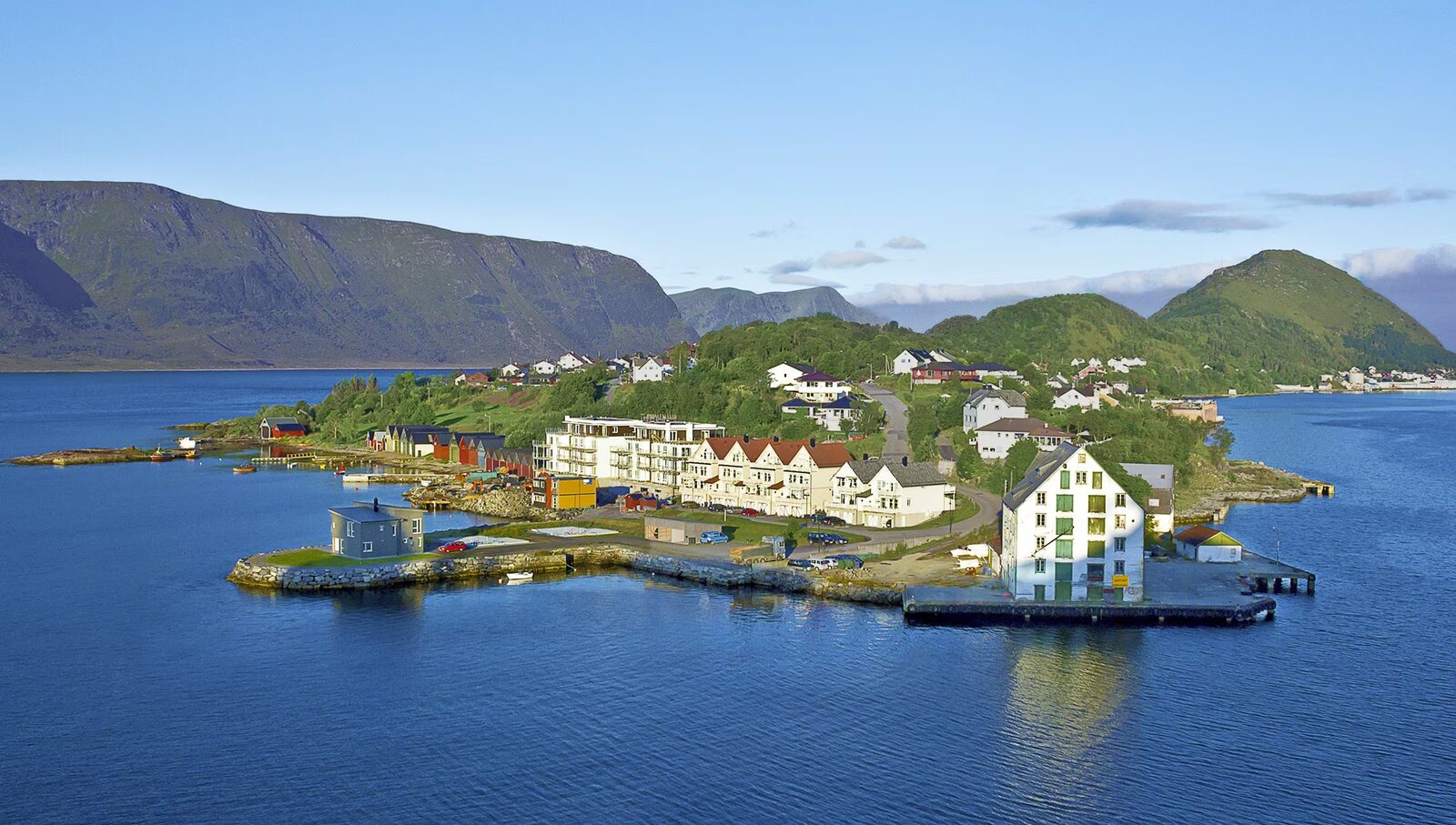
Ålesund: A City Between Fjords, the Sea, and Digital Highways
On the map of Norway, Ålesund appears as a small coastal town on the western edge of the country. But behind its postcard-perfect façade lies one of the most technologically advanced maritime hubs in Northern Europe: a place where ships are designed, digital twins are tested, autonomous navigation is developed, and infrastructure is built to provide the region with fast and sustainable internet.
A City Literally in the Sea
The center of Ålesund is located on the islands of Hessa, Aspøya, and Nørve, connected by bridges and underwater tunnels. The urban area is home to about 56,000 people, while the entire municipality has nearly 60,000 residents. It is the main port of the Sunnmøre region and one of the most important administrative and business centers on Norway's western coast.
The modern appearance of the city emerged after a catastrophic fire in 1904. Nearly the entire wooden center burned down, and Ålesund was rebuilt within a few years, predominantly in the Art Nouveau or Jugendstil style. As a result, the city today has a uniquely cohesive look: towers, ornaments, stone facades, and narrow streets coexist with modern port terminals, research centers, and technology company offices.
The sea here is not just a backdrop but the foundation of the economy. Fishing, shipbuilding, maritime logistics, offshore energy, and underwater infrastructure maintenance have created a full-fledged engineering ecosystem around the city.
How the Internet Works in Ålesund
From the perspective of an ordinary user, the internet here is highly developed. The city offers:
- fiber-optic connections for homes and businesses;
- 4G and 5G mobile networks;
- fixed wireless access in areas where laying cables is challenging;
- corporate channels with redundancy and separate routes;
- dark fiber leasing for operators, data centers, and large organizations.
In Norway overall, by the end of 2024, 99.1% of households could access connections with speeds of at least 100 Mbps, and 96.2% could achieve speeds up to 1 Gbps. The average ordered speed for fixed connections reached approximately 325 Mbps. Given Ålesund's urban density and the presence of several local operators, its central areas rank among the best-connected regions.
Notable local players include Ålesund Fiber, which operates its own network equipment and a combination of proprietary cables and leased dark fiber. The company claims to have several separate routes out of the Møre og Romsdal region. The region also benefits from the infrastructure of Nordvest Fiber, now part of Tafjord Connect, while services are offered by national operators and mobile networks such as Telenor, Telia, and Ice.
For a city scattered across islands and surrounded by mountains, this is especially important. A single physical route via a bridge, tunnel, or narrow coastal corridor can become a single point of failure. Therefore, the quality of connectivity is determined not only by the speed of the last mile but also by the existence of independent paths for traffic out of the region.
Which Submarine Cable Lands in Ålesund
Ålesund hosts the landing point of the submarine fiber-optic cable N0r5ke Viking. This is a modern domestic backbone approximately 810 kilometers long, laid along Norway's western coast between Bergen and Trondheim. The cable was commissioned in December 2022 and includes a branch between Molde and Åndalsnes. Its route connects 16 coastal locations, including Ålesund, Florø, Åheim, Kristiansund, Molde, and Trondheim.
The cable contains 192 optical fibers, or 96 fiber pairs. The operator leases dark fiber, allowing clients to install their own optical equipment and determine the channel's capacity independently. This is particularly appealing to telecom operators, cloud platforms, government agencies, and data center owners who require a physically independent route.
It is important to note, however, that N0r5ke Viking is not a direct international cable connecting Ålesund to the UK, the US, or continental Europe. Its primary purpose is to deliver traffic along Norway's coast to major exchange points and interconnection hubs. From Bergen, Trondheim, Oslo, Stavanger, and Kristiansand, traffic can then transition to international systems leading to the UK, Denmark, Ireland, and the US.
Thus, Ålesund's internet does not operate on the principle of "one cable - one gateway to the world" but rather as a multi-layered system: home or business → municipal fiber → regional backbone → national hub → international submarine cable → global networks and clouds.
N0r5ke Viking is particularly valuable because it runs independently of many existing land routes. If an accident occurs on a mountainous section, roadworks damage a cable, or one of the traditional lines between cities is disrupted, traffic can be rerouted via the marine route.
Why Ålesund Needs Robust Digital Infrastructure
The primary consumer of technology here is the maritime industry. Around the city, the Blue Maritime Cluster has formed, bringing together over 200 companies, universities, research organizations, shipowners, designers, and equipment manufacturers. In 2014, the cluster was awarded Norway's Global Centre of Expertise status.
Companies in the region are working on:
- autonomous and remotely operated vessels;
- digital bridges and navigation systems;
- dynamic positioning systems;
- hybrid and electric propulsion systems;
- vessels for servicing offshore wind farms;
- underwater robots and sensor platforms;
- energy consumption and emissions monitoring;
- digital twins of ships, ports, and maritime operations.
Such tasks require the transmission of large volumes of telemetry, work with 3D models, cloud computing, and video streams. Therefore, reliable gigabit internet in Ålesund is not just a convenience but an integral part of industrial infrastructure.
The University, Simulators, and the "Digital Fjord"
The NTNU Ålesund campus - a branch of the Norwegian University of Science and Technology - plays a key role. It houses faculties of ICT, natural sciences, maritime operations, civil engineering, and international business. The campus is designed to foster close proximity between the university, research centers, and industrial companies.
The Norwegian Maritime Competence Center hosts the Ship Operation Research Lab, equipped with a suite of maritime simulators. These simulate bridge operations, crane and offshore activities, vessel handling, and complex emergency scenarios. This enables the testing of technologies and the training of crews without risking real vessels.
The fjord surrounding the city has effectively been turned into a testing laboratory. Sensors for waves, currents, wind, noise, and emissions are deployed in the water and along the shore. Research vessels collect data from radars and other sensors, while experimental devices can be operated from a shore-based operations center. This vividly illustrates how traditional seafaring merges with IoT, artificial intelligence, computer vision, and digital twins.
An Interesting Paradox of Ålesund
Ålesund is not a major international internet hub like Oslo or Kristiansand. The city hosts only one major submarine telecommunications system - N0r5ke Viking - whereas Kristiansand has seven cables, Stavanger has four, and Bergen has three.
But this is precisely what makes the city interesting. Its technological strength is defined not by the number of international cables but by a combination of:
- modern local fiber networks;
- an independent coastal backbone;
- redundant routes through other cities;
- advanced mobile networks;
- a university and research laboratories;
- a dense cluster of maritime engineering companies.
As a result, this small island city can develop world-class technologies. Here, the internet is not just for communication, streaming, or remote work. It becomes the nervous system of the maritime industry - connecting ships, design bureaus, simulators, fjord sensors, data centers, and international engineering teams.
A City of the Future Without Flashy Futurism
Ålesund is intriguing because modern technologies here are almost invisible. On the surface, you see historic facades, fishing harbors, cruise ships, and mountains. But beneath the streets and seabed run fiber-optic lines; complex maritime operations are modeled on campus; and the real fjords are used as a testing ground for autonomous systems.
This is not a "smart city" in the marketing sense. Rather, it is an example of a place where digitalization has grown out of real necessity: complex geography, a dangerous sea, remoteness from major European centers, and the need to manage critical equipment with maximum reliability.
Ålesund is a small port that, thanks to fiber optics, maritime engineering, and the close integration of science and industry, has become one of the most fascinating technological hubs in western Norway.
What next: Ålesund, Norway in the global directory of cable landing points; see surrounding routes on the interactive submarine cable map or follow live network monitoring.
Other Landing Points in Norway
Landing Point
- CountryNO Norway
- Coordinates62.4715°N 6.1744°E
- Connected Cables1
See Real Cable Routes
View actual submarine cable routing from Ålesund, Norway - with backbone nodes, distance calculations, and latency estimates
Open Calculator →