Jeddah, Saudi Arabia
Landing Point · SA Saudi Arabia
Connected Cables
| Cable | Status |
|---|---|
| 2Africa | Active |
| Asia Africa Europe-1 (AAE-1) | Active |
| Europe India Gateway (EIG) | Active |
| FALCON | Active |
| FEA | Planned |
| FLAG Europe-Asia (FEA) | Active |
| IMEWE | Active |
| India Europe Xpress (IEX) | Active |
| Middle East North Africa (MENA) Cable System/Gulf Bridge International | Planned |
| Middle East North Africa (MENA) Cable System/Gulf Bridge International | Active |
| PEACE Cable | Active |
| Saudi Arabia-Sudan-1 (SAS-1) | Active |
| Saudi Arabia-Sudan-2 (SAS-2) | Active |
| Saudi Vision | Active |
| SEACOM/Tata TGN-Eurasia | Active |
| SeaMeWe-4 | Active |
Live Performance
RTT measurements to this landing point from 2026-03-02 through 2026-07-07 - live ICMP round-trip time via our monitoring probes. Recomputed daily. ✓ No anomalies detected in the monitored period.
Measurement sources
| Probe | Location | Samples | Avg |
|---|---|---|---|
| #6431 | control probe | 40 | 163.4 ms |
| own probe | Jerusalem IL | 14 | 123.7 ms |
| #6427 own probe | Sydney AU | 10 | 277.7 ms |
| own probe | Balancer IL | 10 | 128.0 ms |
| own probe | Tbilisi GE | 7 | 168.5 ms |
| own probe | Minsk BY | 5 | 74.9 ms |
| own probe | Almaty KZ | 5 | 118.9 ms |
| own probe | Moscow RU | 2 | 105.6 ms |
| #6410 own probe | Sao Paulo BR | 1 | 271.1 ms |
| own probe | Sevastopol UA | 1 | 143.4 ms |
About Jeddah, Saudi Arabia
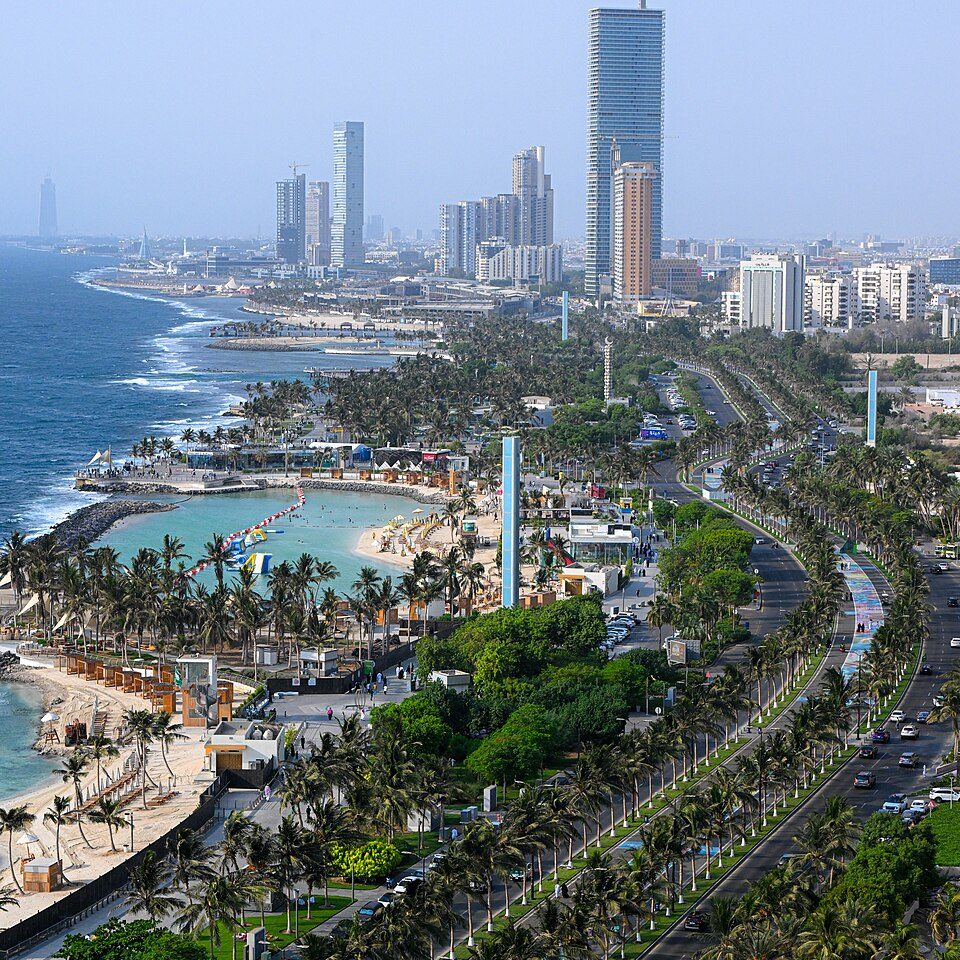
Jeddah, Saudi Arabia: Submarine Cable Landing Point
Jeddah sits on the Red Sea coast in the Hijaz region of western Saudi Arabia and stands as the country's second-largest city and its principal commercial centre. This coastal position places Jeddah at a geographically significant point along one of the world's most heavily trafficked submarine cable corridors, linking Europe, the Middle East, Africa, and Asia. Nine submarine cables land at Jeddah, making it by a substantial margin the most connected landing point in Saudi Arabia and one of the most active cable hubs in the broader Red Sea and Indian Ocean region.
Among the most prominent cables landing here are 2Africa, one of the longest submarine cable systems in the world at 45,000 km, and Asia Africa Europe-1 (AAE-1), a 25,000 km system reaching from Southeast Asia to France. Together, the nine cables at Jeddah collectively enable connectivity across a wide arc of corridors: westward toward Europe via Egypt and the Mediterranean, southward along the African coast, eastward across the Indian Ocean toward South Asia and Southeast Asia, and northward into the Gulf region. This combination of intercontinental, regional, and inter-regional connectivity is notable even by global standards.
Cables Landing at Jeddah
2Africa is a 45,000 km cable that reached ready-for-service status in 2024. From Jeddah, it connects to Angola, Bahrain, Comoros, Côte d'Ivoire, the Democratic Republic of Congo, and Djibouti, among other points on its extended route around the African continent and into the Middle East.
Asia Africa Europe-1 (AAE-1) spans 25,000 km and became ready for service in 2017. The cable connects Jeddah with Cambodia, China, Djibouti, Egypt, France, and Greece, forming a long-haul intercontinental link between Southeast Asia and Western Europe via the Red Sea and Mediterranean.
PEACE Cable is a 25,000 km system that entered service in 2022. It connects Jeddah to Cyprus, Egypt, France, Kenya, the Maldives, and Malta, extending both northward into the Mediterranean and southward toward East Africa and the Indian Ocean.
Europe India Gateway (EIG) stretches 15,000 km and became ready for service in 2011. From Jeddah, EIG reaches Djibouti, Egypt, Gibraltar, India, Libya, and Monaco, providing a route linking the Indian subcontinent to the western Mediterranean.
IMEWE covers 12,091 km and entered service in 2010. The cable connects Jeddah with Egypt, France, India, Italy, Lebanon, and Pakistan, serving the corridor between South Asia and Southern Europe through the Red Sea and Mediterranean.
FALCON is a 10,300 km cable that entered service in 2006, making it the earliest landing cable at Jeddah. It connects to Bahrain, Egypt, India, Iran, Iraq, and Kuwait, serving both intra-Gulf connectivity and the broader Indian Ocean corridor.
Middle East North Africa (MENA) Cable System / Gulf Bridge International spans 8,000 km and reached ready-for-service status in 2014. It connects Jeddah with Egypt, Italy, and Oman, providing a route through the Red Sea and into the central Mediterranean.
FEA connects Jeddah to Egypt, India, Jordan, Malaysia, Thailand, and the United Arab Emirates. No cable length or ready-for-service year is published for this system. Its endpoints span the Gulf, the Indian Ocean, and Southeast Asia.
Regional Context
Saudi Arabia has five submarine cable landing points in total, collectively hosting 14 cable systems. Jeddah's nine cables place it well ahead of the next most-connected sites: Al Khobar and Duba, each with four cables, followed by Haql and Yanbu with two cables each. Jeddah's Red Sea position evidently attracts a far greater share of long-haul international systems than the Gulf-facing or northern Red Sea landing points in the country.
Network Role
Jeddah functions as a major multi-cable hub rather than a simple terminus, concentrating nine international systems that span a combined geographic reach from Western Europe and the Mediterranean to Sub-Saharan Africa, the Indian subcontinent, Southeast Asia, and the Gulf. The cables landing here collectively represent almost every major submarine cable corridor that traverses the Red Sea, meaning that traffic flowing between Europe and Asia or Africa frequently touches infrastructure associated with this landing point. The diversity of endpoints - spanning more than twenty countries across four continents - illustrates how Jeddah aggregates intercontinental, inter-regional, and Gulf-level connectivity within a single location on the Saudi Red Sea coast.
Within the regional submarine cable graph, Jeddah's concentration of nine systems at a single Red Sea landing point makes it a primary node through which a broad range of international cable routes converge, reinforcing the city's role as the dominant submarine cable gateway in Saudi Arabia.
What next: Jeddah, Saudi Arabia in the global directory of cable landing points; see surrounding routes on the interactive submarine cable map or follow live network monitoring.
Incident history
Significant incidents on cables landing here, each with its own report.
Other Landing Points in Saudi Arabia
FAQ
Landing Point
- CountrySA Saudi Arabia
- Coordinates21.4813°N 39.1828°E
- Connected Cables16
See Real Cable Routes
View actual submarine cable routing from Jeddah, Saudi Arabia - with backbone nodes, distance calculations, and latency estimates
Open Calculator →